In life we often hear that acheivement entails short-term pain for long-term gain. Donald Trump’s trade strategy—a calculated plunge into uncertainty, is predicated on the notion that short-term dislocation can yield enduring prosperity. Like a poker player pushing all chips to the center, Trump wagers that America’s unmatched consumer might can bend global trade to its will. The stakes? Nothing less than the reconfiguration of the world’s economic order, with the U.S. as its unassailable fulcrum. Yet, as with all high-risk ventures, the line between triumph and catastrophe is perilously thin.
Few believe the exorbitant trade restrictions proposed will occur or be sustained for long. The art of any rational negotiation is to gamble with excessive demands while appearing conciliatory in settling for better terms than existed originally.The logic is deceptively simple: endure transient pain—higher prices, disrupted supply chains, a cooling economy—for the promise of long-term gain – to bring interest rates lower for debt refinancing while spurring US and other foreign producers to transfer their factories to our shores. With a trade deficit headed toward a trillion annually, Trump is the first President ever to take serious steps to correct the imbalances. Trump’s tariff threats, brandished like a cudgel, aim to coerce trading partners into concessions, leveraging the U.S.’s $19 trillion consumption engine against rivals like China, whose $7 trillion market pales in comparison. The specter of 145% tariffs on Chinese goods, already in motion, is less a policy than an embargo, daring Beijing to blink. China will dig in its heels and stimulate massively to compensate. Meanwhile, exemptions for allies like India, Japan and South Korea, coupled with selective relief on electronics and auto parts, suggest a strategy of divide and conquer—securing deals with friends to isolate foes. Today, the prospect of tariff inspired embargo has resulted in Taiwan Semi, the worlds greatest semiconductor maker, expanding its $65 billion production of advanced chips in the US to $165 billion with expedited permitting.
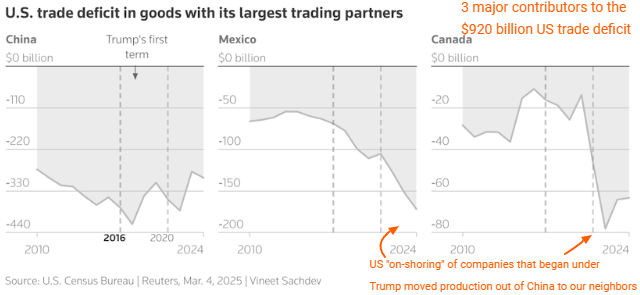
The peril is unmistakable. A misstep could plunge the global economy into a 1930s-style depression, as trade grinds to a halt. The U.S., reliant on imports for everything from cell phones to missile components, cannot swiftly replace these lifelines. A protracted standoff risks stagflation—rising prices amid slowing production—already evident in climbing manufacturing costs and softening output. The trade deficit, nearing $1 trillion annually, underscores the urgency of Trump’s mission, but his bullying tactics, scorned by traditional strategists, hinge on a precarious assumption: that adversaries will buckle before America’s resolve falters.
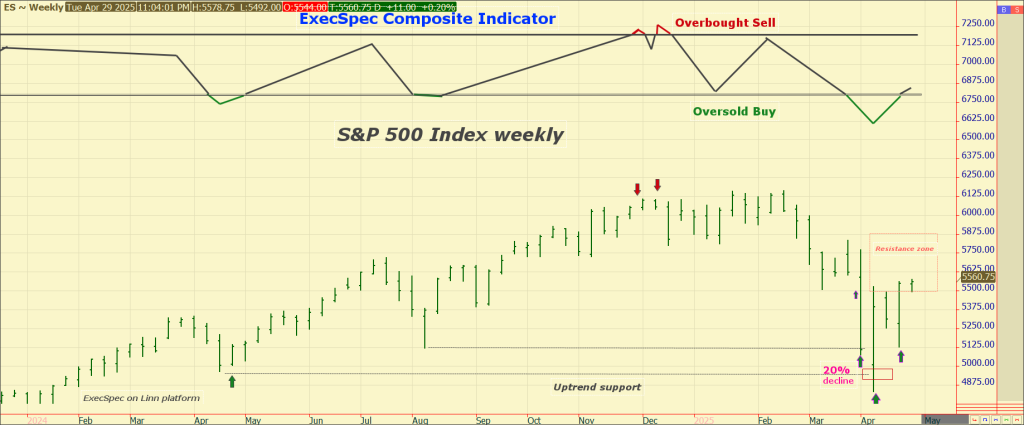
For now, the hard data offers a reprieve. Unemployment remains low, consumer spending robust, and corporate profits resilient with a double digit growth rate. Stock markets, soothed by Trump’s 90-day tariff pause, have clawed back half their 20% losses from February highs, with the S&P 500 stabilizing in the mid-5000s. When the pause was announced we sent a report forecasting a rally to the 5600s to 5700. Should a deal with India or other major country be announced soon – as we strongly suspect – then the 5700s could quickly be hurdled. Yet soft data—sentiment, expectations—tells a grimmer tale. April’s AAII investor survey recorded near-historic pessimism, a echo of the fear that gripped markets when Trump announced his “Liberation Day” tariff plans. There are strong signs from PMI that current inflation is beginning to spike at factories. The economy teeters on a knife’s edge: a technical recession, driven by tariff surge in imports and inventory stockpiling, looms in the first half of 2025, though rising unemployment, the true harbinger of a downturn, remains at bay. Until the labor force contracts, there is no recession!
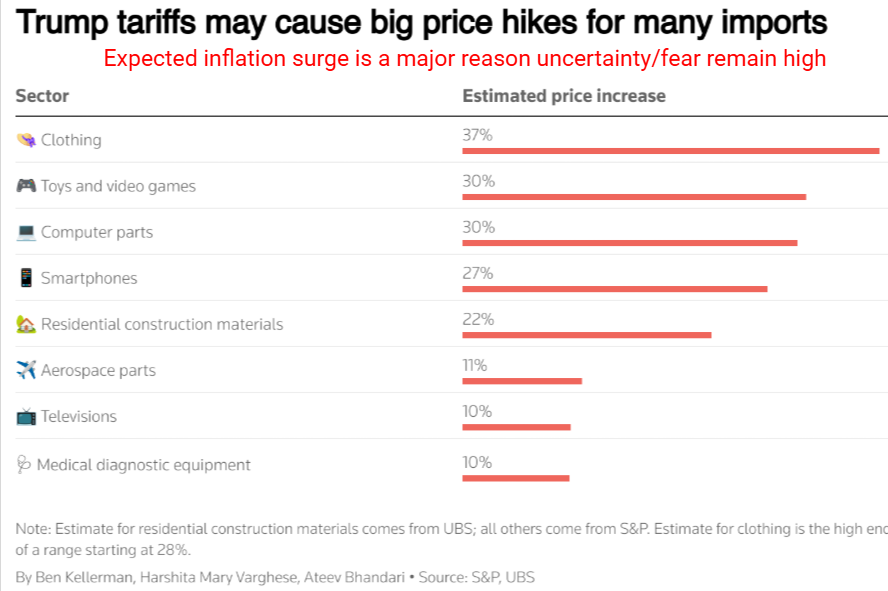
Trump’s timeline is unforgiving. Trade deals with allies must materialize by summer to maintain leverage against China. Delay invites recession, with odds rising in lockstep with each missed deadline. A recalcitrant Beijing, buttressed by domestic stimulus and supply-chain dominance, could play the long game, eyeing the 2026 midterms to exploit U.S. political fragility. Such a strategy would test America’s mettle, as shortages and price spikes erode consumer confidence.
The President’s timetable to reorient global trade in favor of the US before the 2026 mid-term election fosters record economic uncertainty this year. As long as Europe and China don’t call Trump’s bullying bluff on tariff trade terms and wait him out, then there remains a path to success for our pertinacious President.
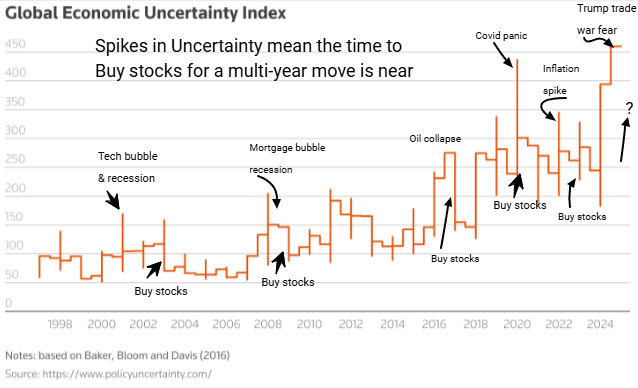
Consumers and businesses have been front running the potential tariffs with higher spending and inventory stocking. This will lead to inventory destocking for months to come. Over the near-term, investor pain should be measured with more stability in stock prices in the 5000s basis the SP 500 Index. The upper limit is the 5600 to 5800 range where investors would be wise to increase cash levels. At this point we do not see the risk of new lows in the various stock indices as multiples stay slightly elevated while earnings forecasts continue to fall. However, if the trade prospects don’t continue to improve, then earnings per share estimates for the SP 500 index will start to dip below $260/share with a upper teens multiple, unless interest rates drop dramatically. Our forecast calls for short-term economic pain that grows throughout the May through August period at a minimum. The stock market, the severity of which is tethered to a single negotiator – DJT – should stay range bound in the mid-5000s SPX until the later part of the summer when the deal or no deal decision with Europe and China should determine if stocks test new 2025 lows or begin a new Bull market. Historically, these periods of high uncertainty present excellent long term buying opportuities.
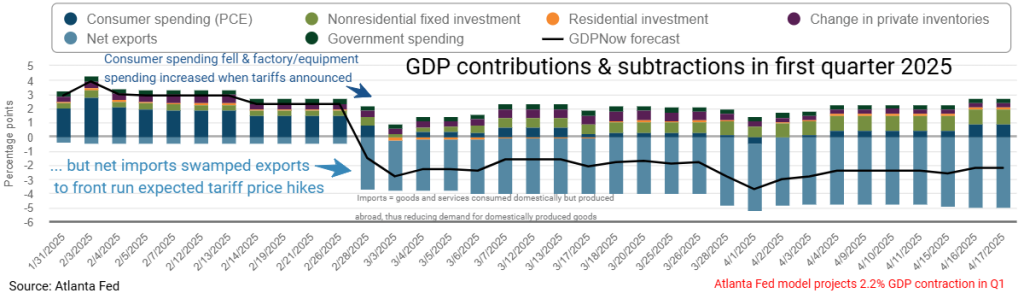
With the critical mid-term elections 18 months away, the hard data of economic growth and a healthy labor market remain positive. However, aberrant GDP contraction risk in the first half is likely due to gold imports and business inventory stocking ahead of the trade war. Consumption is growing and factory spending related to technology, autos and power supply is accelerating. Due to the key net exports component of GDP turning sharply contractionary through April (due to tariff realted importa), it is possible that we have an inconsequential technical recession in the first half of 2025 without any actual pain in the labor market and corporate profits. If the trade agreements with the major US trading partners are secured before businesses fail and workers are fired, then this expected down wave in the economy will be seen in hindsight as “the faux recession”.
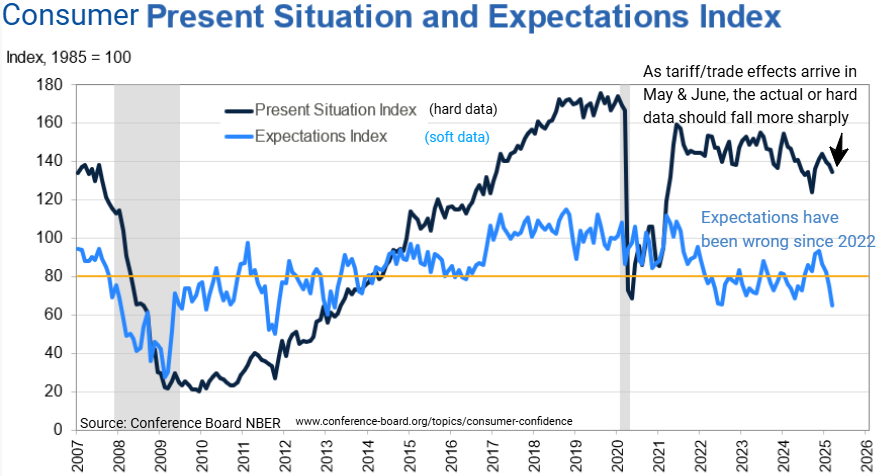
US consumers are feeling good about the economy currently, which is evidence that recessionary conditions do not yet exist. A hostile China that plays the long game into the 2026 US mid-terms would be a smart strategy for our adversary that could send the present situation index much lower. China certainly has more to lose than the US, but then again, which country needs to please it voters more?
Yet there is method in this madness. Trump’s vision extends beyond trade balances to a broader renaissance: the onshoring of manufacturing, not just by U.S. firms but by foreign giants eager to tap the world’s largest market. Success here could idle Chinese factories, forcing Beijing into concessions or economic retreat. The president’s protean instincts—bluster tempered by strategic exemptions—suggest a negotiator’s cunning, not a madman’s caprice. If Europe and Japan align with Washington, China’s isolation could tip the scales.
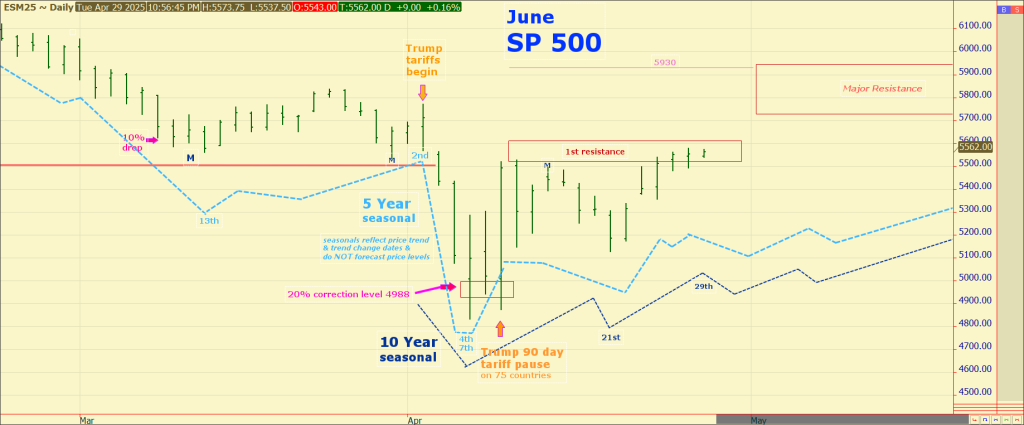
Domestically, Trump’s trade (tariff) embargo will lead to supply shortages and higher prices in the US with increased odds of hostility regarding Taiwan if detente fails. Stock investors have found solace in Trump’s 90 day pause on proposed extreme tariffs. With maximum uncertainty having peaked with the 3-month tariff pause to negotiate deals ex China, stocks are in rebound mode, jettisoning much of the economic recession discount when the SP 500 Index was under 5000. Until the first half of June investors should use partial retracements of the April rally to add stocks to the portfolio. The SP 5300s would be our first support area into the first half of May.
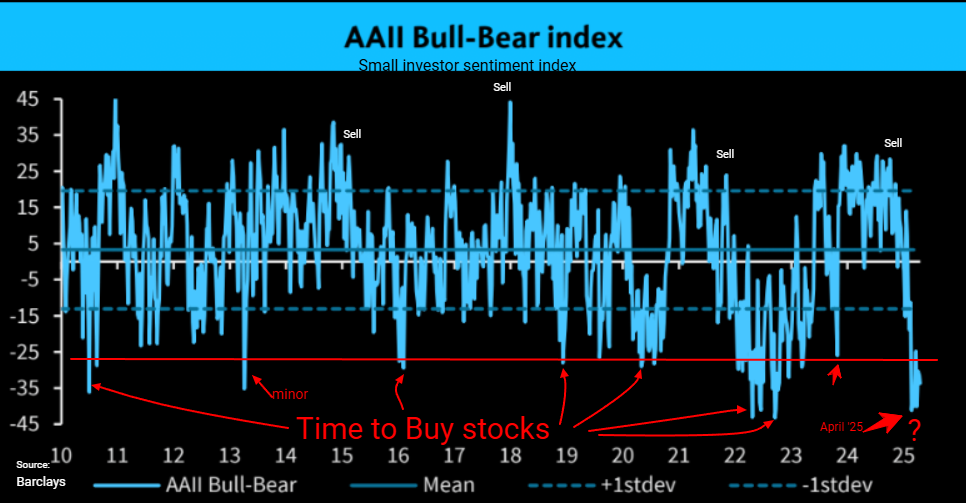
The benchmark SP 500 and Nasdaq Indices, dominated by large cap technology companies, fell over 20% from their February tops to their April troughs, but have retraced 50% of their Bear market declines in just 2 weeks. At the April Bear market lows the AAII survey of individual investors reached extreme levels of pessimism, coinciding with the week after Trump’s Liberation Day announcing plans to implement intolerable tariffs on all countries exporting to the US. April has marked one of the most extreme periods of negative sentiment in history on numerous indicators. Such extremes in AAII, Fear and Uncertainty Indices often signal that it’s time to more aggresively buy the dips. The last period that the current levels were acheieved was the June through October window of 2022 with teh SP 500 Index testing its final lows near the 3600 level. We still have a China problem containing any upside, but the near-term environment provides strong support above recent lows.
The stock market, tethered to Trump’s dealmaking, will likely remain range-bound through mid-2025, with the S&P 500 oscillating between 5100 and 5900. A failure to secure trade pacts could drag earnings below $260 per share, pushing indices toward new lows. Conversely, a string of agreements could ignite a bull market, restoring investor faith. The third quarter looms as a crucible: either a breakthrough or a breaking point. We expect a significant rade deal within days – possibly India.
In this high-wire act, Trump channels a distinctly American faith in audacity over caution, wagering that chaos can birth order. Whether this gamble yields a “faux recession” or a deeper malaise hinges on his ability to outmaneuver adversaries without permanently alienating allies.
With a floor near S&P 5000, it’s evident that the technical indicators favor an increased Bullish posture that will push further with any minor trade deal, yet the fundamentals indicate that the trade war with China and others will continue for months and cap the upside below SP 6000.