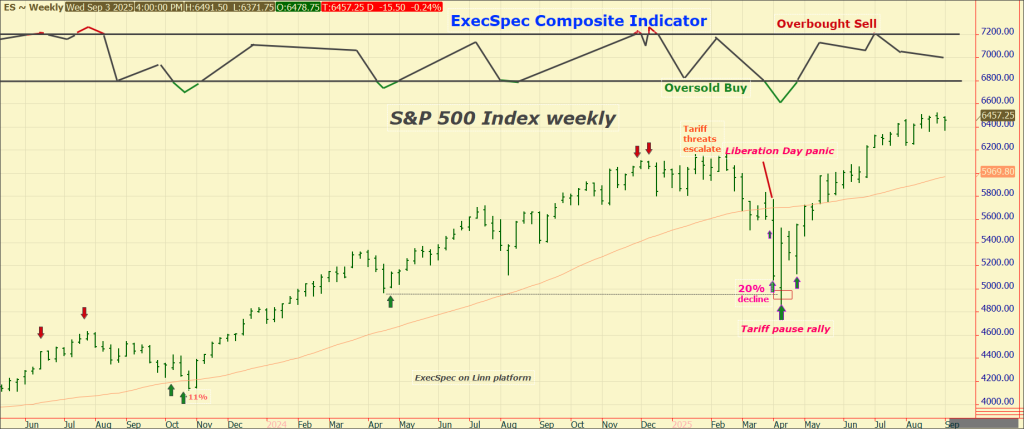
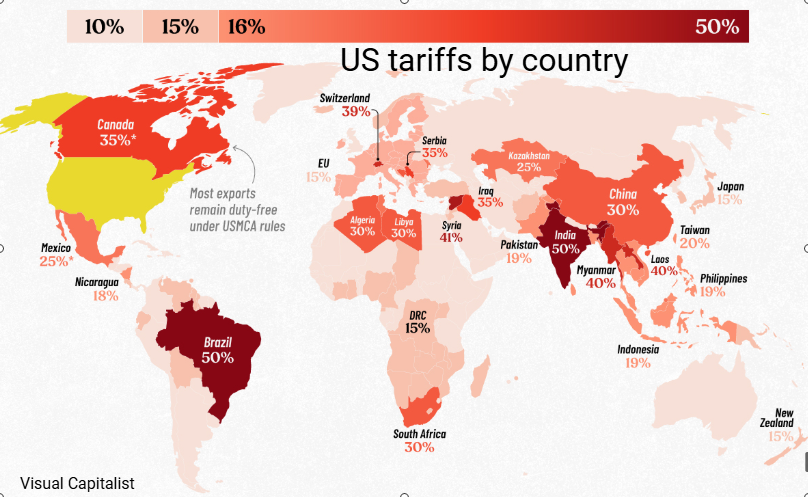
America’s constituional founders created a masterpiece of instructions for running a Republic with checks and balances. President Trump’s usurpation of tariff powers from the Legislative Branch strain against constitutional confines. The framers, ever vigilant against concentrated authority, entrusted Congress with the prerogative to impose tariffs. Thus it should not be a suprise that courts at every echelon below the Supreme Court have now invalidated Donald Trump’s deployment of the International Emergency Economic Powers Act of 1977 (IEEPA) to enact tariffs under the guise of an existential threat. Trump, with characteristic bravado, anticipates vindication from the Supremes before mid-October, envisioning an endorsement of executive tariff latitude unbounded by rationale or restraint. An affirmative ruling would not just nudge precedent; it would propel Presidential power of either party into uncharted territory into perpetuity. Do Conservatives want Liberals to wield such power? What’s good for the goose is good for the gander. A wholesale reversal of the April 2nd Liberation Day tariffs might ignite market chaos, evoking the Covid crash of March 2020 where policy uncertainty amplified volatility.
However, consider the parallel avenues Trump has belatedly pursued that are more laborious and narrow yet constitutionally sound. Sections 232 and 301 of the Trade Expansion Act and the Trade Act of 1974, respectively, empower the Executive Branch to impose tariffs via the Presidents Commerce Department investigations into national security threats or unfair trade practices. For months, Trump’s administration has been amassing dossiers on raw materials, vehicles, technology, pharmaceuticals, and sundry imbalances, as evidence over his emergency edicts. With strategic foresight, these statutes should have been the primary thrust from the outset. The president’s haste—driven, perhaps, by the looming shadow of the 2026 midterms—reveals a tactical impatience, allowing for economic and political disruption over deliberation in a bid to reshape trade deals before electoral winds shift.
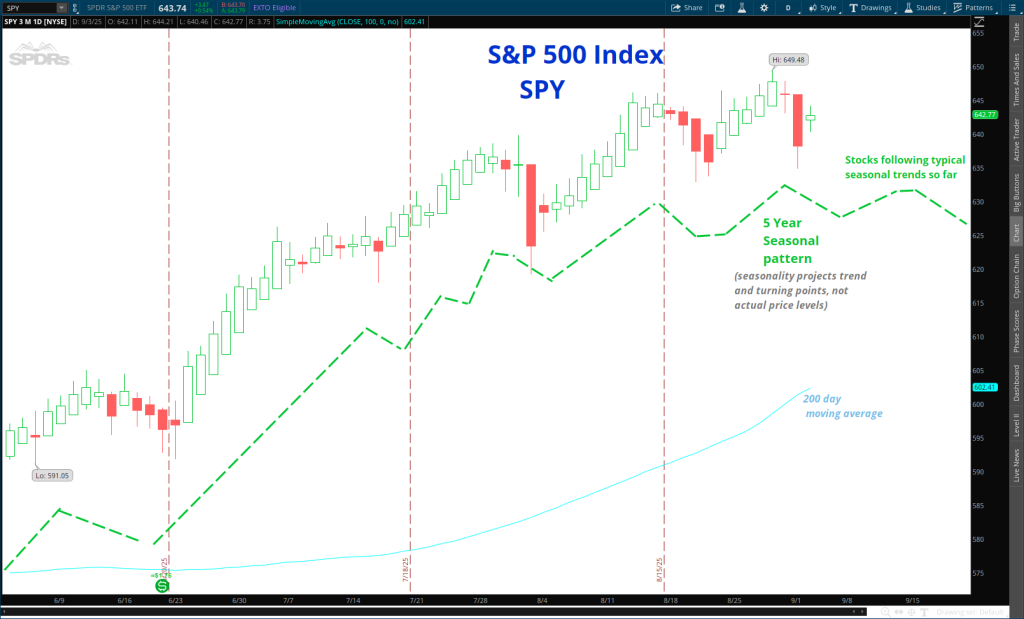
The investment markets, a mercurial barometer of collective anxiety, greeted the lower courts’ rebuke with a predictable 2% to 4% dip, though pundits hasten to blame any decline on September’s negative seasonality. These explanations are not mutually exclusive. Last week we warned of a market peak for both of those reasons with lower prices expected this week and for the month. Media coverage has been voluble, bundling this illegal tariff setback with defeats on deportation policies and National Guard deployments, painting a portrait of an administration besieged by political overreach and impeded by judicial activism. Many Federal court rulings reflect the ideological tilt of lower benches, often rectified by a Supreme Court conservative majority. Assuming tariffs endure post-litigation, equities remain buoyantly fixated on an anticipated Federal Reserve pivot toward rate cuts in mid-September and fiscal stimulus in 2026.
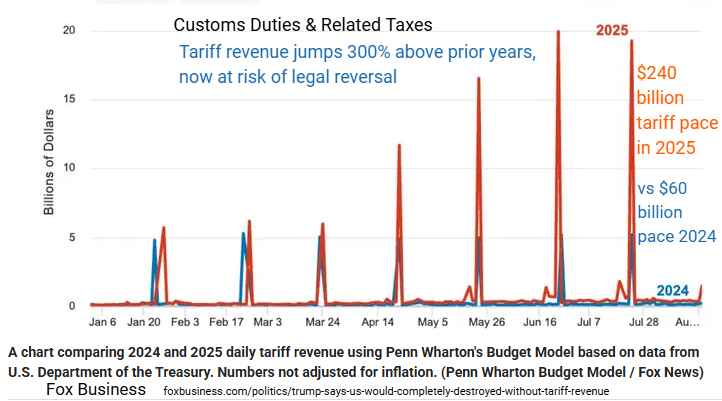
While some tariffs will persist, the bulk— currently yielding an extra $180 billion annually—hang in precarious limbo until Sections 232 and 301 bear fruit. The specter of refunds to aggrieved nations like China would erode investor confidence, injecting uncertainty that lingers like a fog over negotiations. Close trading partners and adversaries, sensing vulnerability, may now procrastinate on deals, awaiting legal clarity—a classic game of diplomatic foot dragging where hesitation becomes leverage.
The S&P 500 and Nasdaq have found temporary support near their 50-day moving averages, setting the stage for a modest rebound before the Federal Open Market Committee’s September 16th deliberation on rate cuts. Yet, the shadow of a deeper correction looms into October, as a Supreme Court ruling on tariffs could unsettle markets, potentially driving indices to test or breach the 200-day average—a plunge exceeding 7% from recent highs. Despite this, the bull market’s mooring remains resolute: a dovish Fed, abundant liquidity, restrained investor exuberance, pent-up mergers and acquisitions awaiting release, fiscal largesse, the early innings of the AI surge, and a deglobalization current steering capital from Asia’s factories to America’s robust consumers. Unlike the 1990s, when the internet’s rise fueled a rush to offshore production for cost efficiencies yo the far east, today’s inward pivot channels investment to U.S. shores. The judiciary may clip Trump’s tariff wings, and his warnings of national ruin—evoking dystopian visions of a “third world” America—ring as hyperbolic. Yet, an October affirmation by SCOTUS of lower court rulings against the Liberation Day tariffs need not derail prosperity; alternative mechanisms, like Sections 232 and 301, will pave the way for a reinvigorated bull market, fueled by a flood of public, private, and foreign capital onto America. Trump’s ultimate aim—redirecting global investment homeward—gains traction, even if his methods falter under constitutional scrutiny.
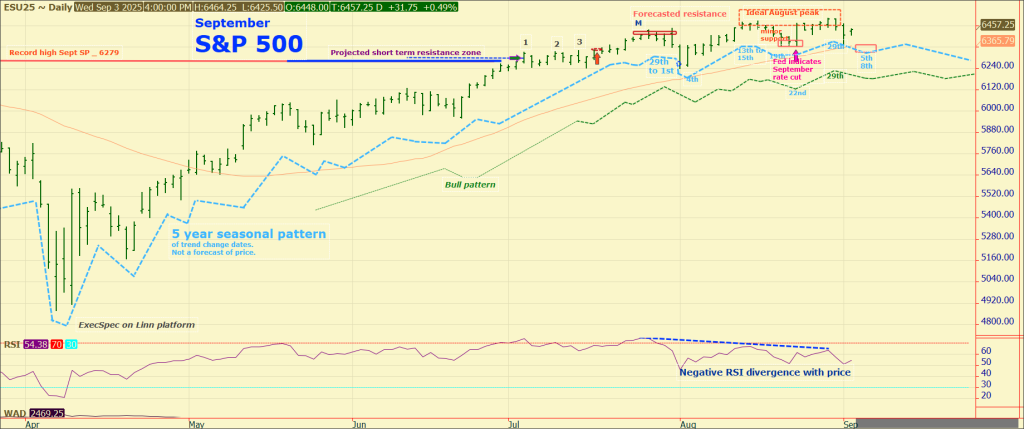
As alternative tariff frameworks take root and trade disputes resolve over the coming quarters, anticipate the bull market’s next ascent, building on its already robust gains. With our projected GDP growth of 2 to 3% and S&P 500 earnings per share of $300 to $320 for 2026, paired with a price-to-earnings multiple of 22 to 24, the index could climb to a range of 6,600 to 7,700. Our inclination leans toward the higher bound, suggesting dips remain buying opportunities. While the Founders, Jefferson among them, would likely recoil at Trump’s oversteps—such as seizing Intel shares or eyeing Nvidia’s China revenues—his trade fervor, when disciplined by legal guardrails, may yet foster wealth without fracturing the republic’s constitutional foundation.