
President Teddy Roosevelt famously advised leaders to speak softly and carry a big stick.
China’s Xi Jinping practices a modern variation: speak softly and carry a big wallet.
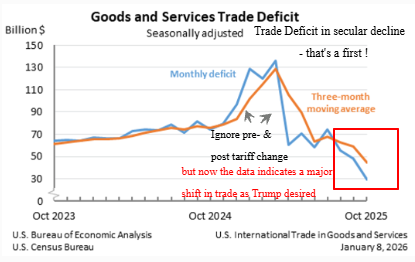
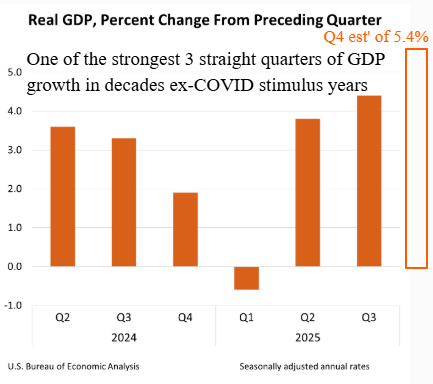
President Donald Trump’s aphorism, by contrast, prefers to talk loudly and swing a big stick early—often angrily, publicly, and without apology. It offends diplomats, unnerves allies, scares investors and irritates voters across the political isles. Yet time and again, it works. The latest incalcitrant leader of Canada garnered a standing ovation at Davos this week for standing up to Trump’s bullying. However, 18% of Canada’s GDP is due to the US with 90% of their crude oil exports heading south. It would be impossible to find new outlets for the majority of this $1.3 trillion in annual trade without Europe and other allies joining the paper tiger to our North. Trump will punish our neighbors and allies by any financial means available to create a trade surplus and onshore supply chains to the US. The President feels emboldened with the shrinking trade deficits and surging GDP. Thus far, corporate profits and margins as well as consumer spending push toward record levels, which is a magnet for stock market investors beyond the barrage of policy uncertainty.
Trump’s approach violates nearly every norm of modern diplomacy. But it leans heavily on something previous leaders were reluctant to use explicitly: American leverage. The United States consumes more than the next four economies combined. Roughly 90% of global transactions touch the U.S. dollar in some form, and the dollar still accounts for well over half of global reserve holdings. The U.S. alone can project military power anywhere in the world, instantly – no other nation comes close. Trump didn’t create this leverage, but he is the first modern president to wield this dominance openly—and unapologetically—as a negotiating weapon.
Where China offers infrastructure loans and long-term investment promises, Trump offers something more immediate and coercive: access to the American consumer, capital markets, and security guarantees—or the credible threat of withdrawing them. That dynamic explains why even Trump’s most outlandish demands rarely last long in their original form. The outrage is real, but so is the retreat. The TACO label is catchy – Trump Always Chickens Out – regarding deal making. The fact is quite the opposite. OACO – Opponents Always Chicken Out – is the reality. The demand is maximal. The reaction is hysterical. The settlement is incremental but directional. And markets, after briefly pricing catastrophe, quietly reprice reality.
The Art of the Deal, Replayed—Again and Again
-
Trump makes a demand so extreme it dominates headlines and tanks markets for a day or two.
-
Allies and adversaries issue fierce objections and threaten symmetrical retaliation.
-
A compromise emerges that looks suspiciously like what Trump likely wanted all along.
-
Markets rebound—often sharply—on the realization that catastrophe was never the goal.
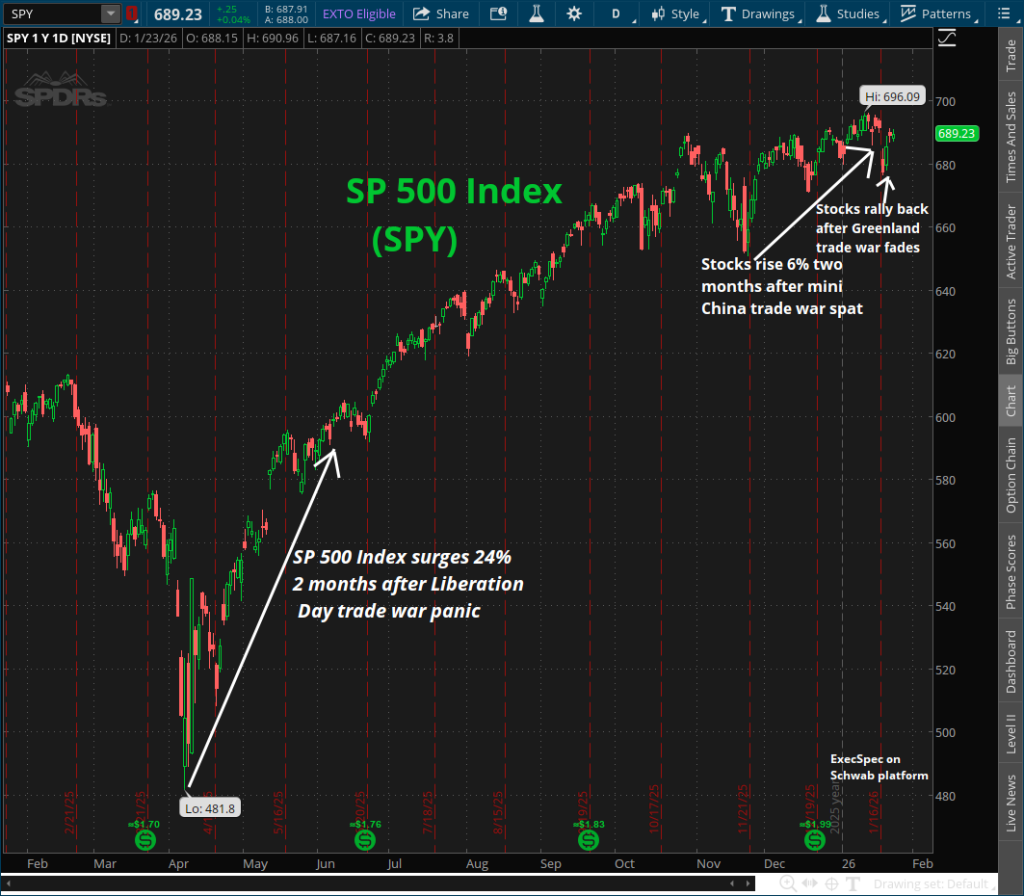
We’ve seen this script replay repeatedly. Drug pricing was once deemed politically untouchable; Trump forced international parity. Border security was said to require years of bipartisan negotiation; it was materially altered in days. Last April’s tariff threats were predicted to ignite inflation, trade wars, and recession; instead, no trade war followed, inflation failed to reaccelerate, and growth surprised to the upside with multi-decade high GDP growth today.
More recently, drug interdiction, the curtailment of Chinese and Russian influence in the Western Hemisphere, the isolation of Cuba, and effective control over Venezuela were achieved through naval pressure, the Noriega style removal of a narco-Dictator and enforcement of what amounts to a revived Monroe Doctrine—or, as some have dubbed it, the “Donroe Doctrine.” The stock markets panic first. Then they adapt. Investors, like diplomats, initially confuse tone for intent.
Greenland, Ukraine, and the Art of the Fake Crisis
The Greenland episode this week was not a prelude to invasion, an outcome that a surprising number of voters feared. Access, military basing rights, the Golden Dome missile defense, and critical-mineral coordination were. While the details are yet to be revealed, these general goals would seem to have been achievable without Trump’s hostile diplomacy. However, employing a more civilized diplomatic approach is irrelevant to the issue. Markets briefly priced in absurdities—troop movements, alliance turmoil, geopolitical escalation—before realizing that the episode fit a familiar template: pressure, negotiation, settlement.
As with Ukraine, meaningful rare-earth extraction remains many years away-maybe never. Cheaper and friendlier sources already exist. But the point was never immediate output. It was strategic alignment, defense posture, and long-term leverage.
Precious Metals: The Panic Barometer
If equities reflect optimism after clarity, precious metals thrive during confusion. Gold and silver rally when markets assume the worst—trade wars, military conflict, or runaway inflation.
Gold bulls often attribute rallies to dollar debasement, yet the dollar has not weakened in any meaningful long-term sense. It remains roughly where it stood a decade ago and is notably stronger than five years ago. Inflation hovering under 3% is not supportive of the currency, but wage growth running faster than inflation largely offsets that concern.
What does support precious metals is persistent policy uncertainty. The near-constant drumbeat of tariff threats, geopolitical friction, and shifting alliances encourages foreign governments and institutions to diversify reserves toward hard assets rather than U.S. Treasury debt. Silver carries an additional tailwind, as rising industrial-tech demand continues to outpace supply growth. Gold is already testing $5,000 and the calls for $6,000 are becoming louder. Bullish consensus is overbought, the technical oscillators are extreme, but supportive. Given Trump’s penchant for geopolitical controversy, we suspect this Bull will continue further, but February and March are typically the highest risk periods of the year to expect a corrective pause in this parabolic wave higher in Gold and Silver.
Gold thrives on ambiguity. Stocks thrive on cash flows. Trump supplies both phases in rapid succession.
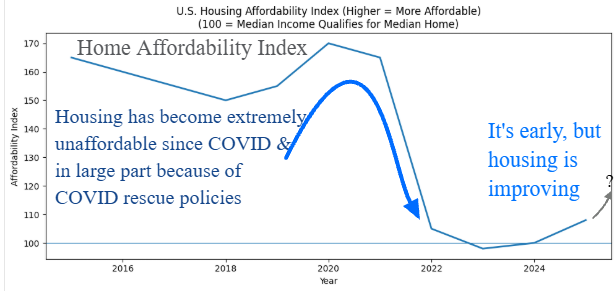
Domestic Shock Therapy: Affordability at All Costs
Trump’s strategy is about velocity. He has shown a willingness to adopt traditionally Democratic policies if they serve a singular goal: cheaper goods, lower costs, and a happier consumer.
Among the levers now being pulled or proposed:
-
Temporary credit-card rate caps, aimed at consumer relief rather than banks.
-
$200 billion mortgage-backed securities purchases to reduce long-term rates
-
50-year mortgages, controversial but effective in lowering monthly payments
-
Penalty-free use of retirement and education savings for home down payments
-
Pressure on institutional homeownership to release supply
-
Expanded access to federal land and zoning relief to accelerate construction
-
Energy abundance, lowering electricity, transportation, and building-material costs
Not all of these will manifest. Some may fail outright. But markets are embracing the directional force.
Why Stocks Keep Believing
The most important takeaway is not that Trump’s policies are inelegant. It is that he will keep pushing levers long after others would stop trying.
Each selloff driven by fears of invasion, trade war, or alliance collapse has assumed outcomes Trump has never actually pursued. The rhetoric is real; the apocalypse is not. Investors who sell the news eventually relearn this lesson at higher prices.
In the end, Trump’s governing style is not subtle diplomacy but transactional disruption: shock the system, force negotiation, extract advantage, repeat. The process offends sensibilities, but the outcomes—lower costs (drugs, gasoline…), continued growth, and resilient equity markets—explain why every panic has so far been followed by a rebound. Markets may flinch at the shouting. They still believe in the deals.
Earnings, Valuation, and the Road to 2026
Consensus expectations for S&P 500 earnings are in the $310–$313 per share range in 2026 – thus far. During periods of earnings expansion—particularly when inflation is contained and liquidity remains ample—markets have historically tolerated forward P/E multiple peaks between 22 and 24. Applying those multiples to the 2026 earnings outlook produces a reasonable range for a peak:
Table 3: Forward Valuation Scenarios
| Forward EPS (2026) | Forward P/E | Implied S&P 500 Level |
|---|---|---|
| $310 | 22× | ~6,820 |
| $310 | 24× | ~7,440 |
| $313 | 22× | ~6,886 |
| $313 | 24× | ~7,512 |
In other words, 6,800–7,500 on the S&P 500 is a straightforward extrapolation of earnings growth combined with valuation expansion during the second half of 2026. The downside risk is currently 5 to 7% (mid-6,000s SP) whose percent decline could increase in conjunction with any new record high in stock indices before a material decline >6% arrives.
Seasonally, history suggests the potential for important short-term topping action into February, followed by a March reset or corrective low. From there, the path of least resistance likely points higher—toward new highs into the summer months, as earnings visibility. Beyond that, as midterm elections approach, markets typically drift into a more sustained correction—driven by political uncertainty.
President Trump’s methods are abrasive, his rhetoric polarizing, and his diplomacy unapologetically transactional. Yet markets, ever pragmatic, have learned to separate tone from outcome as he pursues any controversial policy, pushing the limits of constitutional guardrails to increase prosperity to secure his parties grip on all branches of Government. The shouting will continue. The deals will follow. And until earnings stop growing—or leverage truly breaks—the market’s verdict remains unchanged: noise fades, math endures and equities march higher.