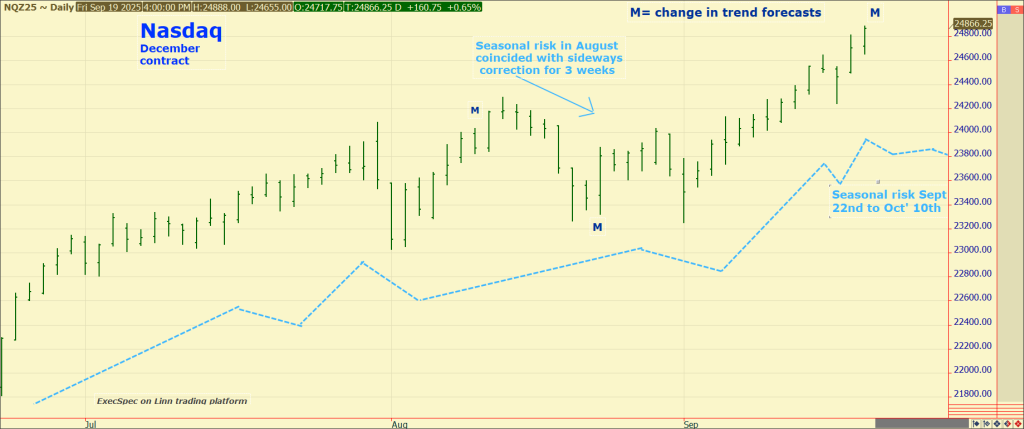
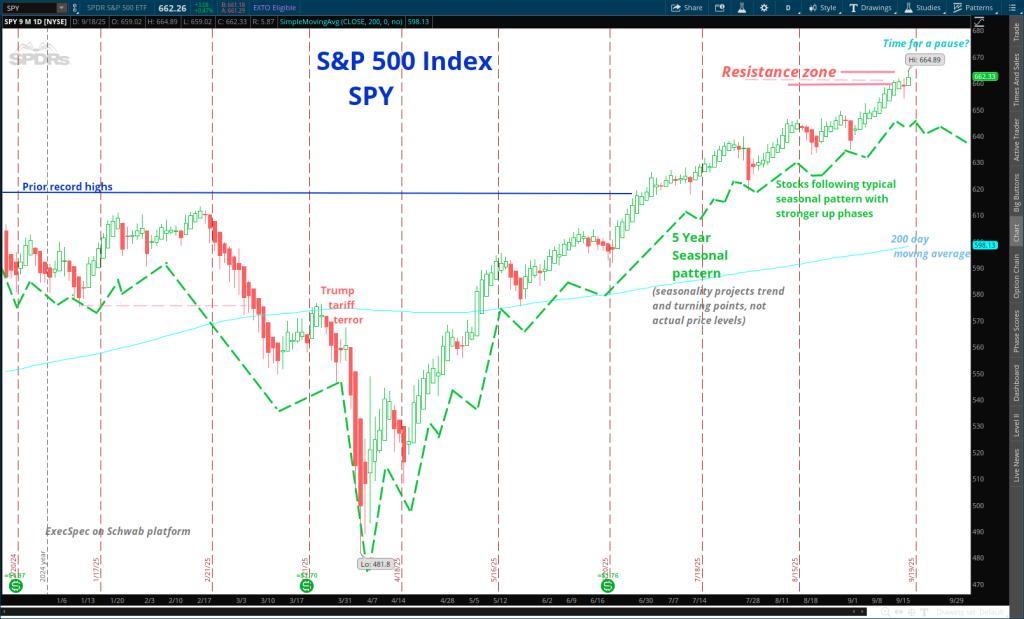
The economic tempest unleashed by tariffs in April 2025 has given way to a recovery so vigorous it evokes the halcyon days of President Trump’s first term, a testament to the market’s remarkable capacity to forgive and adapt as it rides the crest of an AI-driven prosperity wave. The S&P 500, having endured what analysts deemed the worst market turbulence since the 2020 pandemic—including the fifth-largest two-day decline in history in early April—has staged a comeback that mirrors the steady gains of 2017. From its April nadir, 20% below February’s peak, large-cap AI-related stocks in the S&P 500 and Nasdaq indices have climbed steadily for five months with no discernible corrections – echoing the low volatility advance of 2017. The S&P 500’s 13% gain in 2025 aligns with its 2017 performance under Trump, while the 37% surge since April, despite persistent trade uncertainties, is quite remarkable.
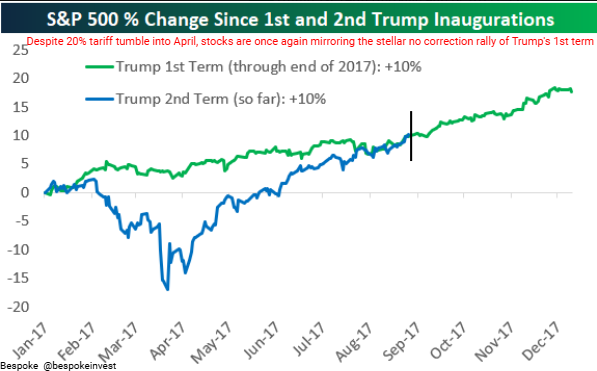
The market parallel between Trump’s terms reflects the market’s learned response to Trump’s governing style, a complex shuffle between initial alarm and eventual accommodation. Investors are now quick to glean that the president’s opening gambits in trade negotiations, however dramatic, are rarely his final positions. The underlying structure of this rally remains formidable. The S&P 500 has advanced more than 80% since entering the current bull market in October 2022, powered by the artificial intelligence revolution that promises productivity and earnings gains. This AI-driven expansion is buttressed by monetary policy and now lower borrowing costs, providing a rocket fuel of liquidity for technology-intensive sectors which are becoming the dominant portion of the economy.
The market’s institutional memory is long, and it recalls vividly the prosperity generated during Trump’s first term with major tax cuts. His major tool this time is trade policy, coercing domestic and foreign based companies to relocate to the US.
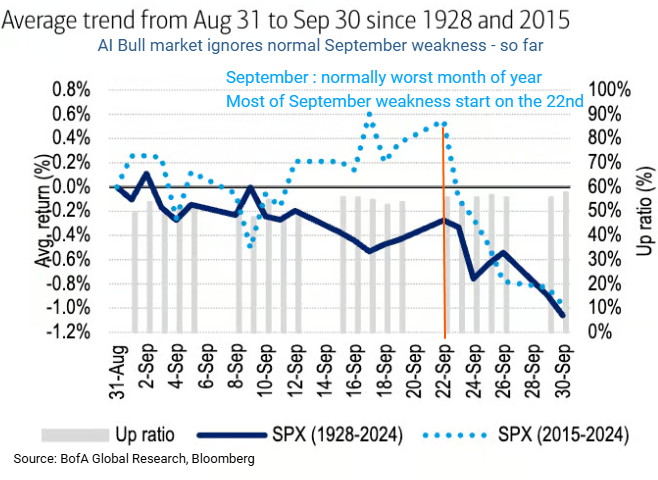
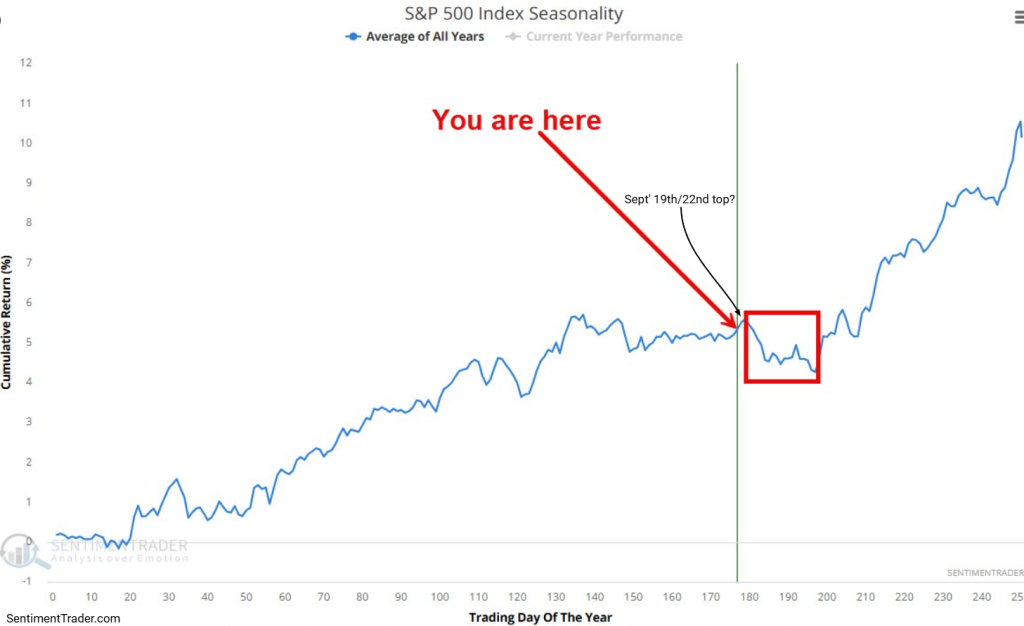
We are not worried about seasonal demons, but the last two weeks of September are generally among the most persistently weak periods of the year. Going back to 1928, the S&P 500 has declined an average 1.2% in September, the weakest month of the year for stocks, ending lower 56% of the time. Despite the potential for seasonal malaise, the market’s continued ascent beyond any near-term surpsises, appears promising.
While different time periods of seasonal stock market patterns suggest possible tops from August through mid-September and lows anywhere in October, the 20 year average illustrated below by SentimentTrader.com implies we are just now entering a 2 to 5 week window of “potential” weakness. This pattern merely implies the market is more vulnerable to a negative news trigger, such as a court ruling against Trump tariffs, over the next month. The good news is that stocks are “usually” subject to upside price action on news during the final two months of the year.
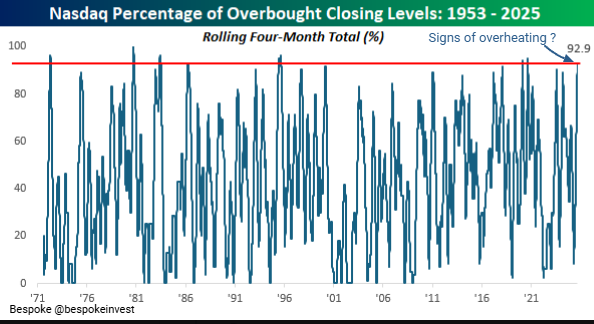
This has been a record setting year for stock investors with rare overbought momentum indications, yet sentiment is rather subdued. The market should be vulnerable to a banana peel slip over the next month of seasonal vulnerability, but other than the two big obstacles of the tariff tiff with China and the Supreme Court, this remains a buy the dip market with more record highs into 2026 expected.
The market’s institutional memory recalls the prosperity of Trump’s first term, driven by major tax cuts. This time, trade policy is his lever, coaxing domestic and foreign firms to relocate to the U.S. Despite seasonal headwinds, two pivotal events will shape the rally’s trajectory. The Supreme Court’s imminent ruling on Trump’s tariff powers is a constitutional fulcrum. A decision – due by early October – limiting executive authority could reduce uncertainty and nudge the administration toward conventional diplomacy, bolstering market confidence. Conversely, an adverse ruling could spark volatility and a quick 5 to 10% equity market panic if no resolution is visible.
Equally critical, but less imminent, are trade negotiations with China. Optimism hinges on expectations of substantive agreements to avert renewed trade conflicts. China’s ban on Nvidia chips and its dominance in rare earths underscore its resolve, signaling that compromise is essential. Failure to secure a deal could unsettle markets, though the current momentum suggests resilience. We expect a deal to appear by Q1 of 2026.
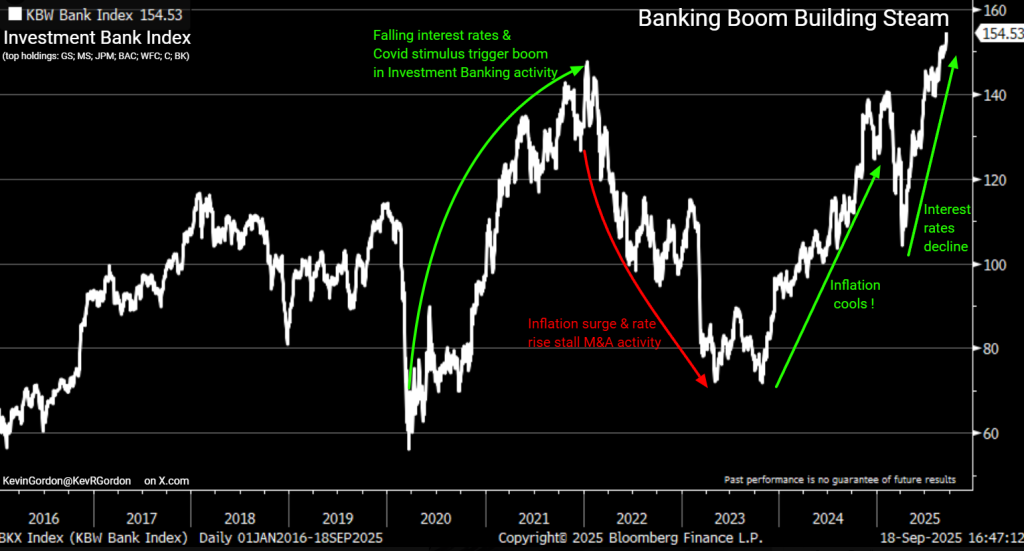
Our collosal investment banks are sensing more opportunities for Exits, M&A and IPO’s as their stocks have gone parabolic into record high territory. The prior COVID surge in deal making was an anomoly due to Government mandated cheap credit. Thus the current investment banking wave during an environment of relatively expensive credit and trade deal obscurity is more noteworthy with ample room to run before the economy overheats.
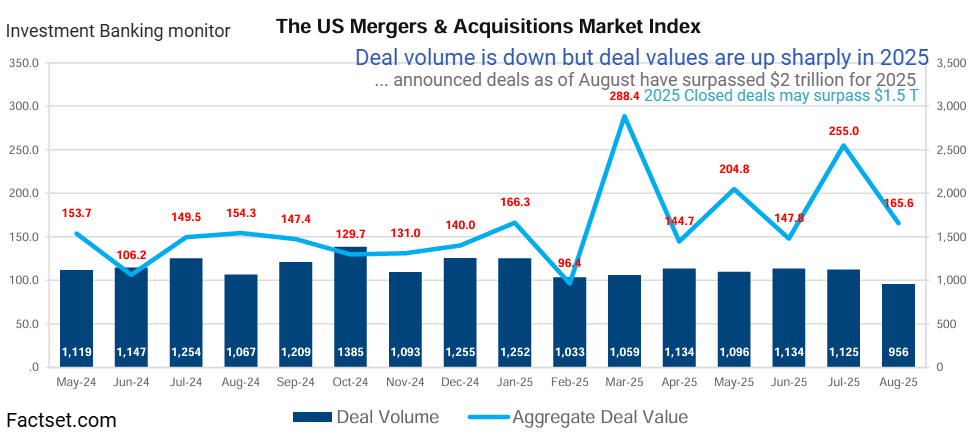
This year has been a banner one for stock investors, with overheated momentum tempered by subdued sentiment. Mergers, acquisitions, and IPOs have surged, with trailing 12-month M&A activity exceeding $2 trillion, announced deals surpassing $3 trillion, and closed deals potentially reaching $1.5 trillion in calendar year 2025. These metrics, projected to strengthen in 2026, reflect robust corporate confidence and excess capital hungry for better than idle money market returns. These are positive omens surrounding a very pessimistic consumer, according to surveys.
While AI and related sectors—chips, energy, data center construction, rare earth and services—have led this bull market, small- and mid-cap stocks are now trying to join the ascent. Many sectors continue to lag, but its a healthy sign to see the Russell 2000 small cap value stocks testing record highs for a third time. If prices cool off near-term, it may set up a strong technical backdrop for a breakout in coming months.
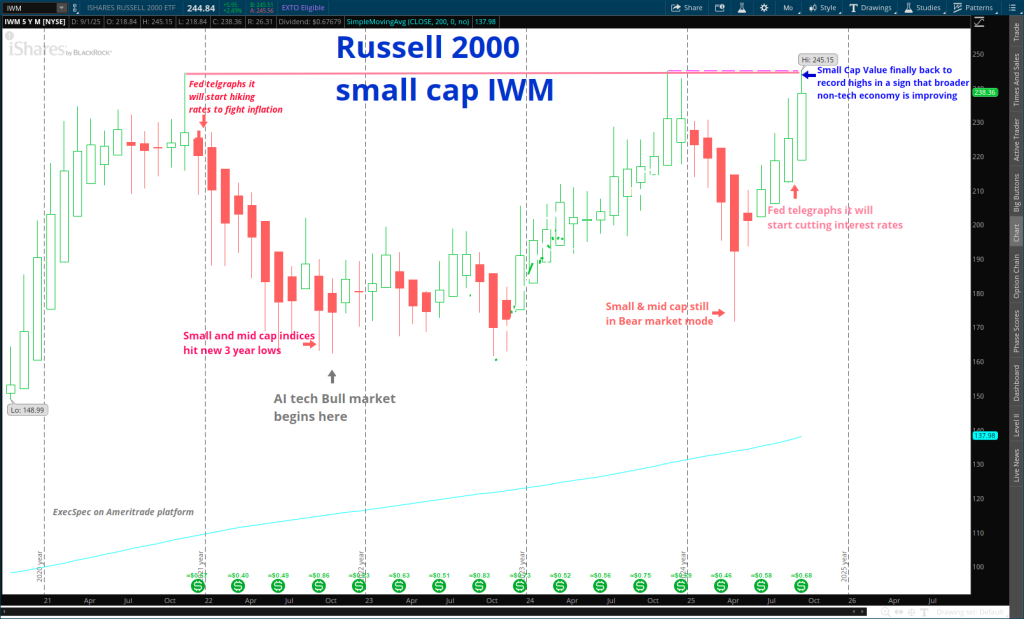
The good news is that while the small cap value stocks in the Russell 200 Index are a bit overheated short term, they have considerable upside potential to regain a fraction of the ground they have lost compared to the benchmark SP 500 Index since the Covid peak. It may be hard to see below, but the small Russell stock index has outperformed the SP 500 index by an impressive four percentage points over the past month. Lowering interest rates, court approved retention of Trump tariffs and a trade deal with China are the final road hazards to drive past for the broad stock market and economy to accellerate into 2026.
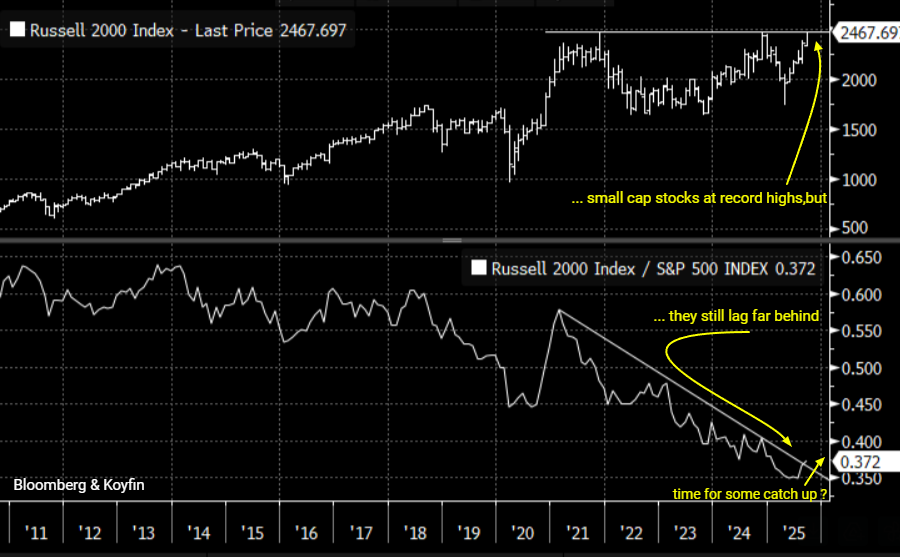
In the end, what we observe in 2025’s market performance is the stock market’s ability to absorb the April shock and emerge not merely intact but strengthened speaks to the resilience of our economic institutions and the enduring power of entrepreneurial dynamism. This is not to dismiss the risk of corrections or the weight of seasonal patterns. The Supreme Court’s tariff verdict and trade talks with China remain formidable hurdles. Yet, viewed through the lens of economic history and the pent up stimulus that continues to build, such challenges appear less as threats than as opportunities for a market poised to accelerate into 2026, provided it adroitly navigates these roadblocks.