
The political calendar casts an increasingly long shadow over the Trump administration. With the November 2026 mid-term elections looming, President Trump finds himself engaged in a furious, multi-front campaign for the very preservation of his executive authority and, some would argue, his post-presidency tranquility. The stakes are high: a failure to maintain Republican majorities in both chambers of Congress would not merely curtail his power, but likely unleash a torrent of investigations, impeachment efforts, and legal challenges designed to incapacitate his remaining term and potentially beyond.
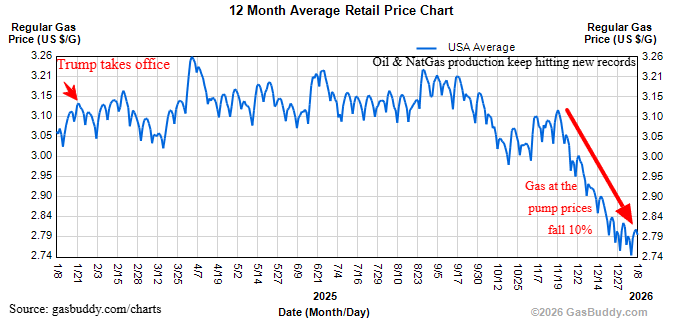
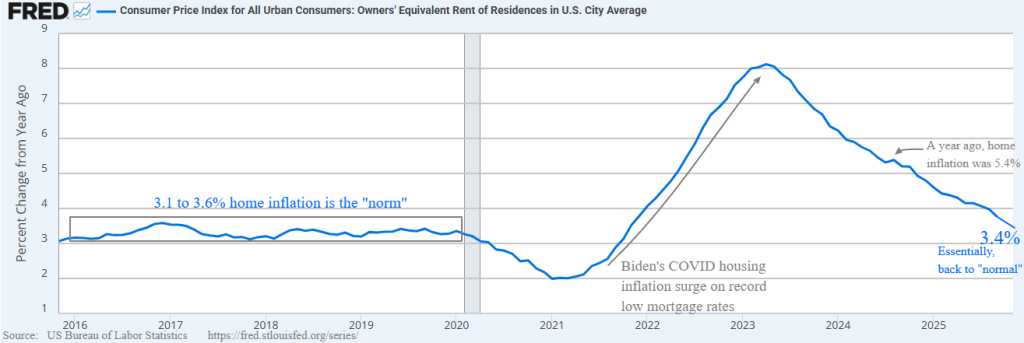
Trump, ever the pragmatist sensing the American zeitgeist, understands that a robust economy and a financially mollified electorate are the most potent antidotes to political vulnerability. Thus, his administration has focused on the twin pillars of household expenditure: energy and housing. Despite the emotional deportation protests in the media, the economic results, as of late 2025, are striking. National gas prices at the pump have fallen over 10% since the President took office less than a year ago, providing an immediate and psychological boost to the commuter. Simultaneously, the housing inflation rate—specifically owners’ equivalent rent—has plummeted by over a third to a an historically normal 3.4% rate as of November 2025. These improvements are the bedrock of his “prosperous voter” strategy.
The global chessboard reflects this same muscular pragmatism and expansion of Executive authority to the chagrin of Democrats and tacitly supportive Republicans in the shadows. This week’s dramatic removal of the Maduro regime in Venezuela was less an exercise in increasing global oil supply and more a strategic decapitation of a hostile neighbor that indirectly threatens American lives. For years, Venezuela served as a conduit for deadly narcotics and a gracious host to a quartet of American adversaries: Cuba, Russia, China, and Iran. Venezuelans are ecstatic. Do the ends justify the means is a question that is begrudgingly ignored by elated Republicans, while predictably irritating Democrats and foreign rivals. It remains to be seen if this sets a precedent our adversaries might attempt to imitate. Furthermore, Trump’s populist effort to ban institutional home buying, while politically savvy – pleasing to far left Democrats, faces the cold reality of data: such entities account for less than 3% of housing supply and are mostly occupied. The ban by itself is unlikely to move the needle on prices significantly, as the true barrier remains mortgage affordability—a problem that only lower systemic inflation can solve. We forecast lower PCE inflation rates by year end that will marginally reduce borrowing rates. Will mortgage rates fall far enough, fast enough to assuage young families desperate to find a home is a question that is uncertain at this juncture. To this goal, Trump just announced today the Government will buy Mortggae bonds, forcing rates lower. While the President has moved to shrink the size of Government, he has greatly expanded Presidential powers in an effort to cement a robust legacy with a booming US economy and assetive military.
However, the administration’s domestic front is not without its perils. The vast majority was intially supportive of removing illegals that were gang members and criminals. The “riskier” strategy of deporting non-criminal illegal immigrants has triggered a wave of mass protests and, in some quarters, violent confrontations with government agents. From the streets of Los Angeles, Portland and Minneapolis to regional hubs, the optics of civil unrest are a double-edged sword. To secure a peaceful path to the midterms, Trump will likely need to navigate toward a deportation policy that is perceived as more orderly and less confrontational before the election cycle reaches its fever pitch.
On the legal front, a cloud gathers at the Supreme Court. A potential ruling against Trump’s tariff overreach this January may force a tactical shift. Yet, the administration appears ready to simply reimpose the same tariffs through alternate legal channels, even if the process takes time. Investors may punish stock valuations for a period of weeks following a negative ruling, but history suggests the bull market will resume. Indeed, a 10% market correction would be entirely normal and should be expected during the first half of 2026—a healthy “breather” before the next leg up. Yet, a silver-lined cloud gathers on the judicial horizon. A potential Supreme Court ruling against Trump’s tariff overreach this January, while a setback for a President who views “tariffs as the most beautiful word” as well as a potent economic weapon, could paradoxically provide a short-term boost to the dollar and act as a deflationary force, perhaps even temporarily reining in the recent exuberance in precious metals. Central banks may pause their Dollar liquidation and hoarding of precious metals temporarily should tariffs abate. Such a development, while initially perceived as a blow, might ultimately contribute to the very economic stability Trump so desperately seeks.
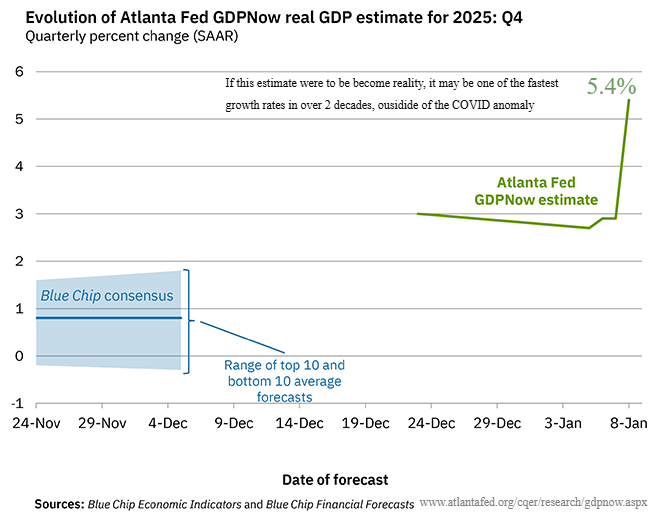
The stock market offers a fascinating subplot. For much of the current bull market through late 2025, large-cap tech and communication stocks dominated the S&P 500. However, the gap is closing. Small and mid-cap stocks have begun to outperform, with materials, healthcare, industrials and financials beating tech in early 2026. This broadening is a profound signal: it suggests a wider optimism about sales growth and proves that a recession is nowhere on the horizon. With GDP estimates jumping above 5%, driven in part by AI-led productivity that pushes down unit labor costs, the economic backdrop remains incredibly sturdy. Trump is staking his future on the bet that a prosperous populace will be a forgiving one.
The stock market, that great metronome of economic fortunes, offers a Bullish view. For much of the current bull market, specifically the three years leading into late 2025, the indices have been dominated by a relatively narrow band of behemoth technology companies, primarily those benefiting from the AI revolution. The S&P 500, in particular, has been disproportionately influenced by these titans, leaving a significant portion of the market trailing in their wake. The Russell 2000, a bellwether of small-cap value, languished in comparison, a testament to the concentrated nature of the market’s ascent. Almsot 2 and a half years into this AI led Bull market saw a stark disparity with the S&P up about 30% as of August 2025 while the Small Cap Russell was negative.
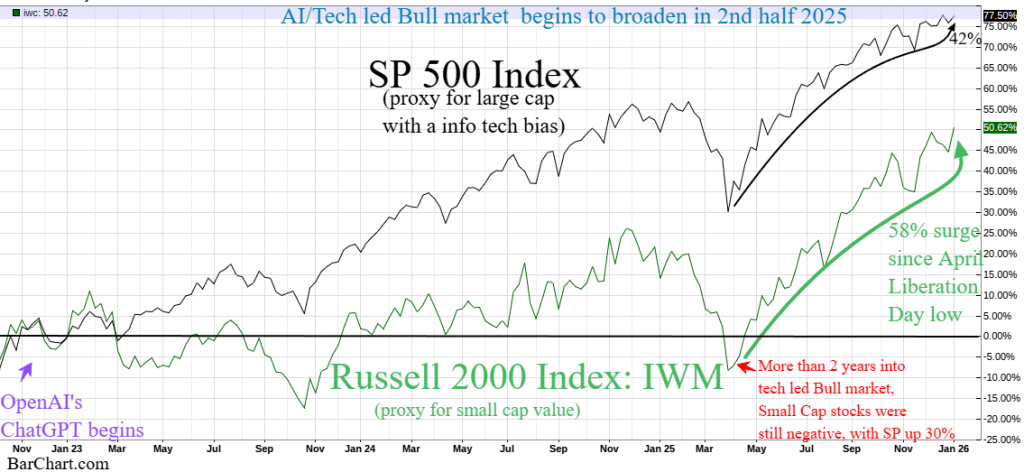
However, a significant shift has been underway since the latter half of 2025. The gap has begun to close. Small and mid-cap stocks, along with a diverse array of sectors, have not only caught up but, in many instances, have begun to outperform their large-cap tech counterparts. The past six months have witnessed a notable resurgence outpacing the once-unassailable information technology sector. This supports our expectation of an S&P that will at some point in 2026 test the upper 7,000’s, surfing a double digit earnings growth wave – again.
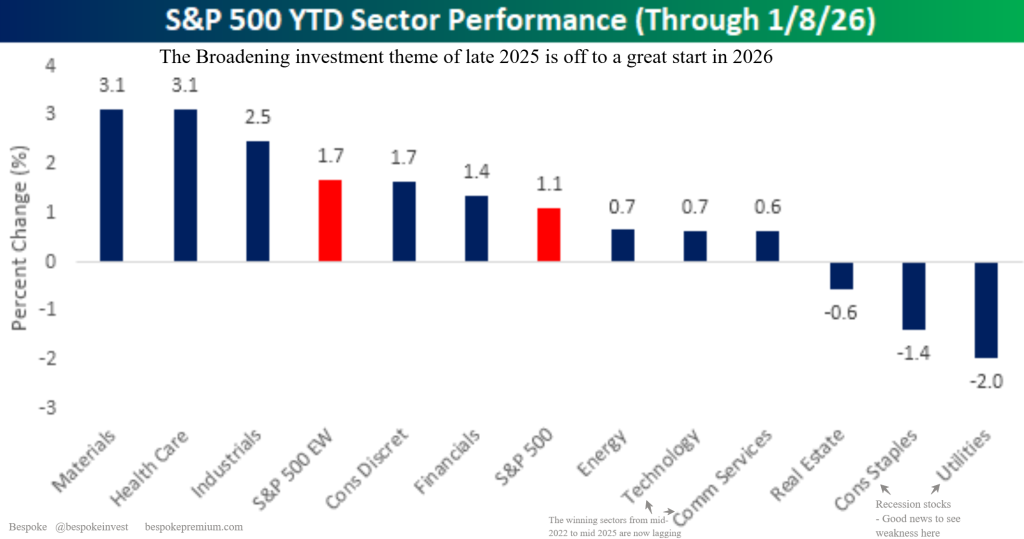
This broadening of market leadership is a profoundly bullish signal. It suggests a growing optimism regarding earnings and sales growth across a wider spectrum of the economy, a conviction that extends beyond the immediate beneficiaries of artificial intelligence. Additionally, the poor performance of the more defensive areas such as utilities and consumer staples strongly imply that a recession, once a persistent fear, remains a distant specter. Indeed, current GDP estimates, now leaping to 5.4%, and excellent corporate profit margins paint a picture of an economy firing on multiple cylinders. This robust expansion, in part, can be attributed to the burgeoning impact of AI, which is demonstrably boosting net business profit margins to an amazing 12.9% and exerting downward pressure on unit labor costs. This virtuous cycle, combined with lagging housing rental price declines, bodes well for a continued fall in inflation rates that we estimate will test 2% this year – precisely the economic tonic President Trump requires. Can Trump quell the deportation riots that is energizing his opponents while bringing more prosperity to the masses and can he do it in time to extend his legacy beyond next November?