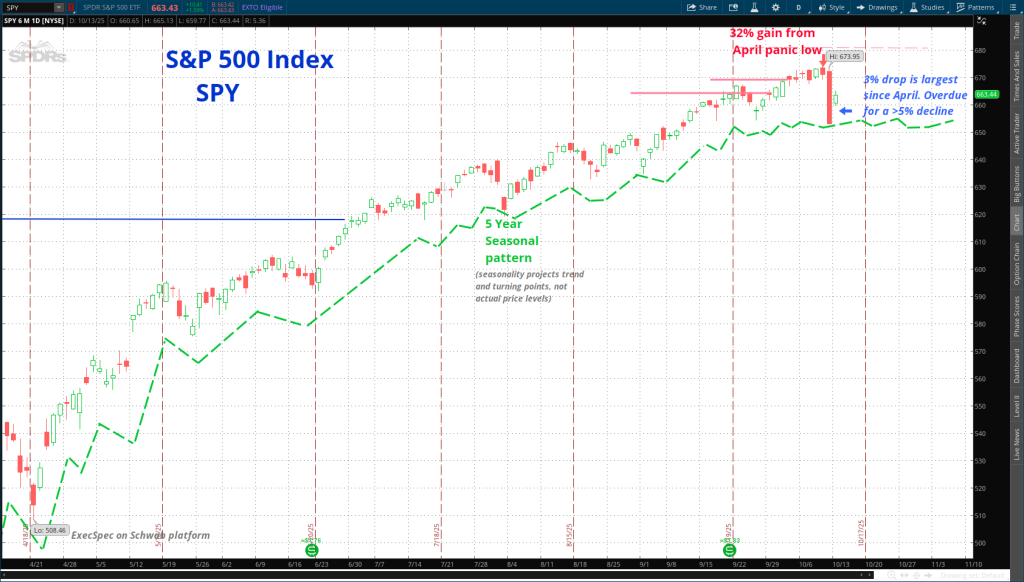
At the speed of a social media impulse the financial markets endured a perfect micro-storm brewed from Beijing’s resource nationalism and Washington’s penchant for trade-war brinkmanship. The temperamental vagaries of Trump’s Twitter feed sent the stock market down 3% from record highs, its deepest single day drop since April 21st. The immediate trigger for the market’s swoon was a calculated escalation from President Xi to create leverage ahead of a planned trade policy meeting with Trump. Seeking to weaponize its near-monopoly on critical minerals, Xi’s Government announced new and tightened export controls on rare earth elements and the specialized processing equipment necessary to refine them. These seventeen elements—such as neodymium, dysprosium, and terbium—are indispensable components in everything from F-35 fighter jets, missile guidance systems, submarines, lasers, EV batteries and the advanced microchips that power artificial intelligence. China’s move was a reminder that it holds the chokehold on the physical inputs of the future and the race for hegemonic dominance.
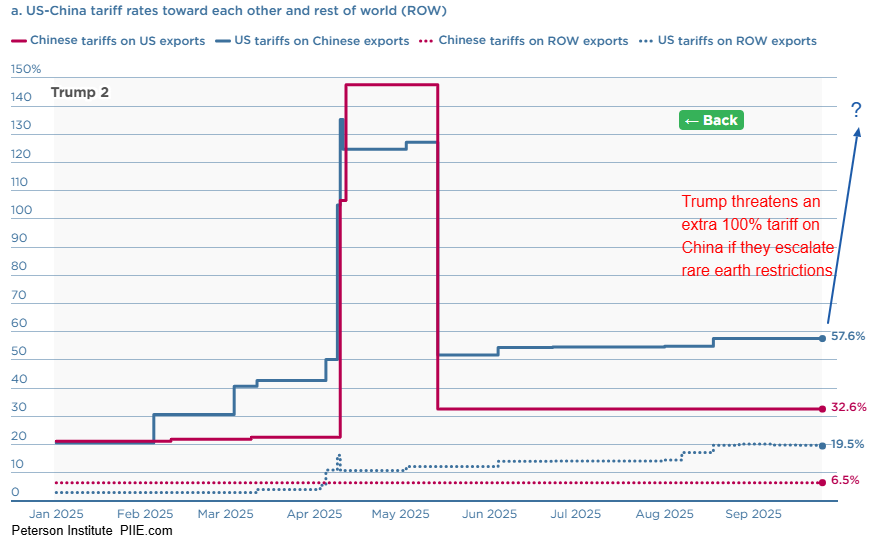
President Donald Trump’s disproportionate response threatened to impose a staggering 100% additional tariff on Chinese goods, reaching over 150% potentially on November 1st. This wasn’t a tweak to the trade framework; it was an attempt to administer a commercial grade electroshock. The ensuing market reaction to this classic Trumpian intimidation tactic was both instantaneous and predictable: major U.S. stock indices suffered an almost 3% correction on the day, with tech and industrial stocks—the most exposed to both rare earth supply chains and Chinese retaliation—bearing the brunt of the downdraft. Rare earth stocks, already riding a hyperbolic high, were the only sector to roar higher on the day, assuming that the US would invest ever more into our fledgling elemental mining industry to replace China.
Yet, in a theatrical twist, the market’s anxiety was summarily dismissed over the weekend. Trump, having created a genuine panic with his first tweet, then offered his own political-economic antidote via a second tweet: investors, he asserted, “Don’t worry about China, it will all be fine!”
The immediate, narcotic effect of this assurance was a market rebound that should erase most if not all of the losses. Nothing has been resolved, but investors have become pawns to the extraordinary power of a single personality to generate and then momentarily quell economic dread. This sequence is a recurring motif in the current epoch: maximum volatility induced by policy-by-social-media, followed by a stabilizing tweet that momentarily restores the faith required for a buoyant market. It may underscore the global economy’s dangerous dependency on the mercurial rhythm of political pronouncements, rather than the drumbeat of verifiable policy. How else can we explain the breathtaking uncorrected rally over the past 6 months despite lingering trade policy and capital investment ambiguity. Uncertainty has been a feature of this early Presidency, yet it has thus far triggered investor nirvana while avoiding trade wars and triggering a flood of new investment pledges to the US.
Regardless of whether President Trump and President Xi ever manage to achieve an agreement where “it will all be fine”—a resolution that would, in the best case, merely be a temporary pause in a long-term structural conflict—the week’s turbulence has cemented a stark, new, and urgent imperative for both global powers. The economic détente that defined the late 20th century is dissolving into a kind of bipolar decoupling, driven by existential national security concerns.
> China’s Technology Imperative: For Beijing, the trade wars and the constant threat of U.S. export controls—particularly on high-end semiconductors—have made it clear that its future hinges on technological self-sufficiency. The “Made in China 2025” plan is no longer an aspiration; it is a necessity. China must become independent of US technology in their AI race, or face permanent strategic subordination. They are moving swiftly by replacing the 27% decline in exports to the US with an export expansion in Europe and Africa, increasing their global influence as a more reliable trading partner.
> America’s Resource Imperative: For Washington, the rare earth gambit was a chilling reminder that the sinews of American military and economic power pass through a foreign, potentially hostile, bottleneck. The U.S. is belatedly determined to escape China’s chokehold on rare earth and other processed goods, regardless of any economic harmony agreed upon. This requires a rapid and extraordinarily expensive investment in domestic mining, processing, and a diversification of global supply chains. US oriented rare earth companies, which have zoomed 100’s of % higher since April, will fall sharply if China tensions ease toward providing critical minerals to the US and these stocks will rise just as rapidly when political discord escalates. In the long run, these companies will appreciate due to the Government guaranteed demand and price support agreements guided by the overarching necessity of becoming independent of our geo-political adversaries.
Trump has moved forcefully with his major Government backed investments in multiple rare earth and industrial companies, yet a steady ratcheting up of State sponsored assistance may be required to remove the yoke of China’s supply chain chokehold. China has alternatives to Boeing planes, Soybeans and computer chips, while the US has no strategic mineral reserves and needs to maintain its China supply line for a few more years to avoid critical shortages. Since the short term advantage belongs to China, the President had to pull his “trump” card, feigning a total blockade of imports from China. Xi will match any Trump trade tirades with his own, but he also may prefer not to find out how far the President will push. If the Supreme Court rules in favor of Trump’s tariff authority in early November, a trade agreement with China may proceed more quickly. That outcome may trigger short term profit taking in rare earth investments, but it will add another tailwind for the stock market in general. Should SCOTUS follow their constitutional pedigrees and reverse Trump’s primary tariff tool, then market turmoil will return and the trade picture will be colored by a dense fog for weeks, with potential for a 7 to 10% stock market mauling.
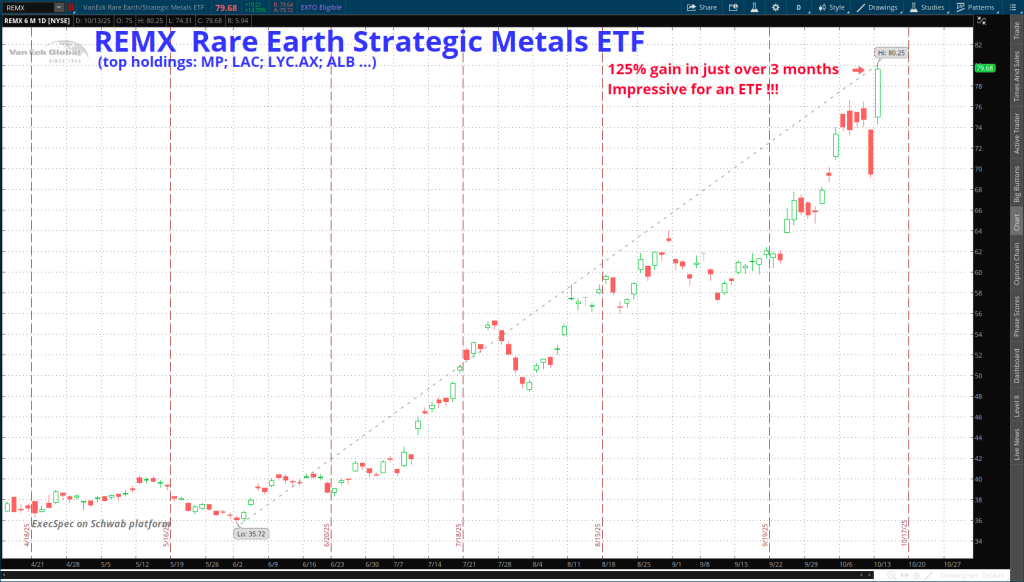
Despite our warnings of an adverse overall market reaction if the Supremes overturn Trump’s tariff authority, our model portfolio continues to emphasize the rare earth sector. REMX is a broad fund in the ExecSpec KDelta portfolio, with gains far surpassing the red hot semiconductor indices – which we also favor. REMX is up 90% since our July 8th recommendation. We have redcuced our exposure here expecting a 25 to 40% correction as tensions with China evetually improve.
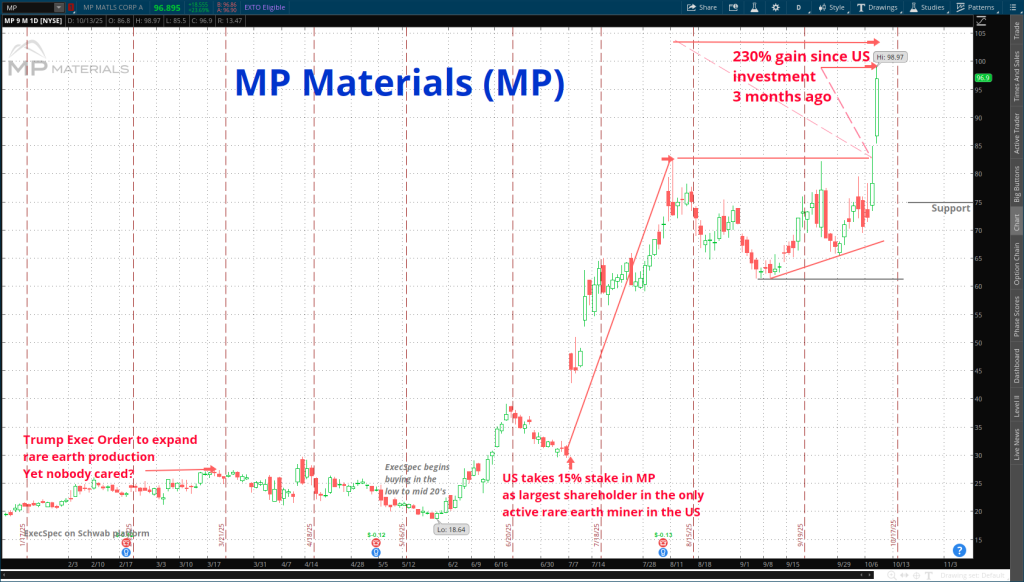
While there are a handful of rare earth, lithium and graphite companies with vertical price charts in recent months, one of the hottest names in the news this season is MP Materials. MP is an ExecSpec holding up 203% since our July 9th recommendation. As we have discussed for months, this is currently the only active rare earth miner and will be the first end to end finished process supplier in the US. This is one of many overheated gainers in the space, but unlike meme stocks, this company has a long established large mining operation with major backing by the US government that will offer to buy everything they can produce at a guaranteed profit. It’s stock price has a layer of froth, but investors should take partial profits from their large gains and look for deep 35 to 50% correction to begin new purchases during this secular quest to supplant China and create a strategic critical mineral reserve akin to the SPR in Oil.