
In July, the Yen carry trade unwound and the US unemployment rate ascended to an unexpected high of 4.3%, thereby thrusting the specter of recession into the headlines and unsettling investors. This rise, from an almost historic low unemployment a year prior to the highest level since 2021, has invigorated proponents of the dreaded “R word” with the Sahm Rule as their rallying cry. This indicator, which tracks a moving average spread of unemployment, has demonstrated historical utility in recession forecasting. Yet, as with many economic tools, its reliance on historical data and the nature of its predictive power warrant cautious interpretation.
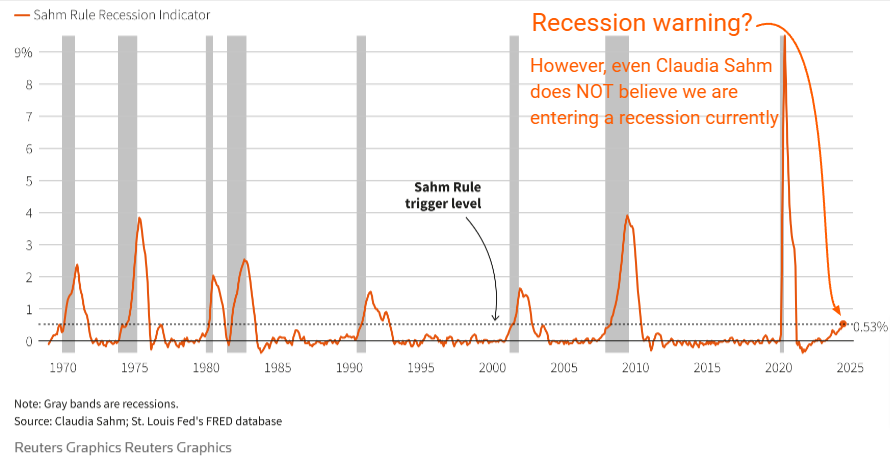
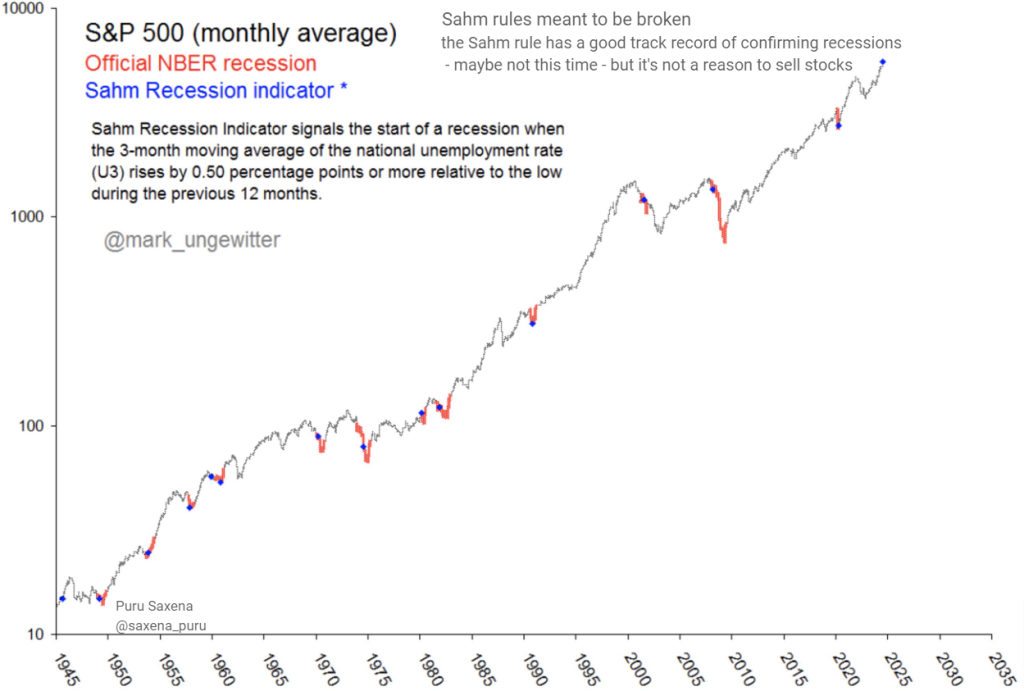
Despite the Sahm Rule’s storied past, its correlation with stock market behavior offers limited insight for investors. A significant market decline, reflecting contracting earnings forecasts, would typically accompany serious labor market concerns. However, the current labor market, despite some wobbles, does not yet present the distress signals for investors that one might expect from such an economic downturn, such as could be implied by the Sahm rule.
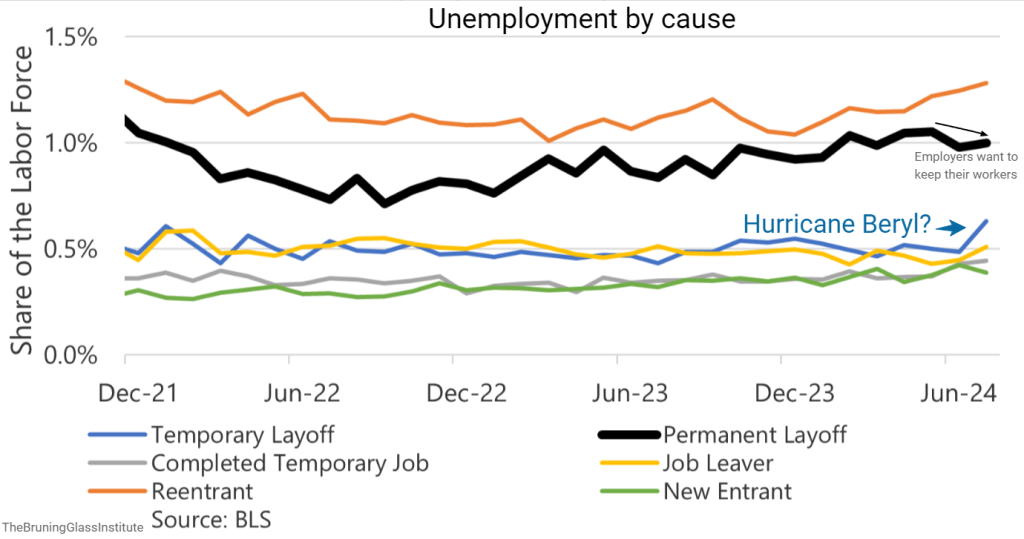
Unemployment of 4.3% isn’t alarming by itself compared to history, but the trend is a concern for some. The context of the labor slack should also be viewed along with the high level of job openings today. Job openings, at a robust 8.2 million, suggest a demand for skilled labor that outstrips the tight labor period of 2018. July’s labor market data may have been skewed by Hurricane Beryl, with temporary layoffs. The Bureau of Labor Statistics asserts “that Hurricane Beryl has little effect [on] the data.” However, the number of those out of work due to bad weather soared to 461,000, the worst July on record.”
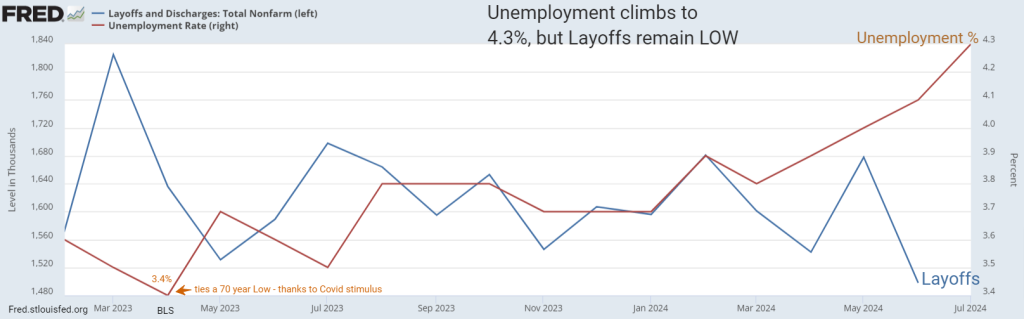
Layoffs have been quite low and falling with rising unemployment, which counters the narrative that employers are trying to trim their workforce to brace for falling margins. It’s hard to sustain higher unemployment if layoffs are not elevated.
The Federal Reserve’s mandate—to balance economic and labor activity while maintaining stable consumer prices—has shifted its focus to labor slack, now that inflation is under control. While we don’t see a high risk of a hard landing for the economy or high unemployment, the Fed’s hesitance to cut rates or halt its reduction of banking reserves is raising market anxieties. We continue to feel that the Fed should have begun with at least an initial Fed Funds rate cut in July along with a cessation of the monthly subtraction of financial reserves from the banking system. The investment consensus is that the Fed will begin a rate cutting cycle in mid-September, but the excessive alarm over 4.3% unemployment has triggered the market to demand that the Fed should either cut rates now or promise a double cut 0f 50 basis points in September. Until the Fed communicates more aggressive easing or the Yen carry trade returns, market volatility may persist where stocks have downside risk beyond our 11% correction expectation.
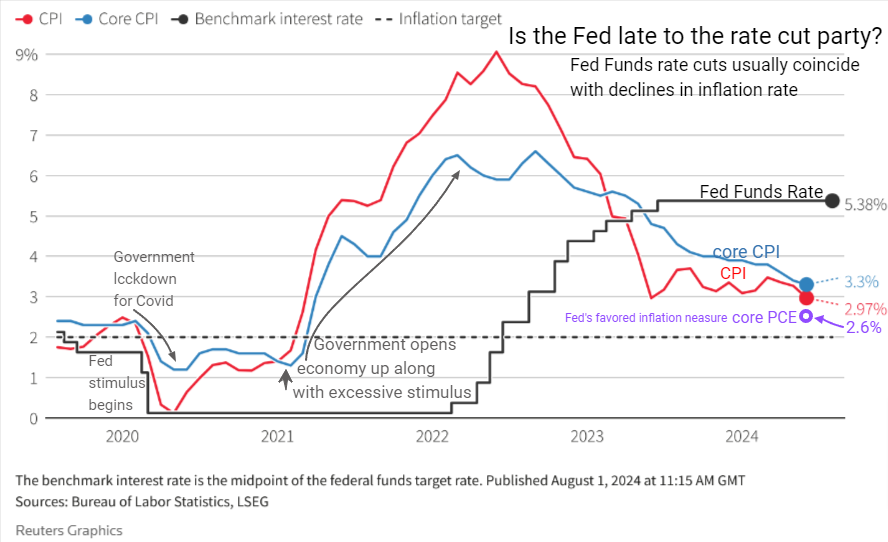
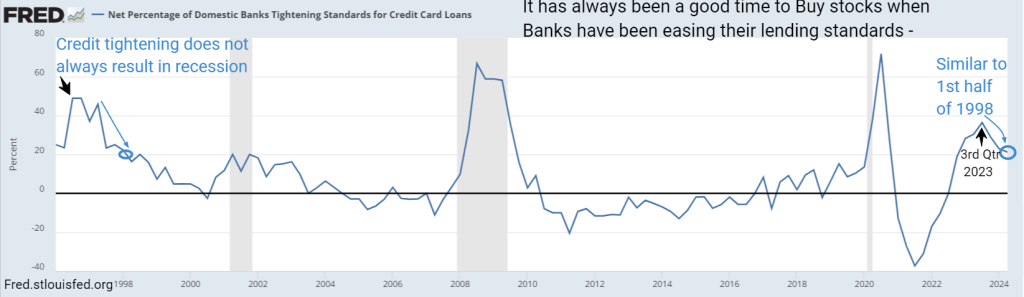
Anecdotally, consumer caution flags arise when Amazon, Wayfair, Restoration Hardware and Mcdonalds all report weaker than expected sales with subdued forward guidance. Yet, travel and leisure are breaking records, same store sales are expanding a robust 5%, GDP is strong, debt delinquencies are low, and banks have been easing lending standards for over 9 months.
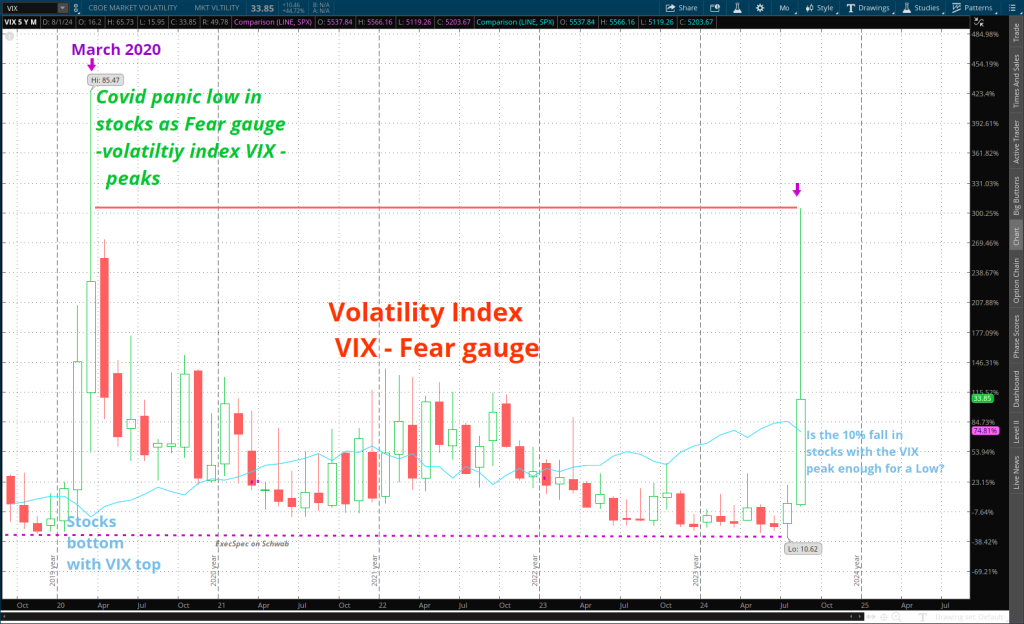
The volatility index (VIX) recently touched 65, a level historically indicative of short-term market lows. Although a further brief panic is possible over the next month, the current phase of volatility appears stretched.
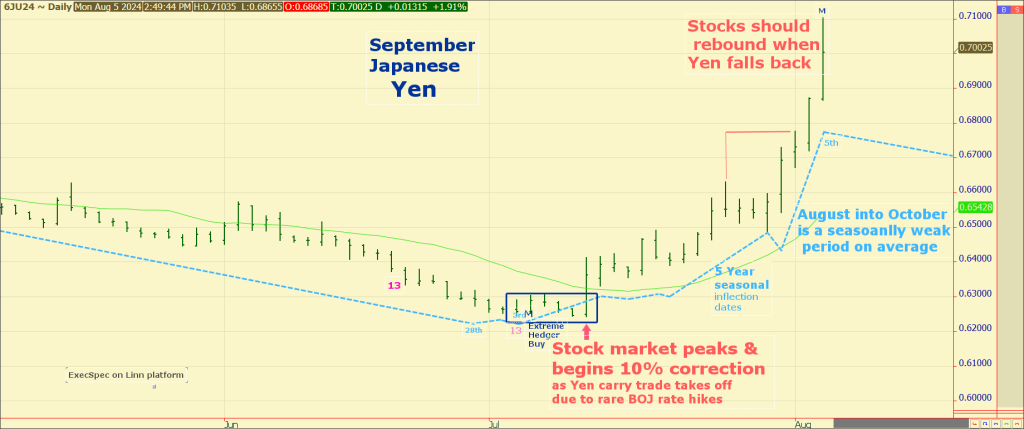
Our ExecSpec report could have begun and concluded with the Yen carry trade that is the primary engine of the current US and global stock market correction. The Yen carry trade, a strategy where investors borrow from countries with low interest rates to invest in higher-yield markets, has been the Indy 500 driver of the Bull market in stocks in 2024 and the recent double digit market downturn is due to its unwinding. The Bank of Japan’s announced shift from monetary easing to credit tightening on July 10 precipitated a sharp rally in the Yen, triggering a sell-off in US equities. As long as the Yen appreciates, equities will face headwinds. Our seasonal analysis is not a crystal ball, but suggests that the Yen may stabilize or decline by early August and move sideways to lower until October, potentially rejuvenating stock market inflows. Without decisive action from either the Fed or the BOJ, investors may demand more aggressive rate cuts from Fed Chair Powell. Historically, markets indifferent to economic fundamentals during periods of panic often realign once the turmoil subsides. Without a verbal boost from the Fed or BOJ, money managers will push their demands for rate cuts from one or two up to 5 before year end with a double cut (50 basis points) in mid-September.
Our anticipated 2-to-3-month equity pullback is only four weeks old. With the S&P 500 down 10%, small caps off 16%, and the Magnificent 7 index losing over 20%, it’s prudent to begin reallocating a portion of our cash reserves from 18% to 12% into utilities, healthcare, and financials, preparing for the eventual stabilization of the market before the November election.