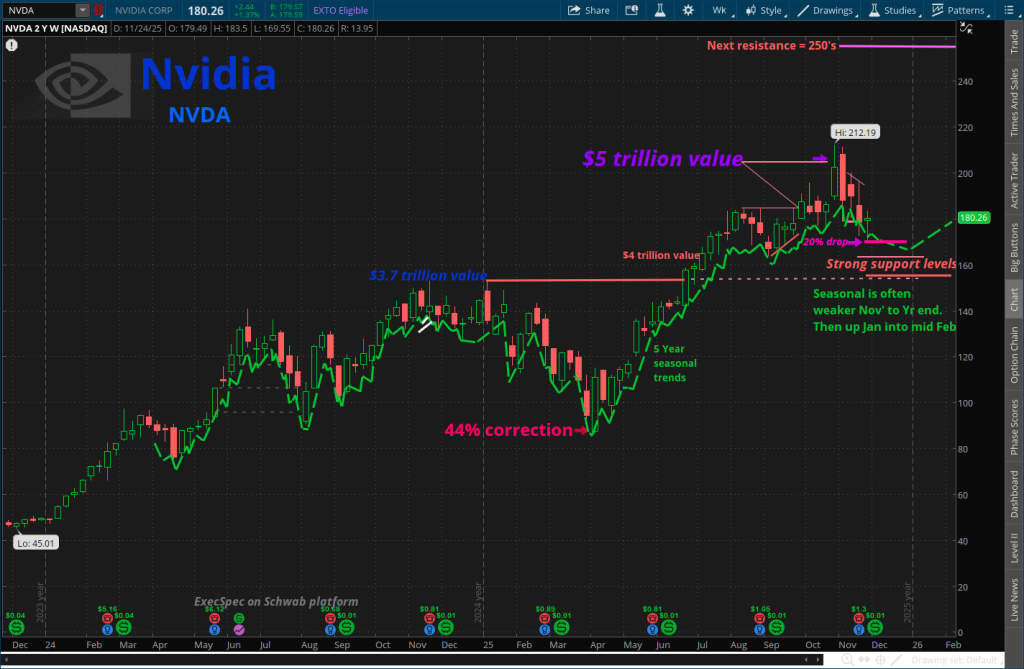
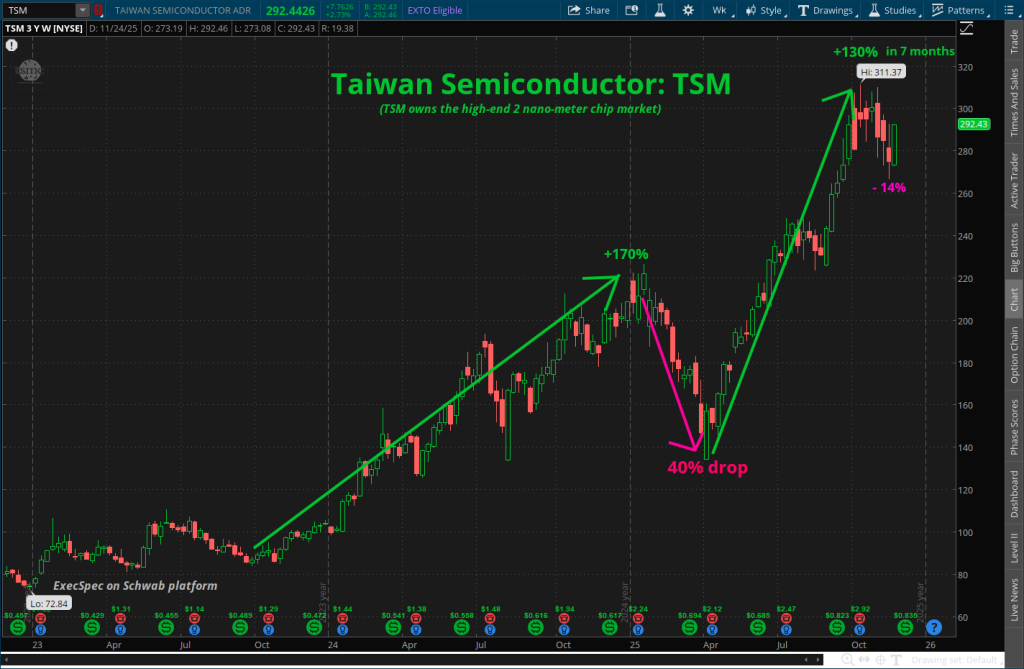
Less than four weeks ago, Nvidia briefly crested the $5 trillion valuation summit, an altitude that promptly elicited the usual chorus of Cassandra-like admonitions about bubbles ready to pop. The S&P 500 and Nasdaq duly obliged with declines of 5% and 9% respectively (merely courteous corrections by the standards of recent memory, rather than the violent throat-clearing cough provoked by April’s tariff tantrums). Nvidia itself surrendered nearly a trillion dollars in market capitalization in a matter of days. Alarming, certainly, to the excitable. Yet a 20% retreat at this stage of a secular bull market is less a harbinger of doom than than the normal ebb and flow of capitalist exuberance after a 1,500% leap in four years; particularly when one recalls that the same stock absorbed a 44% haircut earlier this year only to rebound with a 150% gallop over the subsequent seven months.
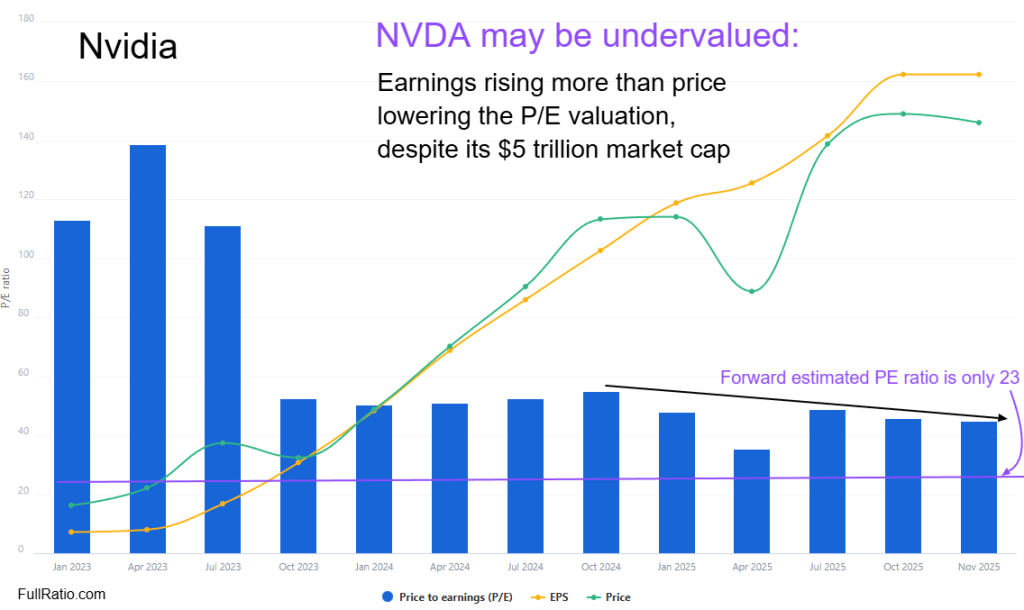
The pertinent question is not whether Nvidia can merely defend its lofty perch but whether it can continue ascending at its current velocity. The answer, thus far, is an emphatic yes, as evidenced by the cold arithmetic of earnings and revenue in their November report. Nvidia has, in fact, grown its fundamentals more rapidly than its share price, an achievement that borders on the miraculous in an era accustomed to the opposite phenomenon. Its data-center products remain “sold out through the foreseeable future.” Profit margins of 73.6% are not merely impressive; they are offensive to jealous competitors accustomed to more modest returns. If not for the fear of large numbers, Nvidia’s P/E valuation multiple would be higher.
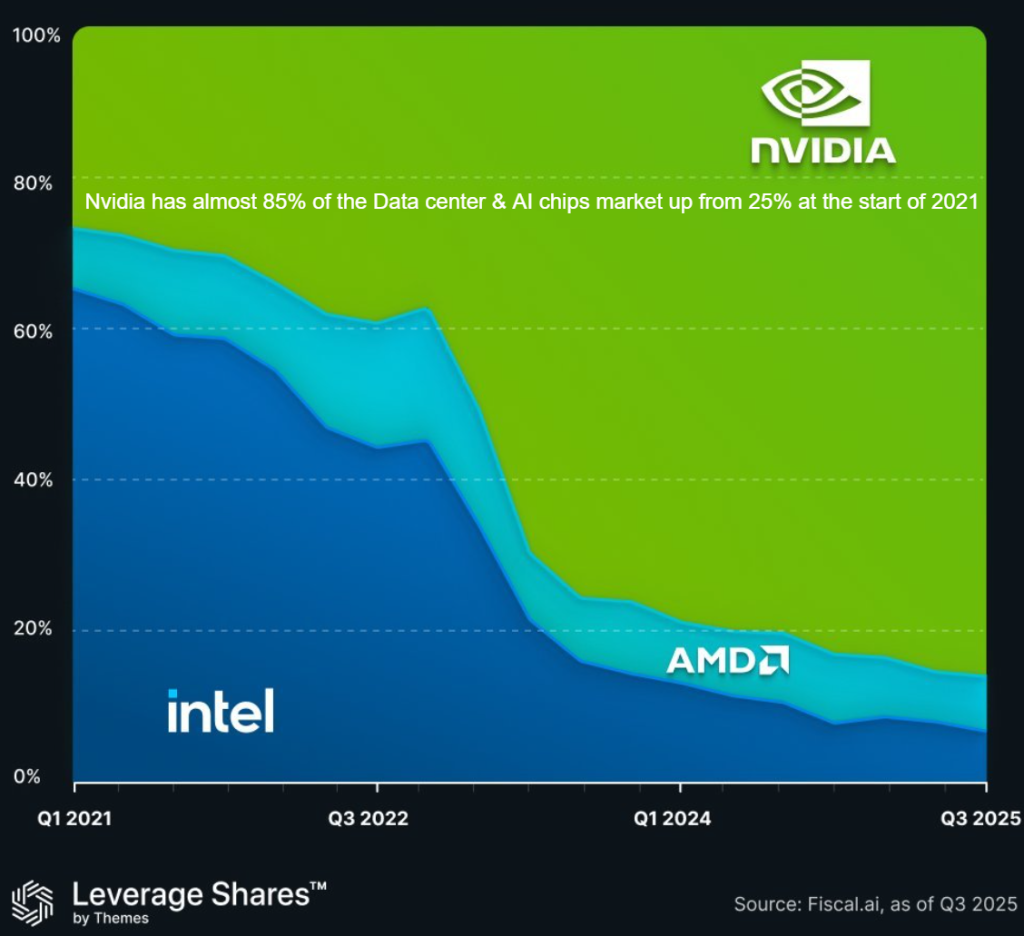
Competition, of course, exists, though it currently resembles a polite queue forming behind a monopolist who has not yet tired of winning. Over the past four years Nvidia has expanded its share of the data-center AI accelerator market from under 30% to north of 85%, poaching territory from a somnolent Intel and a surging but still junior AMD. Intel, that erstwhile colossus of the Silicon Valley celebrities, now attempts a resurrection whose early technological gestures of sub-2 nm nodes are greeted like a former heavyweight champ who now spends most of its time on the canvas. Even if Intel finally produces a world beating 1.8 nanometer node with commercial customers in 2026 as promised, instead of subcontracting its most advanced CPU work to Taiwan Semiconductor, its clear where genuine mastery currently resides. The potential for new players, or renewed competition, is less an existential threat to NVIDIA than a validation of the market’s dynamism and size.
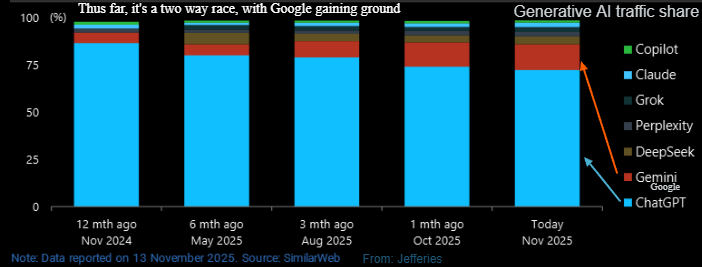
Fresh anxieties surfaced this week with reports that Meta will avail itself of Google’s Tensor Processing Units for certain workloads. Exclusive to Google, TPU’s are superior in performance and energy use than the more broadly comaptible GPU’s that are more common. Google possesses an installed base and an ecosystem that no upstart can yet touch. Yet the large-language-model ((LLM) horserace remains fluid rather than settled; OpenAI, Nvidia’s most conspicuous customer, still holds pride of place with its 800 million installed base of monthly users. While still several years from forecasted maturity, OpenAI has made the largest investment – currently $1.4 trillion – to create a massive ecosystem from scratch to compete with Alphabet and all contenders. We expect a series of major announcements from OpenAI each year to assure investors that they will rise to the top in multiple fields beyond search. For the next several years, however, the pie is expanding for advanced accelerators (call them GPUs, TPUs, or tomorrow’s unimagined acronyms) that will grow robustly enough to accommodate all serious contestants, with Nvidia retaining the largest chair at the banquet table.
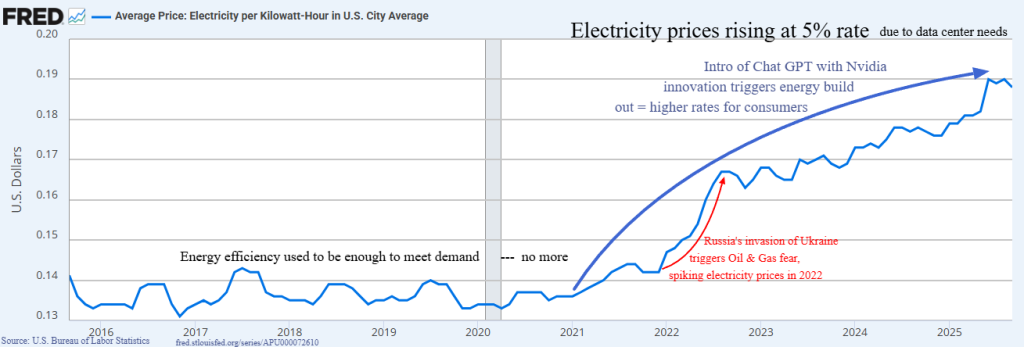
In this light, periodic 20% or even 40% corrections in Nvidia’s share price should be regarded not as portents but as opportunities – the market’s way of offering a discount on a company still positioned at the fulcrum of a multi-decade planetary buildout. The music has not stopped Nvidia and other AI contributors; it’s merely a pause for a commercial break. Investors who mistake these interludes for the finale are likely to lament the shares they declined to acquire during the momentary silence. However, de-levergaing the portfolio of hypercsaler domiannce will increasingly be a theme we will focus upon as we enter the stimulus wave of 2026. Small cap should outperform in coming months as the trillioaire companies require deeper corrections before new money should be apllied. Stocks of interest: A speculative entrant for micro cap this month that we like is DUOT (Duos Tech) that is pivoting from rail car inspections to managing trubines and energy management for data centers (latest price = 9.55). This company is a micro cap, buyable as a Spec on 20 to 40% corrections, but they help bridge the gap with rapid mobile energy production services while waiting for the Utility companies to build their large long range Natural Gas power plants. Indirect larger cap competitors that we strongly favor are GE Vernova, Eaton and Vertiv.