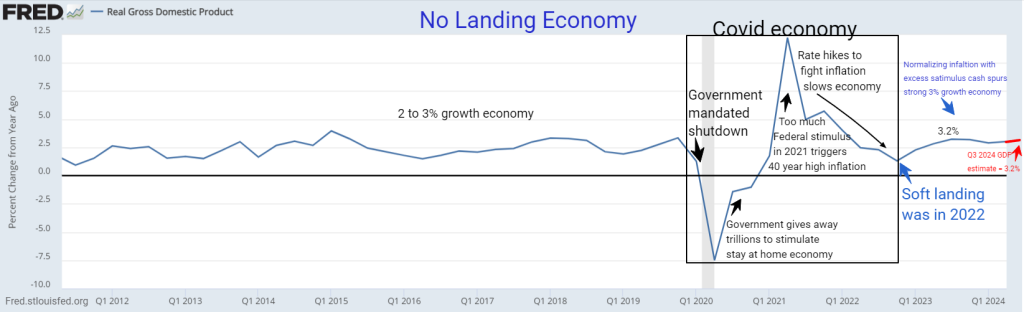
For nearly three years, the chattering class has been locked in a Sisyphean debate, toggling between the notions of a soft landing and a recessionary hard landing. For a time, we leaned toward the optimistic prospect of a soft landing; however, recent data suggests that we might already have endured our proverbial waiting for Godot in 2022. Now, we find ourselves celebrating the second anniversary of a resilient economy, with azure skies ahead.
The current 3.4% GDP growth rate estimate—an impressive feat in today’s labor-constrained environment—accompanied by falling interest rates, presents a backdrop more robust than many might initially assume. Corporate profit margins are surging to record heights. Consumers exhibit healthy financial habits, evidenced by responsible credit card usage and manageable debt service. Banks are easing their lending standards and borrowing costs are falling. Meanwhile, the AI investment boom is just beginning to unfurl its wings, poised to invigorate investment banking and bolster manufacturing activities.
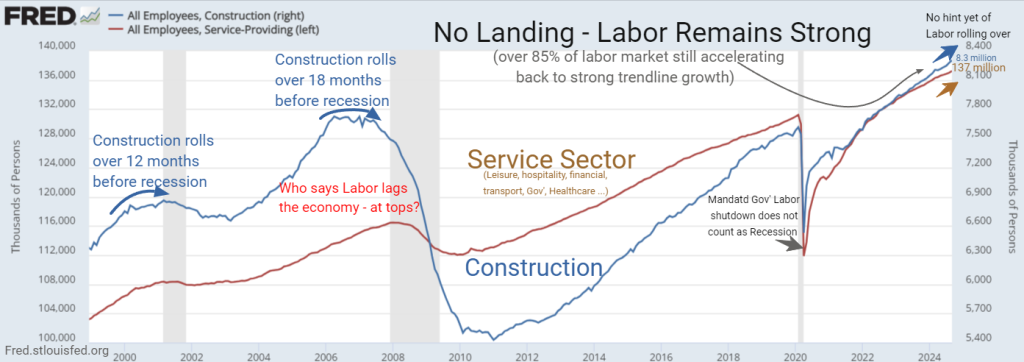
Historically, an unemployment rate below 4.7% has been deemed tantamount to “full employment” over the past eight years, save for the remarkable interruption of the pandemic, during which the government compelled workers to stay home. In times of economic downturn, we often witness layoffs in particular sectors—housing and automotive being notorious harbingers of distress. The trends of the early 2000s, when employment in construction rolled over, provided clear portents of trouble. Yet today, construction employment is breaking records, as both residential and commercial sectors exhibit resilience against recessionary pressures.
Further, the dominant service sector, which accommodates 80% of the American labor force, is accelerating, returning to its growth trajectory rudely disrupted by COVID-19. Recent developments reveal a substantial shortage of housing and skilled labor necessary to sustain AI-driven supply chains and the ongoing reshoring of industry. For now, there seems to be little indication of an impending cyclical recession. (It’s worth noting that unemployment spikes in Q4 shoul be ignored while the Boeing strike and massive hurricane(s) recovery are underway.) Our forecast has been that the US economy will maintain its expansion mode into 2026 or 2027 before cyclical pressures trigger major belt tightening.
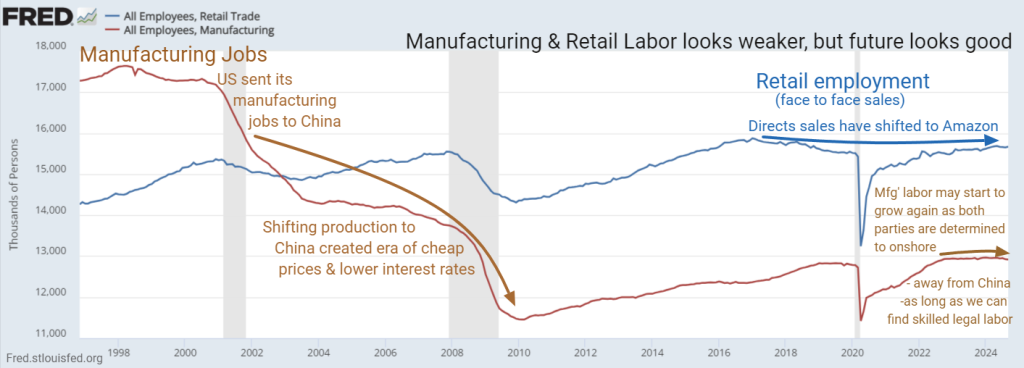
After more than two years of misleading indicators—be they inverted yield curves. LEI or manufacturing purchasing manager surveys—pessimists may note the labor weaknesses in retail sales and manufacturing. However, it is crucial to recognize that not every sector must ascend simultaneously. The shift in retail jobs may even catalyze a beneficial transformation, with many displaced workers finding employment in burgeoning fulfillment centers at giants like Amazon and Walmart.
Manufacturing, which suffered a prolonged decline as basic goods production migrated to China, is witnessing a tentative revival. Although the growth rate for durable goods remains historically modest, manufacturing employment has rebounded to levels not seen in sixteen years. The political fervor from both sides of the aisle to reshore industries and diminish reliance on adversarial trading partners creates an environment ripe for worker demand and automation to flourish.
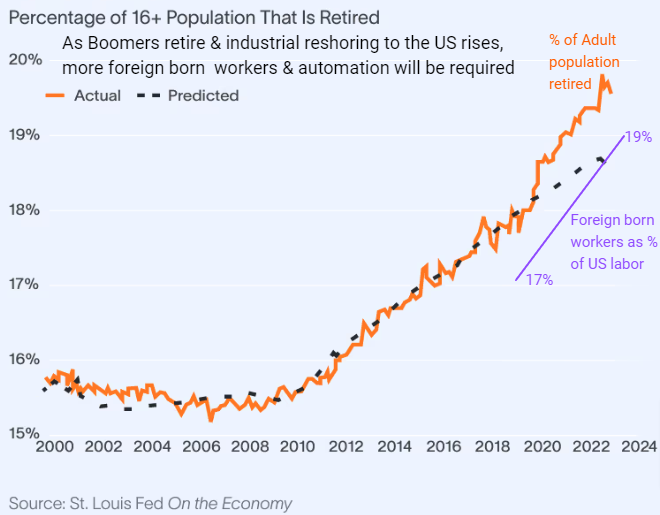
The oldest and 2nd largest generation in American history—the Baby Boomers—are retiring in droves, accompanied by a labor supply faced with falling birth rates and declining male labor force participation. The share of retirees among the adult population has surged from 15% to nearly 20% over the last 15 years, with more workers opting for early retirement. Fortunately, foreign-born legal workers are stepping into some of these vacated roles, supplemented by a steady influx of unskilled labor from our porous borders. However, the shortfall of skilled labor will loom large in the coming decades, necessitating prompt and innovative solutions.
In this context, educators and employers must prioritize skills development, adaptability, and technological acumen over traditional college degrees.
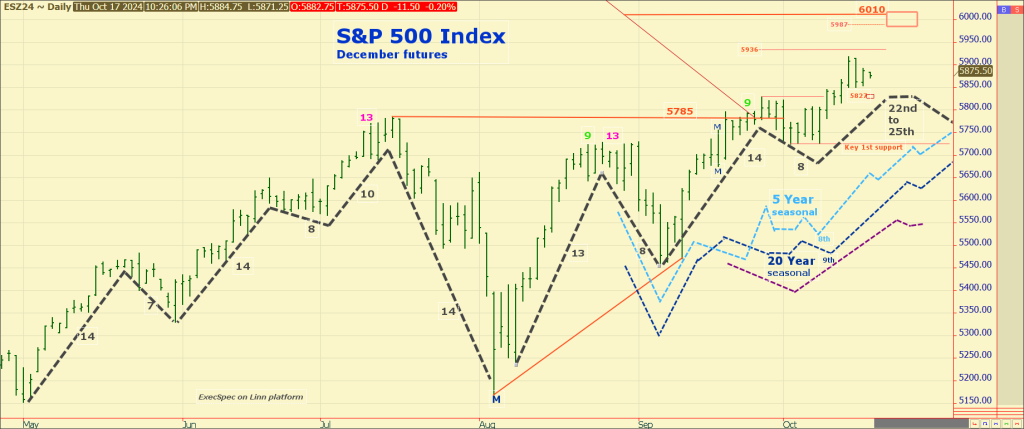
For investors, the horizon glows brightly. Robust profits and commendable credit conditions characterize both consumers and corporations. Inflation is on a downward trajectory, recession fears are muted, and an interest stimulus cycle has commenced. Investment banks, shadow banks and private equity firms are flush with cash, keen to energize the deal-making process as borrowing costs decline and onshoring efforts gain traction. Traders might anticipate a short-term peak in activity in the 2nd half of October, but investors find themselves comfortably positioned, buoyed by healthy fundamentals on both domestic and international fronts.