
From its crude decentralized origins in Medieval times, investment banking has rewarded those who could assemble capital quickly and with scale. Modern banking essentially began with the House of Morgan in the late 1800’s and was enshrined as THE banking powerhouse after the Panic of 1907. The failed attempt to corner the Copper market triggered a run on banks, a stock market collapse and a sharp recession that year. When the financial system froze during this 1907 panic, J.P. Morgan convened financiers in his home with the goal of survival. Trust in the banking system had evaporated. The federal government lacked a central bank. Morgan’s solution was to scale capital supply to the system and restore confidence. That instinct—to centralize financial power in a criss has continued to expand inexorably over the past century. Investment banking, like capitalism itself, advances in waves. Some lift all boats. Others elevate only the largest vessels, leaving smaller craft to drift in shallow water.
The Glass-Steagall Act of 1933 attempted to tame this concentration of power in the financial system by separating commercial banking from investment banking. as though capital could be persuaded to respect boundaries drawn by statute. For decades, capital was persuaded to obey most of the Statutes boundaries. But as global markets expanded and economic downturns continued to occur, those boundaries proved increasingly artificial. By the time Glass-Steagall was repealed in 1999, finance had already outgrown it and bulge banks became a necessity for our financial survival.
Then came 2008 and the Mortgage Meltdown triggering the Great Financial Recession that consolidated banking and cemented the need for printing money through quantitative easing. With the 2008 panic, regulators tightened oversight, weaker institutions vanished, and the survivors emerged larger, more regulated, and “too big to fail”. Bank balance sheets and compliance grew, hardening moats as barriers against competition.
This history explains the present moment.
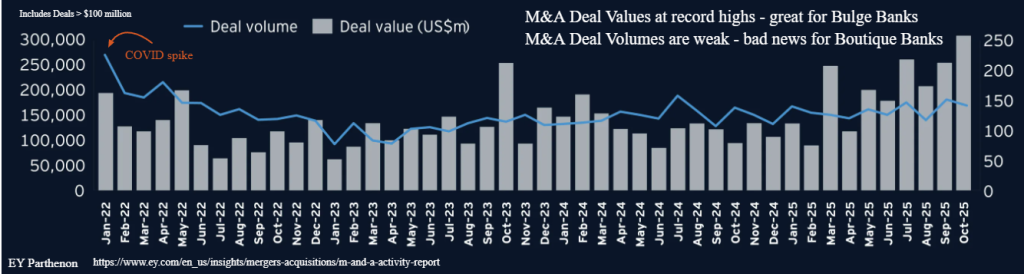
The chart above, covering M&A activity from the end of COVID through October of 2025, tells a story. Deal value has surged decisively from the post-pandemic trough. October 2025 alone saw M&A deal value surge 146.5% year over year with technology and life sciences dominating the landscape. Financing costs have eased since 2022 and confidence among well-capitalized corporate buyers has returned. Valuation gaps – spread between seller expectations and buyer valuations – are expected to narrow further in 2026 and the mega deal size will almost certainly set another record. There were deals in 2025 exceeding $80 billion, yet several deals in 2026 are expected to surpass this, led by the posible OpenAI launch that could approach one trillion dollars. Bulge-bracket banks are designed for this environment.
But deal volume tells a different story as it remains stubbornly ordinary. The number of transactions has recovered only modestly, moving sideways even as total deal value climbs. The market should eventually broaden in the AI led cyclical expansion, but for now it is concentrating. For 2025 bulge-bracket banks are dominating deal action more than usual. Investment banking is not about mid-market advisory fees alone, where boutique banks shine. It is about financing, underwriting, risk management, and distribution. Large banks earn money not only when deals close, but trading desks generate daily revenue, net interest income accrues daily and capital is returned through buybacks and dividends.
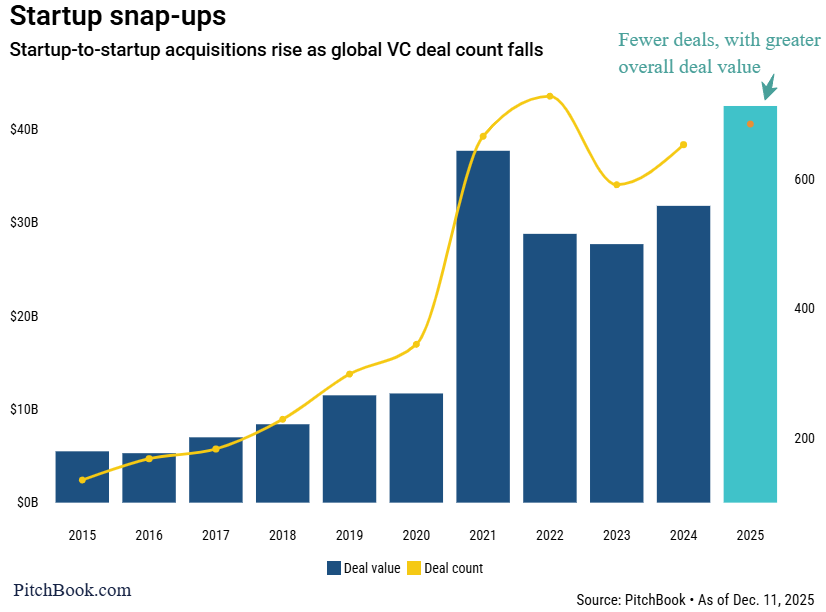
Boutique investment banks, by contrast, were built for their judgment rather than leverage, and frequency rather than scale. They prosper when transactions are plentiful and when private-equity exits recycle capital quickly and advisory fees are predictable. After a slow start in the first half of 2025, banking activity is picking up speed as we close out the year, which is further evidenced by the aggressive acquisition deals proliferating among startup companies that are gobbling up their competition to add value. PitchBook data show a sharp acceleration in venture-backed M&A led by startups, with 686 acquisitions completed this year at a record $42.5 billion in total value—up 5% in deal count and a striking 34% in dollar terms from an already elevated 2024.
This divergence of large and small banks mirrors the broader economy. Higher-income households—less sensitive to financing costs and inflation—continue to spend, invest, and refinance. Subprime consumers, exposed to higher borrowing costs and wage pressure, fall behind. In total, consuming households have healthy balance sheets and are increasing their consumption despite inflated prices and borrowing costs.
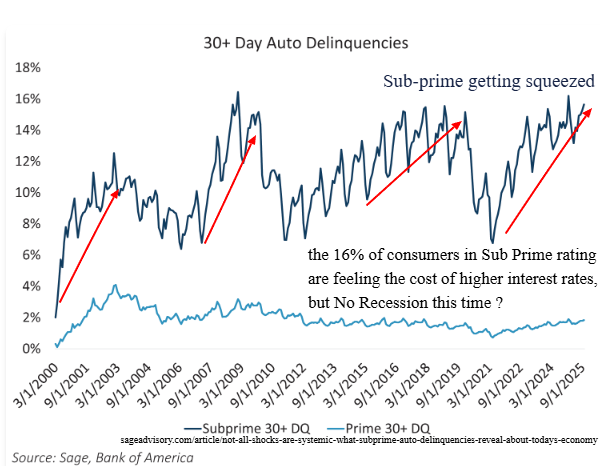
The so-called K-shaped economy grows, but unevenly. Eventually, this will change for small earners and small banks. M&A deal volume is expected to rise as confidence spreads beyond the top tier of buyers, while the volatile cost of capital becomes predictable and fiscal stimulus kicks in next year. Private equity will find their pent up exits again.
In the stock market, this capital concentration has been more visible. Over the past several years of double digit percentage gains, investment flows surged toward large-cap companies, particularly hyperscalers financing the infrastructure of artificial intelligence. These firms command capital because of strong cash flows, immense access to capital and they can deploy it immediately at scale. One source of their growth has been funded readily by bulge-bracket banks. Small and mid-cap companies, similar to median and low income households, have struggled. Higher costs of capital, persistent inflation, and fixation on AI have crowded them out. Many small businesses have stagnated because capital and skilled labor has preferred to flow toward more predictable and profitable outcomes. The result is a valuation gap that has widened materially, as have the household haves and have nots. Smaller companies now trade at significantly lower multiples than their large-cap counterparts, which creates opportunity.
The Hint of a Turn
Late 2025 offers early signs that this imbalance may be easing as market leading hyperscaler stocks and their ecosystem of suppliers have become laggards. Financials, industrials and small cap value in general have outperformed during the seasonally Bullish holiday period. As AI infrastructure spending matures, marginal returns on hyperscaler investment begin to normalize. As financing costs stabilize, tariff clarity returns and fiscal stimulus revs up, deal volume should broaden, as capital looks beyond the largest platforms.
When capital begins to lift smaller company balance sheets—it lifts labor demand. Small and mid-cap companies are disproportionately labor-intensive and more closely tied to domestic employment. A rotation toward them would not only expand valuation multiples; it would increase demand for the lower-income workers left behind during the AI race for the stars. Just as boutique banks stand to benefit from a recovery in deal volume rather than deal value, so too do smaller companies and lower-income workers benefit when growth broadens rather than concentrates.
For much of the post COVID stock market cycle, size mattered. Large-cap stocks, embodied by SPY, ran ahead while small caps, proxied by IWM, labored. In 2022, 2023, and 2024, small caps consistently underperformed large caps. When the cost of capital rises, it is the smaller enterprise—with less pricing power, thinner margins, and greater dependence on floating-rate debt—that feels the squeeze. That dynamic persisted into the first half of 2025. In Q1 2025, small caps fell roughly twice as much as large caps. Even in Q2, when markets rallied, small caps lagged by about two percentage points. The message was clear: investors still preferred scale, liquidity, and the AI hype. Since then the tone has quietly changed.

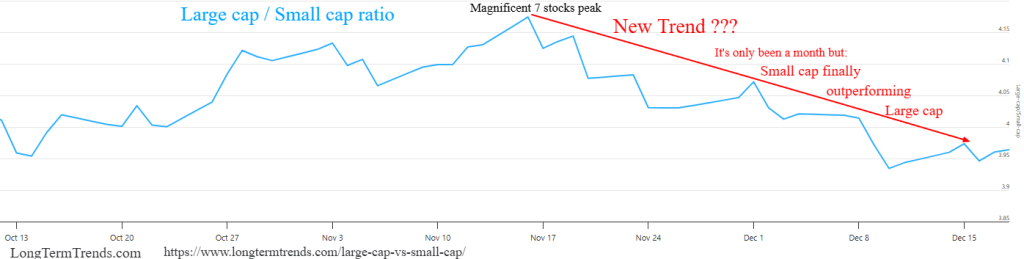
By the third quarter of 2025, small caps began to outperform. In Q3, IWM decisively beat SPY. Just one month ago, the large cap SPY held a significant eight percentage point performance beat over small cap indicies through 2025. In just one month that gap has shrunk to just three percent. This is not a statistical curiosity; it is a behavioral shift. It suggests confidence is spreading downstream. Bank lending standards are easing. After three years of trailing—and a discouraging start to 2025—small caps are no longer falling further behind. They are closing the distance. History suggests that when they do, the economy is not weakening at the margins, but regaining its breadth.
The data through 2025 still reflects a two-tier economy, but concentration carries within it the seeds of its own reversal. Investors, having crowded into the same trade, are again doing what markets always do when returns compress: they look elsewhere.