
The pedestrian consensus, ever eager to mistake tectonic shifts for mere tremors, has at last begun to discern what has been evident for some time: the aerospace sector is not indulging in a transient “sugar high.” We are witnessing the dawn of a genuine renaissance, one that follows a protracted regulatory prison. The institutional chain that had paralyzed innovation has been broken. The question now is not if the industry will recover, but how far and how fast this rebound will carry us beyond the atrophied expectations of the past few years.
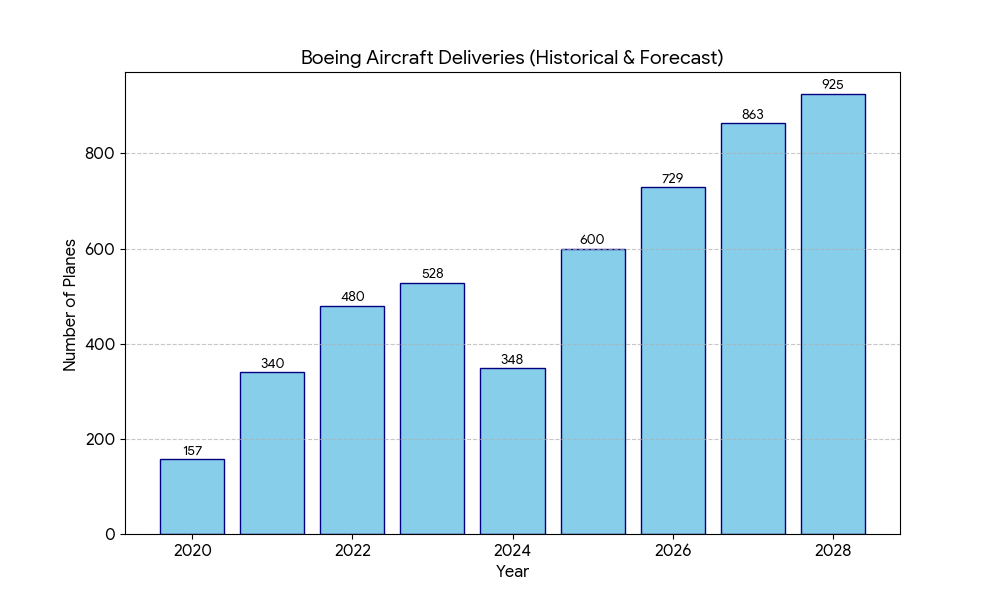
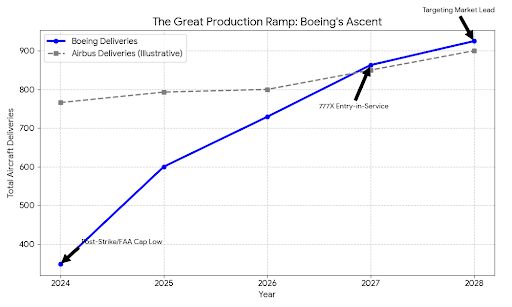
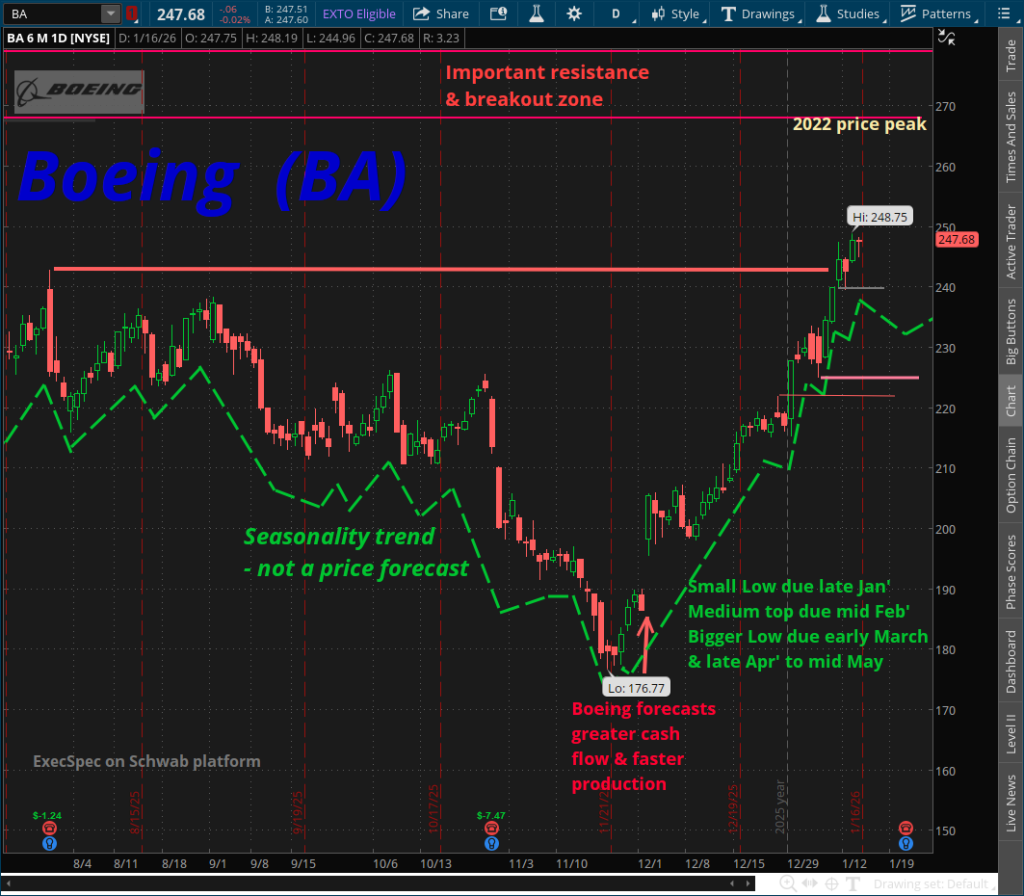
Consider the ascent of Boeing (BA). Having been the primary inmate of that aforementioned regulatory captivity, the company has emerged with optimism that its critics are now beginning to embrace. The FAA’s straitjacket production cap at 38 aircraft per month has finally dissolved, reaching 42 this year and over 52 next. The profitable 777X (the world’s largest twin-engine jet) is poised for a 2027 entry-into-service and full production in 2028. Boeing is no longer a company genuflecting on bended knee; it is a company that has adjusted its flight path back to the clear skies of its past with a strong tailwind. As production rates for the 737 and 787 climb toward their targets, Boeing is positioned to not just compete with, but potentially eclipse, Airbus. The Boeing backlog stretches deep into the 2030s (over 6,000 737s alone, sold out for the next decade). After ceding enormous market share to Airbus, the European rival now lacks the explosive “catch-up” torque that Boeing now possesses. At the start of 2024 the US Government only allowed Boeing to produce less than half of what Airbus was delivering. In two years from now Boeing is forecast to surpass Airbus deliveries and continue growing that advantage in the years to come. Some 2028 estimates have Boeing’s EPS exceeding $20/share with a free cash flow north of $10 billion. With an historical 15 to 20 PE ratio that is likely to be surpassed during the accelerating revenue growth (ARG) phase, we would expect stock price targets near $300 at some point in 2026 rising to the upper $300’s or low $400’s in 2028.
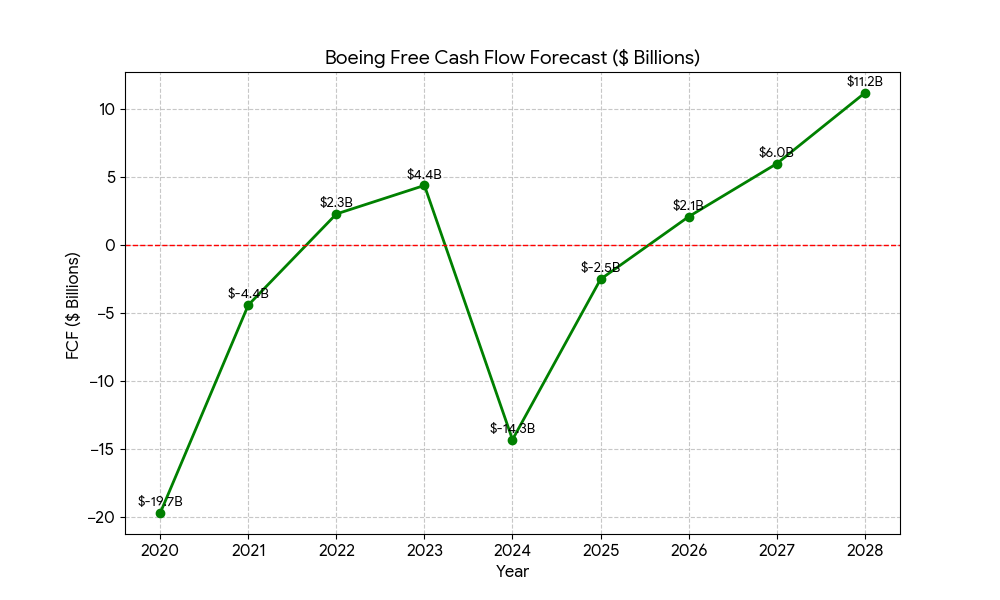
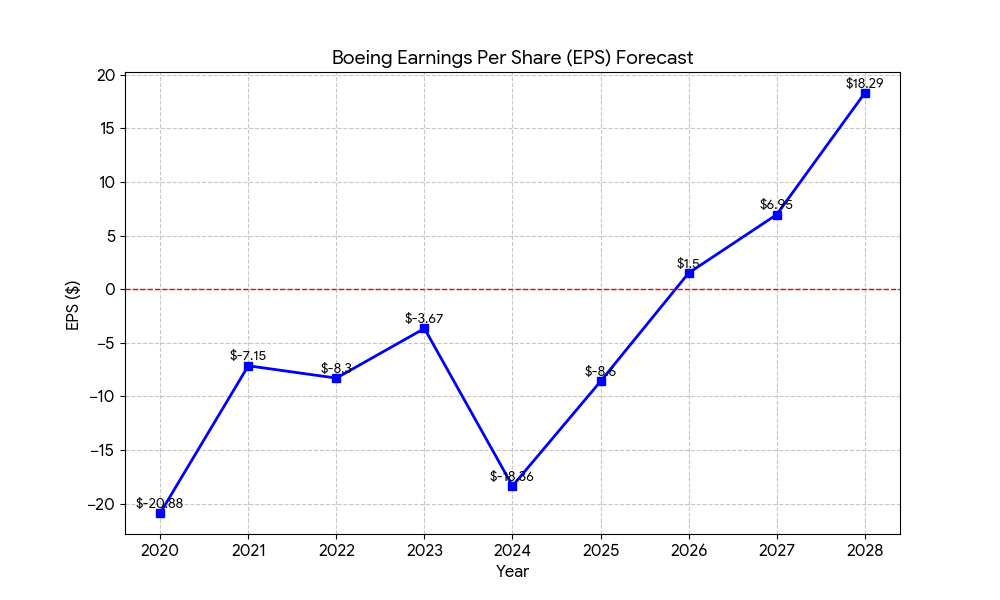
Critical factors in the turnaround for Boeing are: (1) 2026 certification of the MAX 7 and MAX 10 to begin high-volume deliveries in 2027 – increasing profit margins and sales. (2) Inventory Liquidation of 2026 deliveries from the “parking lot”—planes built during the 2024–2025, with deliveries shifting almost entirely to “new-build” aircraft in 2027. (3) Integration of the much maligned Spirit AeroSystems, to reduce “traveled work” (parts being finished out of sequence), which should make the 2027–2028 delivery schedule more predictable.
Yet the renaissance extends beyond the 737 Max and 777X airframes. The “industrial trio” of TransDigm (TDG), Howmet Aerospace (HWM), and AAR Corp (AIR) represents the vital chess pieces of this recovery. TransDigm dominates the parts aftermarket. Howmet is the gatekeeper of engine production and advanced metallurgy. AAR Corp is the primary beneficiary that maintains an aging but expanding global aircraft fleet.
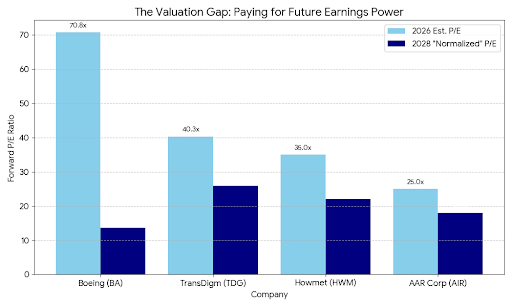
While some money managers have recently discovered these companies, sending them aloft by 15 to 40% over the past month, investors still have an opportunity due to the ability to value these enterprises well beyond their 2026 horizons. Boeing was our 2nd largest model portfolio holding in 2025. The catalyst is not merely commercial. The recently proposed expansion of the 2025 military budget by more than 80% to $1.5 trillion in 2027, could add secular winds to their P/E multiples that may grow as sales accelerate. The market will increasingly realize that 2028, not 2026, is the true destination for “normalized” earnings. The hurdle is no longer demand; it is execution. The world is clamoring for American wings and expertise.
| Metric | 2026 Projection | 2028 “Renaissance” Target |
| Boeing Deliveries | ~729 Planes | 925+ Planes |
| US Defense Budget | ~$962 Billion | $1.5 Trillion (Prop) |
| Boeing FCF | ~$2.3 Billion | $10.5 Billion |
| TransDigm EPS | ~$38.00 | $53.00+ |
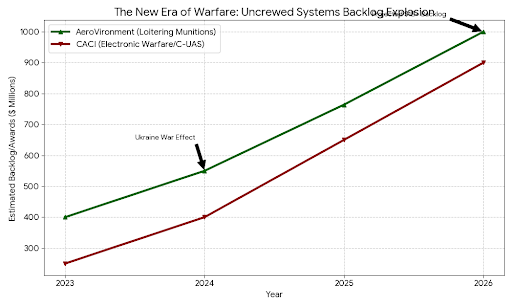
While Boeing and its suppliers reclaim the sky, a new era of warfare—born in the rubble of Ukrainian cities—has minted a different class of winners. Russia, Iran and Ukraine have shockingly demonstrated global vulnernability to drone warfare. AeroVironment (AVAV) and CACI International (CACI) are the sentinels of this new age.
-
Having integrated BlueHalo, AeroVironment is no longer a “small drone” company; it is a small but growing core part of the US defense stack. With a record backlog of $1.1 billion and revenue growth over 150%, it is the undisputed leader in loitering munitions. Drone technology in the air and the sea is advancing perhaps faster than any area of the global military arsenal and the race to have the best has begun.
-
CACI International (CACI): In a drone swarm-filled sky, CACI is the master of Electronic Warfare (EW) and Counter-UAS (Unmanned Aircraft System) providing an invisible shield. Their role in synthesizing sensor data for Trump’s “Golden Dome” ensures their growth is tethered to the largest defense projects in history. With hundreds of drones attacking a single target en masse, a broad spectrum and robust defensive shield of jamming, counter drones, munitions and lasers being developed by CACI and AVAV are critical on the field as well as protecting softer domestic targets in the future. Perhaps even more critical than cyber-security, this area of technology innovation should keep production and backlogs humming for years to come.
With backlogs stretching into the billions, these companies are the architects of a new, uncrewed military paradigm that will be critical to defense budgets for the remainder of this decade with enormous upside demand that has entered the early innings. We have been buyers of some of these companies over the past year, especially Boeing, and view them as high conviction growth stocks upon any double digit percent pullbacks after their recent appreciation in their stocks of 20 to 60% over the past couple of months.
We are witnessing a fundamental rerating of the American industrial spirit. The quartet of Boeing, TransDigm, AAR Corp, and Howmet Aerospace are no longer merely cyclical participants in a volatile trade; they are the foundational pillars of a secular growth phase that is insatiable with exceptional visibility. When joined by their cousins in the uncrewed vanguard—CACI and AeroVironment—they form a comprehensive architecture of modern statecraft, addressing a new tactic of warfare where drone-driven offense and counter-unmanned defense are the prerequisites for sovereignty. While the former market leading Magnificent 7 cohort are falling to multi-week lows, these aerospace stocks are breaking out to new hghs. For these companies, the path forward has been mostly cleared of regulatory hurdles, leaving only the steep climb of execution with new and improved management in place. In this global race for the best wings and advanced silicon widgets, they represent the indispensable connections of both our commercial vitality and our national survival. In a world where a populist President is literally backstopping and taking Government ownership of capital starved companies deemed vital, these favored stocks should not be ignored when market corrections provide opportunities to invest.