
Markets Climb While Reality Waits
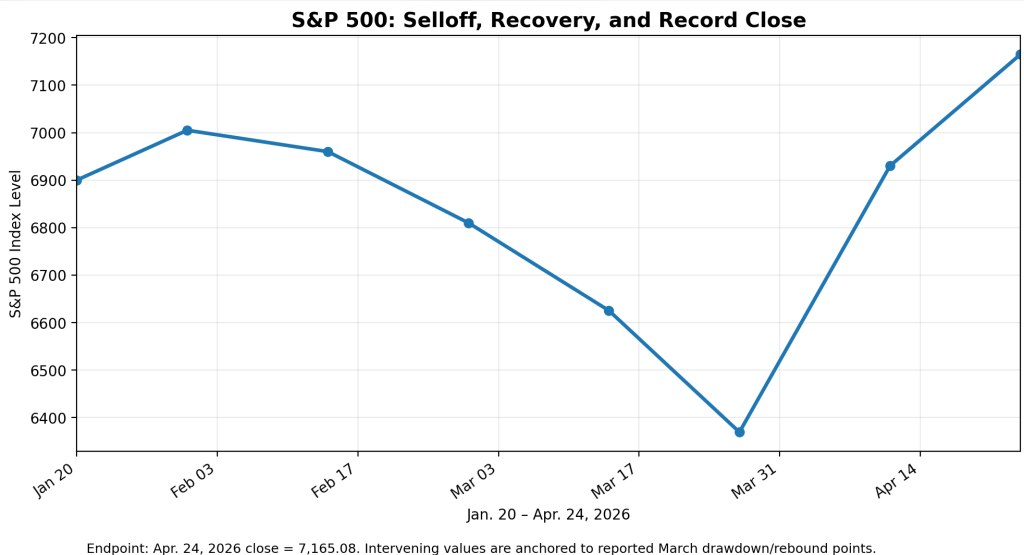
A year ago, markets staged a familiar drama. The S&P 500 fell nearly 20% on fears that sweeping tariffs would trigger a global recession—only to reverse sharply and reach new highs once those fears proved overstated. Today, the rhyme is unmistakable. Today, the same instinct governs investor behavior. The catalyst has changed—from tariffs to war—but the psychology remains constant. Markets sold off on the possibility of an Iranian escalation that might propel oil toward $150+ and drag the global economy into contraction. Yet now, with the faintest outline of a ceasefire and whispers of diplomacy, equities have resumed their ascent to new record highs. The market, once again, is not waiting for resolution—it is anticipating it.
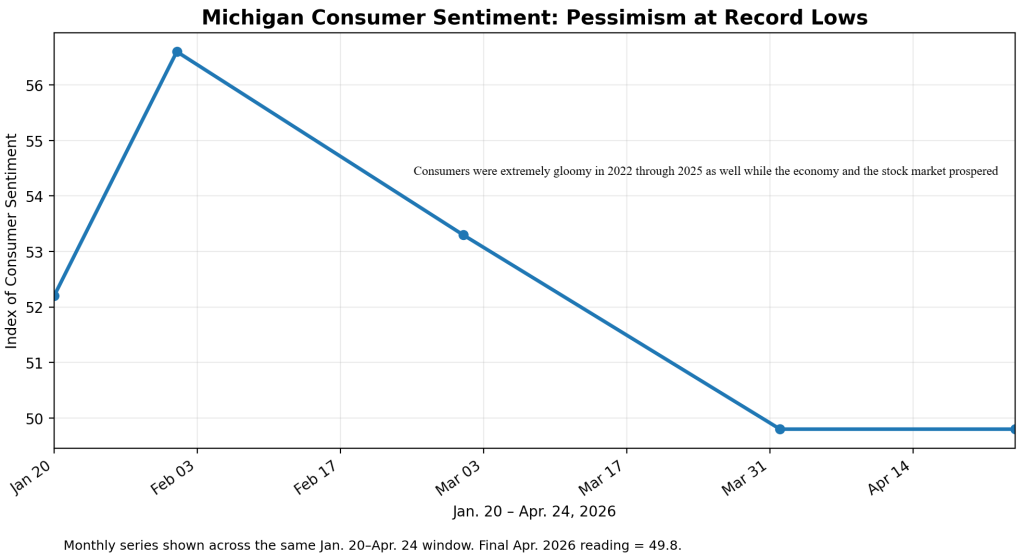
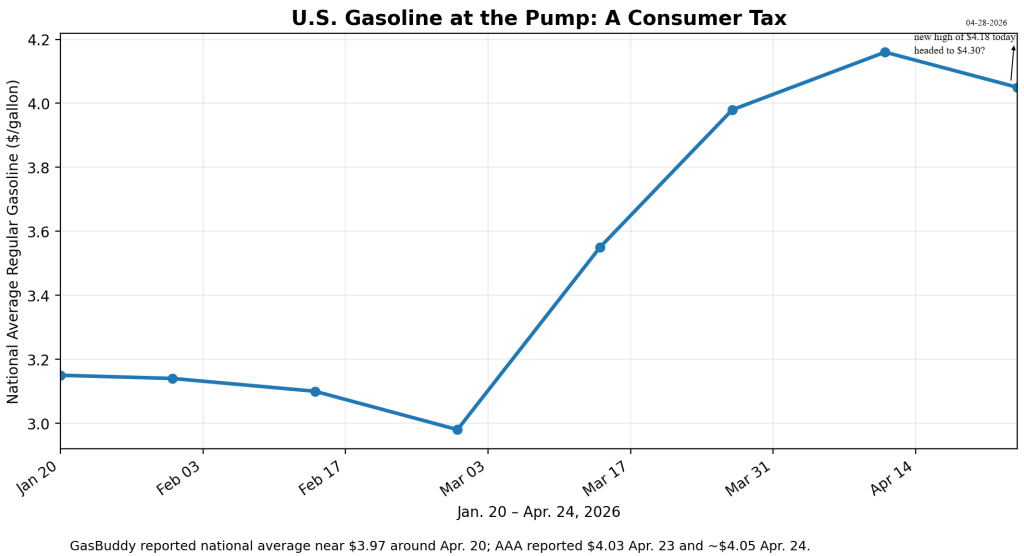
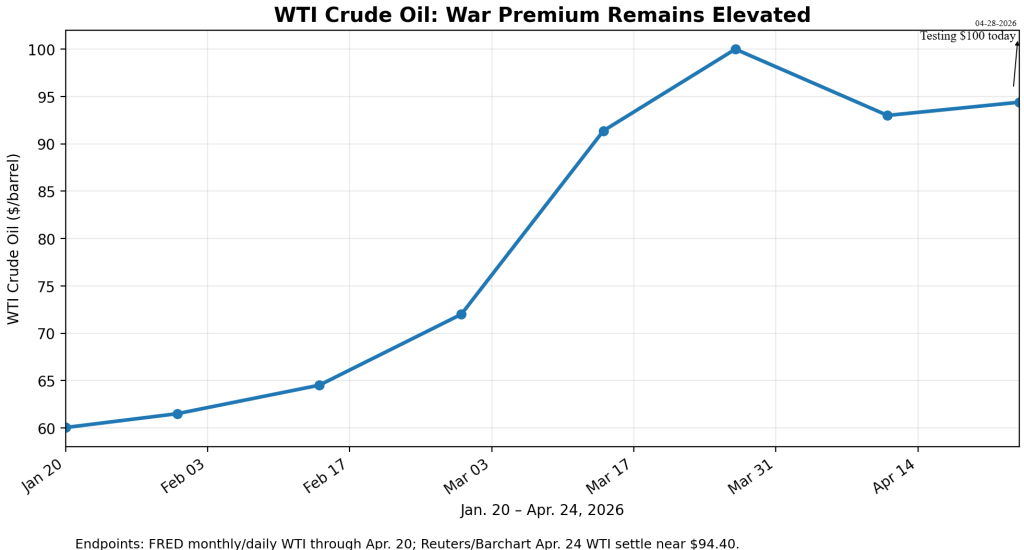
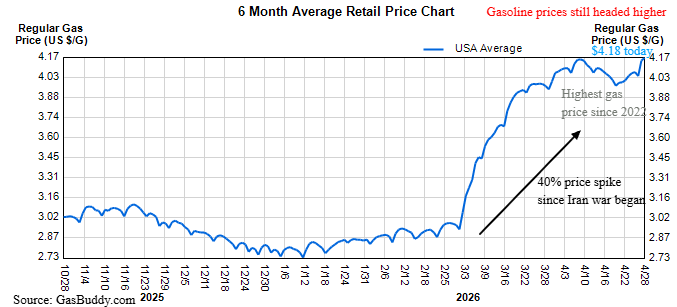
As of April 28, 2026, the market has fully recovered—and then some—while the underlying economic risk has not. Oil remains elevated ($100 in the US and $111 globally), average gasoline prices remain above $4 per gallon, and consumer sentiment has fallen to a record low of 49.8. Yet equities, after a calm 10% March decline, have surged to new highs only a few weeks later. The market is not ignoring the shock—it is simply assuming its expiration. The Strait of Hormuz remains less a passage than a pressure point. More than 200 oil and gas tankers sit constrained by conflict, their cargoes delayed by geopolitics rather than logistics. Energy, like water, seeks the path of least resistance. The result is not merely higher prices, but a reshuffling of global energy flows—one that has sent buyers rushing toward American supply even as gasoline prices at home climb nearly 40%, quietly taxing the very consumer that markets continue to trust. Empty Oil tankers heading to the US have nearly tripled today compared to normal pre-Iran war traffic. With over 8% of Global energy sequestered in the Middle East, the US has become THE primary supplier to satisfy a small portion of the excess demand. Asia will feel the most negative impact, followed by Europe and then California (where governance often lacks wisdom).
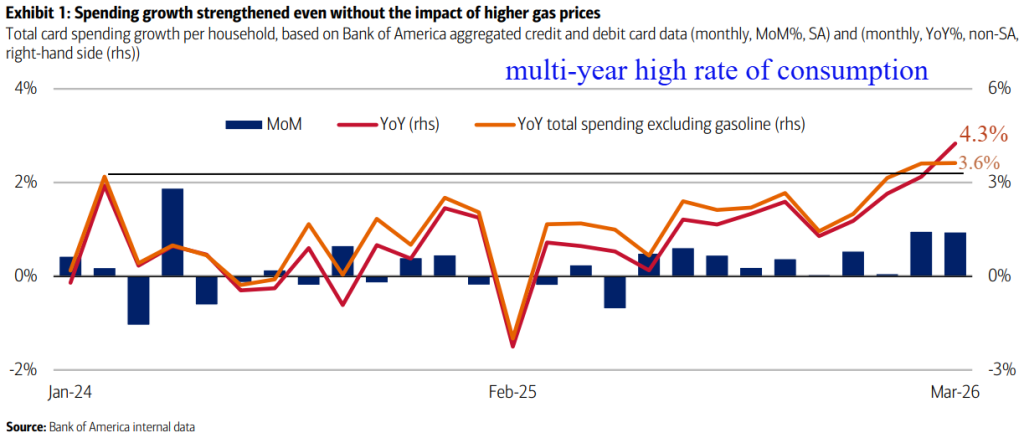
Yet despite economic gloom, strong consumer spending persists. The American consumer, long declared exhausted, continues to transact with surprising resilience. For now, employment, wage growth, and accumulated wealth continue to fund behavior that sentiment alone would not predict.
Oil trades on immediacy—supply, disruption, fear.
Equities trade on anticipation—earnings, resolution, belief, …and belief is winning. Markets are choosing to trust what people do rather than what they say.
The Unsettled Chessboard
The geopolitical backdrop remains unsettled in ways markets appear willing to temporarily ignore. American military assets continue their steady migration into the region—a buildup that suggests contingency, not conclusion. Iranian leadership, diffuse and opaque, offers uncompromising rhetoric that leans less toward reconciliation than toward endurance. No doubt Russia has been providing strategy as well as military intelligence. It is not unreasonable to assume that escalation remains not merely possible, but probable. The recent strategy to block all shipping commerce in and out of Iran appears to be haviung a significant negative impact on Iran’s sea-fueled economy. Iran is being starved of goods and the 90% of its oil revenue that normally flows through the Strait of Hormuz – mostly headed for China. As long as any renewed attacks are not long lasting, the stock market potential for corrections is limited and the economic pressure grows for Iran to open its shipping lanes and make a deal for its nuclear material.
The Strait of Hormuz is the geographic fulcrum upon which this entire narrative rests. Its reopening would validate the market’s optimism. Its continued closure would challenge it with equal force.
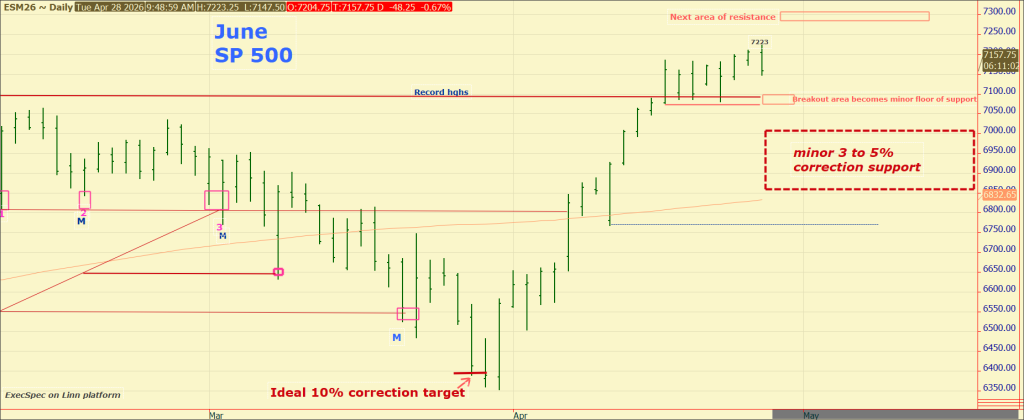
The stock market is an anticipation machine. In March investors correctly expected the war to escalate, which triggered a 10% market correction. As Trump’s telegraphed window of early to mid-April for halting attacks approached, buyers flooded back in. Markets have been betting on resolution in April or May, although history suggests resolution rarely arrives on schedule.
Beneath the surface optimism lies a far more strained global energy picture.
- Over 200 oil and LNG tankers remain effectively stranded or constrained in and around the Persian Gulf
- Global consumers (ex-U.S.) are short a meaningful share of daily energy flows that may require many months to restore
- In response, global buyers are rushing toward U.S. supply, driving exports to elevated levels—it is rerouting under duress.
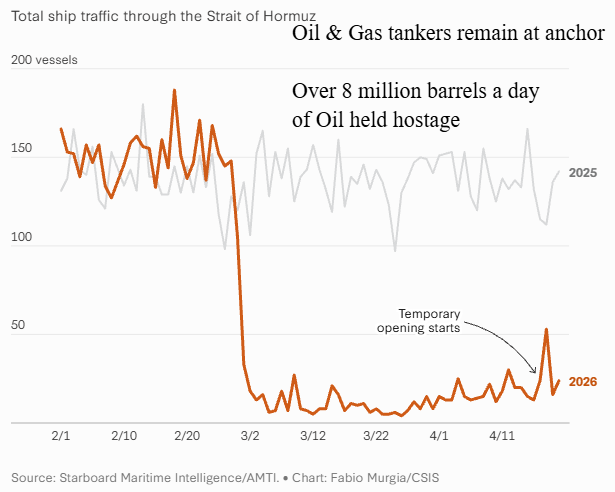
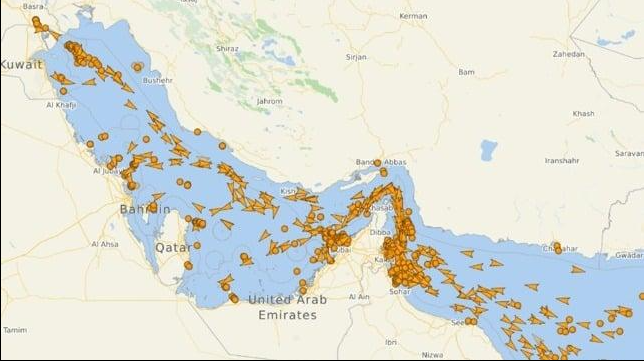
Meanwhile, U.S. drivers are already feeling the strain. Gasoline prices have surged nearly 40%, functioning as a quiet but persistent tax on consumption. The global consumer absorbs the shock more acutely; the U.S., buffered by domestic energy abundance, experiences it more gradually. And yet, markets rise here and abroad. Oil volatility has surged, yet equities have remained remarkably composed—discounting disruption as temporary rather than structural.
The United States enjoys a degree of energy independence that much of the world does not. Natural gas remains abundant, oil production robust – reaching record levels above 13.6 million barrels a day (14 mbd expected in 2027). The domestic economy, while not untouched by global strain, is less exposed than its peers. Consumer spending rates have broken out to multi-year highs today despite the energy fears. Corporate earnings reflect this. Margins endure. Credit risk remains contained.
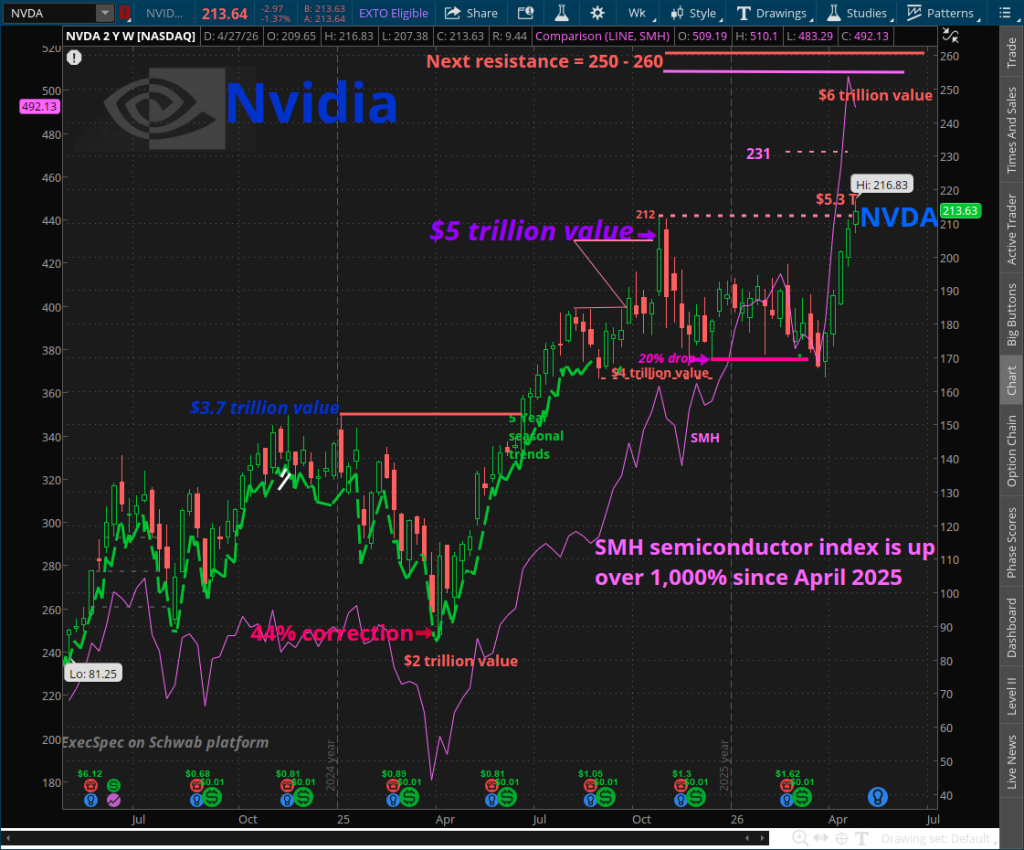
The forward view—so essential to equity valuation—remains intact. More importantly, a powerful secular force continues to exert upward pressure: the capital expenditure cycle surrounding artificial intelligence. This is not a marginal story. It is a reordering of investment priorities across industries—semiconductors, memory, power systems, data infrastructure. It is, in effect, a new industrial layer being poured atop the old. Thus, even amid uncertainty, the market finds justification for ascent. Today’s $64 trillion S&P 500 Index valuation is likely to test $68T later this year and Nvidia’s world beating $5.2 trillion valuation today (up from $2.1 trillion a year ago) is undervalued at a 27 forward price/earnings multiple despite revenue growth of 85%. The conservative target in the 240 – 260 range would value Nvidia at a $6 trillion market cap later this year.
Technically, S&P 500 Index near term support rests in the 6,800–7,000 range—for pricing in brief conflict escalation, with more dire outcomes should the Iran war restart and extend far longer. Above the current 7130 level, the 7,250–7,350 range beckons as a plausible short term extension should the present status quo narrative hold in the Strait of Hormuz, while the 7700 area is the popular valuation swing target many share for an upside objective later this year.
Markets are not ignoring risk. They are deferring it.
They are choosing to believe that:
- the war, though unresolved, will not meaningfully worsen
- energy flows will normalize before damage compounds to harm earnings and GDP
- inflation will ease once oil stabilizes and trend lower
- interest rates will eventually follow – especially with a new Trump Fed Chair
And, perhaps most importantly, that the immense wave of AI-driven investment will continue to lift earnings—and with them, valuations.
S&P 500 Outlook & Leadership
The forward path for equities remains anchored in scarcity and scale. The next leg of the bull market is likely to continue rewarding sectors where demand is both structural and supply is constrained—data centers, advanced memory, and AI chip manufacturing chief among them. Companies such as Taiwan Semiconductor, NVIDIA, Micron, Lam, Seagate, GE Vernova, and Vertiv … sit squarely at that intersection. And now the Intel dinosaur has been revived, doubling over the past 4 weeks. NVIDIA, has added roughly 40% in just four weeks—slicing through the $5 trillion threshold with the ease of momentum unopposed. The entire SMH semiconductor index of 25 companies have rallied almost 40% since the start of April with a record run of 19 days in a row closing at new highs. Such velocity invites suspicion, but history counsels otherwise. Periods of extreme overbought conditions, rather than signaling imminent collapse, more often reflect persistent institutional demand. Three months after the technology sector has a breadth thrust matching the current move equates to further rallies to new highs over the next 3 months almost 80% of the time, according to SentimentTrader.com. Markets rarely peak in quiet equilibrium; they tend to crest only after excess has had time to compound. In that sense, today’s strength is less a warning than a confirmation: this remains a market where the bias favors buying dips rather than selling rallies with unknown expiration dates.
At the same time, a subset of technology companies has been indiscriminately discounted—casualties of a broad “software apocalypse” narrative that has yet to fully materialize. Within that group, CrowdStrike and Palo Alto Networks represent mispriced resilience rather than structural decline. They are rebounding from undervalued levels this month along with the AI vulnerable software index.
At the index level, leadership should remain concentrated in areas levered to industrial expansion and energy demand. The overbought Semiconductor ETF (SMH), Industrial Fund (XLI) and Technology Fund (XLK and MAGS) are positioned to continue leading after pullbacks, while more rate-sensitive and defensive sectors such as Health Care (XLV), Staples (XLP), Bonds (TLT) and Financials (XLF) may lag.
Further down the valuation spectrum, the railroad and trucking sectors presents a quieter opportunity. Orders for large Class 8 trucks are up 130%. Their appeal lies not in immediacy, but in inevitability. Tight supply chains from deglobalization and California’s declining in-state energy production—paired with its unwise dependence on imported supply—sets the stage for a logistical reshuffling that will increasingly rely on rail and trucking networks. As shortages begin to emerge in the months ahead, transport capacity may become as valuable as the commodity itself.
Markets have once again demonstrated their preference for anticipated outcomes over present conditions. They are not blind to the pressures of higher energy costs or weakening consumer sentiment; they are simply wagering that these are temporary inconveniences rather than structural impediments. While the guns are silent and company earnings are stellar, investors can make Bullish bets. Whether that wager proves prescient—or premature—will depend on events still unfolding in distant waters.
In the current cycle, necessity continues to favor scale, infrastructure, and the quiet power of constrained supply meeting relentless demand. That wager worked during last years tariff terror. It is working again. Until, of course, it doesn’t.