
The current market fervor surrounding OpenAI is merely the latest, most extravagant chapter in this enduring narrative that may have begun with a Swiftian satire on human ambition. In the early 1700’s Swift wrote “Gulliver’s Travels” that talked about an algorithmic Engine to generate text, much as AI performs today. The concept of a “thinking machine” began not with silicon, but with the speculation of Alan Turing, in his 1950 paper, “Computing Machinery and Intelligence”, asking the fundamental question: Can machines think? He proposed the Imitation Game—a (Turing) test of a machine’s ability to mimic a human, that remains the philosophical bedrock of the field today. Despite the promising next step with neural networks outlined by Minsky and Edmunds in 1956, like the naive optimism of the Lilliputians in Swift’s novel, the reality of compute power and the limitations of early algorithms—the so-called “AI Winter” soon set in. The dream of intelligence was there, but the engine to power it was absent. The utopian vision of a truly general intelligence went into a modified state of exile until the launch of ChatGPT in November 2022.
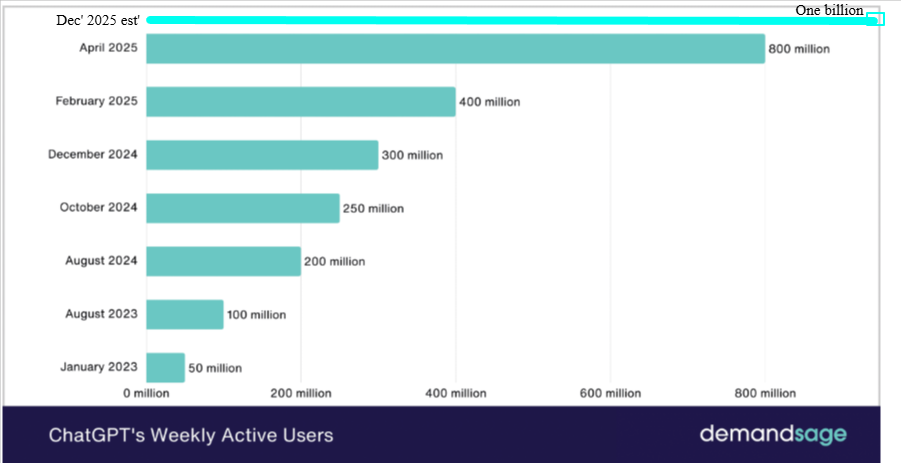
The arrival of OpenAI’s ChatGPT and the underlying Large Language Model architecture was the watershed moment that could be immediately experienced by the public. The result was not a slow adoption curve, but a tsunami of capital and expectation, expected to reach one billion monthly active OpenAI users this month. The annualized revenue rate coinciding with this milestone is $20 billion. OpenAI, in its bid for market dominance, has committed to a truly staggering investment: $1.4 trillion over the next eight years, primarily for data center and compute infrastructure. This commitment is the cornerstone of the Great Leveraging in the AI sector that has already sent a shiver down the spine of Oracle and Coreweave investors skeptical of the ability to service their debt backed boom in backlogs. This chimerical level of debt financing and infrastructure commitment must be justified by an equally imaginative return. The investors sustaining this monumental wager are driven by the belief that AI is not a cyclical boom but a structural, tectonic shift—one that justifies the highest rates of return on capital. Single digit returns on capital will not suffice.
The modern stock market, a barometer of American optimism, is presently possessed by a rhetorical fever concerning Artificial Intelligence. At the epicenter is OpenAI, with its breathtaking projections and yet more breathtaking spending commitments, requiring hyperbolic confidence affecting the collective valuation of the entire AI ecosystem. We chose a couple hyperscaler benchmark companies for comparative valuations to what OpenAI must aspire to. Using a price to sales metric for future profit expectations, Google is 10x while Nvidia is 25x. In other words, using OpenAI’s current $1.4 trillion valuation would require $140 billion in annual revenue using Alphabet’s multiple and $56 billion with Nvidia’s multiple. OpenAI should end 2025 with an impressive $13 billion in revenue and a $20 billion annualized rate this month. A sales projection to $56 or $140 billion requires more than just better models; it requires that AI becomes the essential, daily substrate of all global commerce, with OpenAI at the top of the heap. While OpenAI’s Sam Altman has achieved much, coming from a small midwest high school, his Executive management experience is relatively light and untested in running a company with machinations of a market cap rivaling Nvidia someday to justify the trillions in risk capital he is seeking.
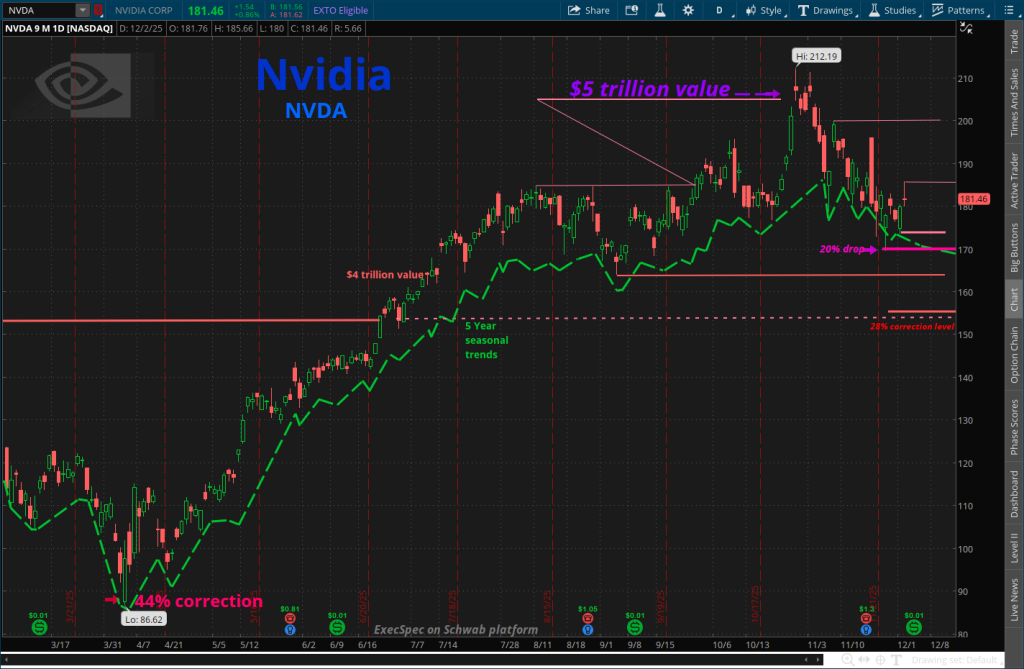
OpenAI is not simply participating in the AI economy; it is, through its partnerships with Microsoft, Oracle, Nvidia, Coreweave and others, dictating the tempo and scale of the entire AI supply chain. The Systemic Risk: The Magnificent Seven—that concentrated cohort which has carried the bulk of the market’s gains for several years—have woven their fortunes tightly to the premise of a perpetually scaling AI model. Should OpenAI fail to deliver the lofty revenue necessary to service the debt and justify the chip expenditure, the financial reverberations will not be confined to a single, privately-held ledger. Nvidia’s high-flying multiple and $4 to $5 trillion market cap is predicated on the constant, ravenous demand for GPUs from entities like OpenAI. A slowdown in this demand would crater the multiples of every hardware supplier.
To achieve the necessary $56 billion to $140 billion in annual revenue, OpenAI must execute perfectly within these high-value vertical markets. This requires selling complex, highly customized Agent-as-a-Service (AaaS) solutions, where the AI is not just a chatbot, but an autonomous worker embedded deep within a corporation’s operations.
The enterprise deals provide the necessary early, large-scale revenues, but long-term security and ecosystem lock-in require a Direct-to-Consumer presence that rivals Google’s ubiquity. Google’s power lies not just in its search algorithm, but in its omnipresence: Android, Gemini, Gmail, Chrome, Maps, Meets, file Drive, Play Store and YouTube. These products form a seamless, data-rich loop that locks users into its gravitational field.
OpenAI, lacking this proprietary ecosystem, must build a conversational operating system from scratch:
-
Elevate ChatGPT from a mere Q&A engine to the primary interface for digital life – integrating booking, purchasing and managing data directly into the chat.
-
Unlike Google’s ad-driven model, OpenAI’s direct-to-consumer revenue must come from premium subscriptions and transactional commissions or task oriented royalties.
-
Cultivate a GPT ecosystem into a thriving app store, incentivizing developers to build GPTs that address niche consumer needs – replicating the networks that Google and Apple command.
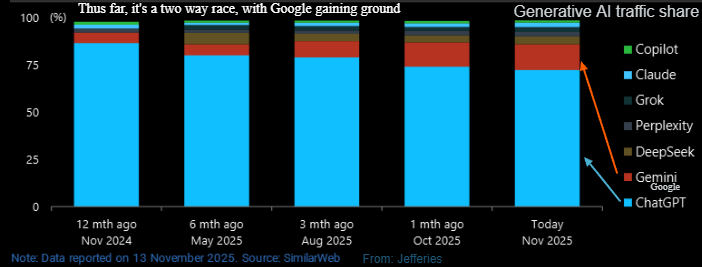
OpenAI is currently a server platform, an API provider that is disintermediable and replaceable. GPT models are competitive and likely to remain so, but the battle is not just over the better model, but over the default human-computer interface for the next generation. The $1.4 trillion commitment – which is likely to grow – is the anchor that makes OpenAI a systemic market and economic risk, but the risk is one of temporal exposure rather than imminent insolvency. The AI buildout is moving past the early innings while monetization is in its nascent stage. The market’s high multiples reflect a justifiable faith in the Structural Demand for AI—a force that will continue to generate massive wealth as it transforms Manufacturing, Finance, and Healthcare. If the execution remains impeccable and breakthroughs continue, the underlying market can continue its ascent for the next 5 to 10 years. The demand curve for true, scalable AI application still has a long way to go before innovation slows. OpenAI has a first mover advantage with an excellent consumer base, much as Facebook achieved 20 years ago. However, while OpenAI must rapidly develop new product offerings, its core product remains vulnerable to a plethora of well-healed competitors that are chipping away at its TAM (total addressable market) with comparable Large Language Models. For conversation, image creation and coding, ChatGPT is still viewed as the best. Yet, Gemini excels in reasoning and integration with the Google Work Station. Claude (Anthropic) is best for human-like prose. Microsoft Copilot is great for enterprise productivity and its robust integrated ecosystem of products. Sam Altman declared a Code Red at OpenAI this week after it was reported Google’s Gemini 3 had outperformed ChatGPT on several benchmarks. With its singular product financing a rapid expansion, Sam knows he must focus his resources on securing the top spot in the rankings to maintain its best in breed label and stay on an aggressive growth trajectory and grow its partnerships that provide critical financing and technology.
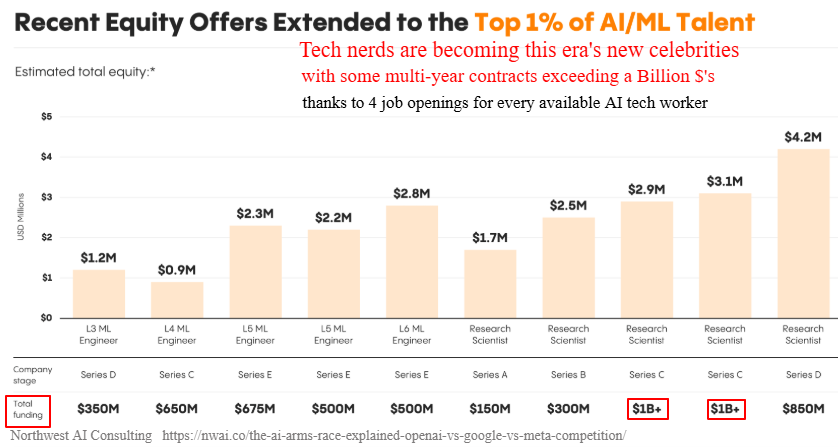
AI execution risk and financing will periodically lead to euphoric peaks and mini-panics this decade, but if anyone doubts the fact that demand far outstrips supply, as we often highlight, look no further than wage wars competing for scarce talent. We often cite the massive skills shortage in numerous fields in this country, but AI tech nerds have become the new rock stars. There are almost 500,000 AI tech job openings today and the cream of the crop engineers and scientists command multi-million dollar salaries with some pay packages exceeding a Billion. With only a quarter of college graduates working in fields related to their degree/major, computer engineers and scientists need to triple their graduation rates – after a double last decade – to close the skills gap. Scarcity of worker talent breeds not only wage inflation, but poaching. OpenAI will increasingly have to pay up to retain and grow top talent as its better funded and far more experienced competitors will do whatever it takes to seek the crown.
While OpenAI is one of the larger endogenous risks for the rest of this decade, true risk of a major bubble bursting is not immediate. Over inflating the baloon is set u for the medium-to-long term, arriving only when the supply side—the multi-trillion dollar commitments in data centers and energy—reaches a point of oversupply and a revolt from financeirs, and the demand for new AI capabilities begins to saturate. It is at this moment of maturity and saturation that the high P/S multiples of the ecosystem will be forced to converge toward the more sober, single-digit ratios of established platforms. For now, companies most closely associated with OpenAI contracts and its daunting financial hurdles are being held back: such as CRWV, ORCL, AMD and NVDA. Those less dependent are fairing better, such as: GOOGL and AAPL. (Our investing focus however continues to shift from large cap to small cap through year end)
While OpenAI contains the risk of failing to monetize its unprecedented investment, the global demand for AI utility is a force that will generate massive rebounds from the inevitable mini-panics that arise on the way to demand curve maturity. Rapid appreciation in related equities will inevitably trigger 25 to 50% setbacks in specific sectors and 15 to 25% corrections in the benchmark indices. However, these panics should transpire in weeks and months compared to the typical Bear markets lasting quarters or years. The market’s conviction that AI will fundamentally revolutionize productivity is too strong to allow any single corporate failure, no matter how grand, to permanently deflate the entire AI-led stock market. Currently, OpenAI is the World Series pitching ace navigating with the bases loaded. The other players on the field and in the bullpen may be vulnerable, but should continue to be winners in this extended World Series of AI. But don’t forget about all the forgotten teams that didn’t make this years playoff, as they are making an off-season move that should outpace these hyperscalers this quarter and next (RSP & SPSM).