
The tulip mania of 17th-century Holland and the US railroad enthusiasms of the 1870’s pale beside the scale and velocity of capital now flooding into artificial intelligence infrastructure. The prevailing anxiety among market observers is not whether this technological upheaval holds genuine promise, but whether the fervor has raced ahead of the practical ability to yield returns matching valuations premised on distant, speculative profits.
Consider the mathematics of such ambition: OpenAI, whose conversational chatbots became available 3 years ago, have now engaged a tenth of the world’s population, and they are seeking investments surpassing $1 trillion over the next decade—a sum signaling not merely growth but a radical remaking of global computational power. Hundreds of data centers are under construction or in planning across the United States, poised to demand upward of 100 gigawatts of electricity by 2030, equivalent to roughly 8 percent of current national generating capacity. Meanwhile, Nvidia, purveyor of silicon wonders, begs Taiwan Semiconductor Manufacturing Company to hasten production of more processors, graphics units, and the much-heralded Blackwell chips to meet what executives term “insatiable” demand. Echoing this, AMD’s chief executive, Lisa Su, recently invoked the same adjective in projecting overall revenue growth exceeding 35% annually for the next three to five years. She expects their chip sales to grow at an 80% annual rate. AMD’s market capitalization, hovering near $100 billion a year ago, now approaches $420 billion, en route perhaps to the trillion-dollar echelon within a few years.
Such insatiable appetite is an enviable quandary—the economic equivalent to Midas’s boon. Yet for investors familiar with the rhythms of market cycles, this concentration evokes recollections of past booms where concentrated optimism collided with the stubborn facts of execution. The “Magnificent Seven” tech titans, together with their suppliers, have charted growth defying the usual drag of scale. Their prowess, purportedly the engine of future global prosperity, rests with a few firms whose destinies are bound to valuations demanding unerring performance. Such a stellar ascent sprouts fears of a fall where sentiment has become more negative with each new record peak in the stock of our technology leaders. After the recent 6% pullback in the mega tech oriented Nasdaq, investors seem to be adopting the ABC perspective to investing – Anything But Chips.
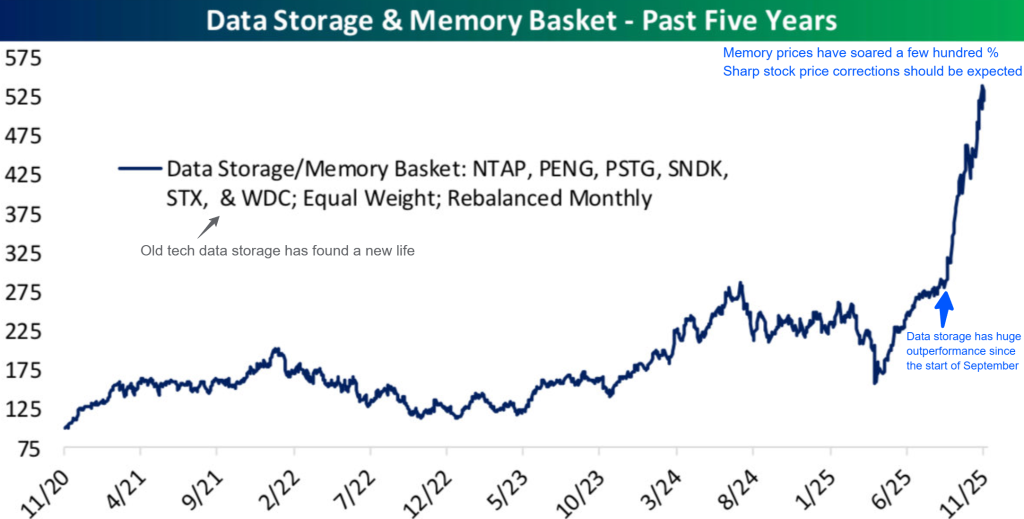
A substantial portion of mega techs burgeoning order book hinges on OpenAI’s expansion plans. Firms like Oracle, CoreWeave, Nvidia, and Advanced Micro Devices are increasingly reliant on prospects lashed to OpenAI’s capacity to navigate intricate timelines. The envisioned partnership of these giants involved in the Stargate supercomputer data center cluster might span an area comparable to Manhattan’s Central Park. Projections for $7 trillion in global AI infrastructure spending over the coming years could sustain these colossi on robust trajectories, provided that each operational hiccup does not precipitate scary market adjustments.
The supply chain unfolds as a cascade of interdependencies that would fascinate the architects of just-in-time manufacturing. Will the 10 gigawatts needed for Stargate’s power grid emerge on cue? Can construction keep pace for CoreWeave’s interior build-outs? Will Taiwan Semiconductor scale up to fulfill pledges where Apple and Nvidia alone may claim 40 to 50 percent of its advanced-node output by 2026?
This last metric merits reflection. When two clients command such a share of a fabricator’s capacity, the symbiotic relationship transcends into vulnerability—what risk assessors dub a “single point of failure.” Taiwan Semiconductor stands not as a mere chokepoint but as the vital road through which the AI rush hour must navigate. Its Arizona fabs are slated to produce 2-nanometer chips by 2028, yet meaningful volume may lag by years, imposing a supply-side brake on demand-driven expansion. Today’s stock prices embed assumptions of not just triumph but impeccable orchestration across realms: innovation, building schedules, logistics, permitting, and energy provisioning. Disrupt one pillar, and the architecture of anticipated revenues sways percipitously.
Compounding this fragility, November 2025 introduces a judicial wildcard: the Supreme Court’s impending decision in a case challenging the scope of presidential authority over tariffs, stemming from disputes over executive trade powers under statutes like Section 232 of the Trade Expansion Act. A verdict curbing such authority could spawn policy flux, prompting capital flight and corrections exceeding 10 percent. A court affirmation of broad Executive powers might invite a precedent for disruptive tariffs. In this context, continuity of the current trade policy might prove preferable, though the Court may well delineate limits on what qualifies as an existential trade threat warranting emergency measures.
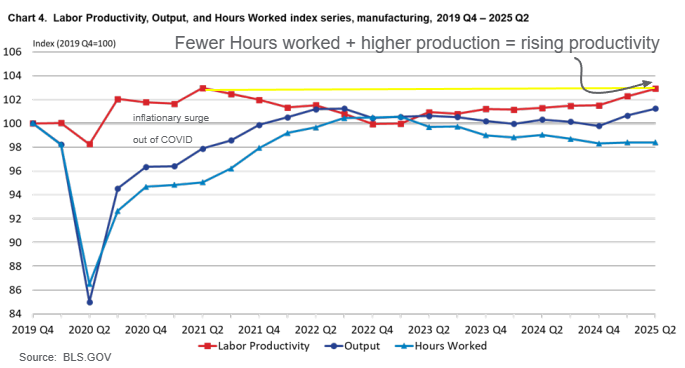
As AI’s wave crested in 2025, U.S. economic output swelled through a labor market strained by skilled-worker shortages, yielding productivity gains amid declining hours worked. This confluence of automation and talent scarcity has fueled earnings surprises, with 82 percent of reporting firms besting estimates this quarter—far above the five-year norm. Against this sanguine tableau, fiscal stimulus, monetary easing, and private capital outlays are set to accelerate over the next several years, auguring well for sustained expansion. The recent relative strength in healthcare and financials over technology supports the case that investors are beginning to anticipate the broader multi-faceted stimulus wave that is expected to rejuvinate the Bull market in 2026.
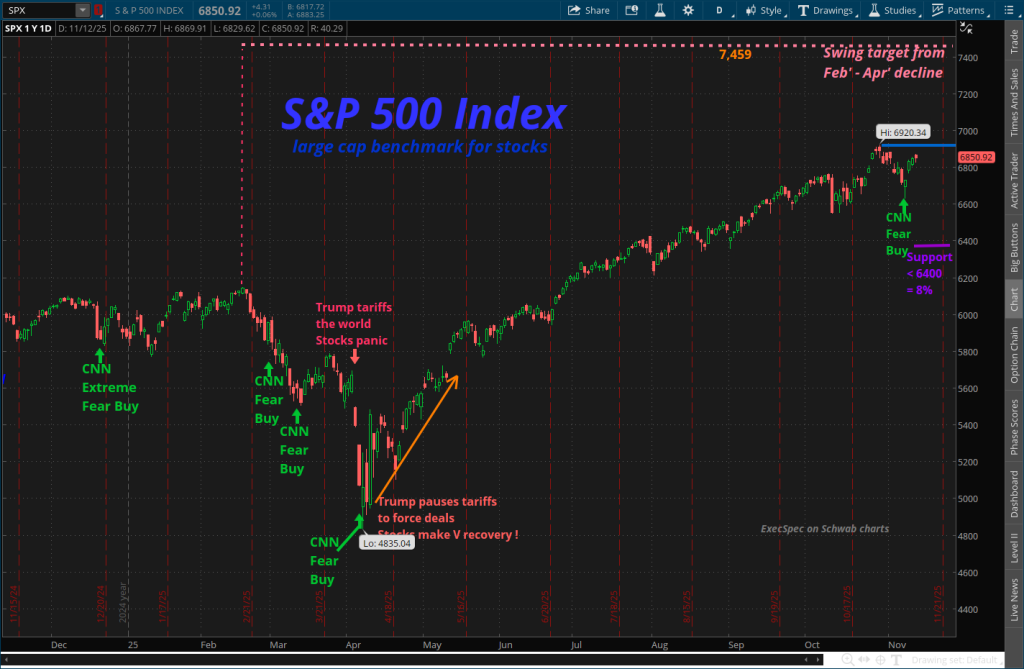
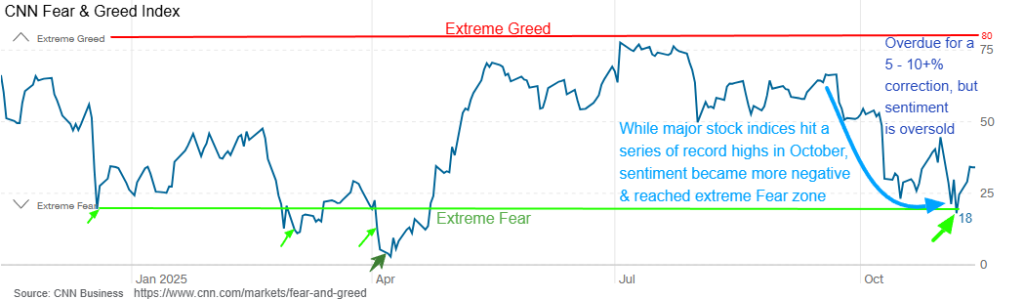
Yet, while major indices notch record highs on blockbuster profits, investor sentiment frays. The tech-laden Nasdaq has climbed 58 percent, and the S&P 500 43 percent, since the post-Liberation day lows of early April 2025. A fresh concern looms: hyperscalers among the Magnificent Seven are leveraging debt atypically to fund AI buildouts, heightening balance-sheet risks. Absent a substantive pullback in seven months, this debt-fueled sprint invites caution, even as prices ascend. Recent dips—4 percent in the S&P and 6 percent in the Nasdaq—scarcely register as corrections in a bull regime, but latent perils persist. Holders of AI victors might retain positions while reserving cash for opportunistic buys or judicial triggers this month. Skeptical investors are less willing to buy the rips to the upside as exemplified by the increased negative sentiment with each new record rise in the stock market. The elevated reading on the CNN Fear Index we view more as a sign of complacency near a market peak rather than an opportunity to continue adding equities to the portfolio.
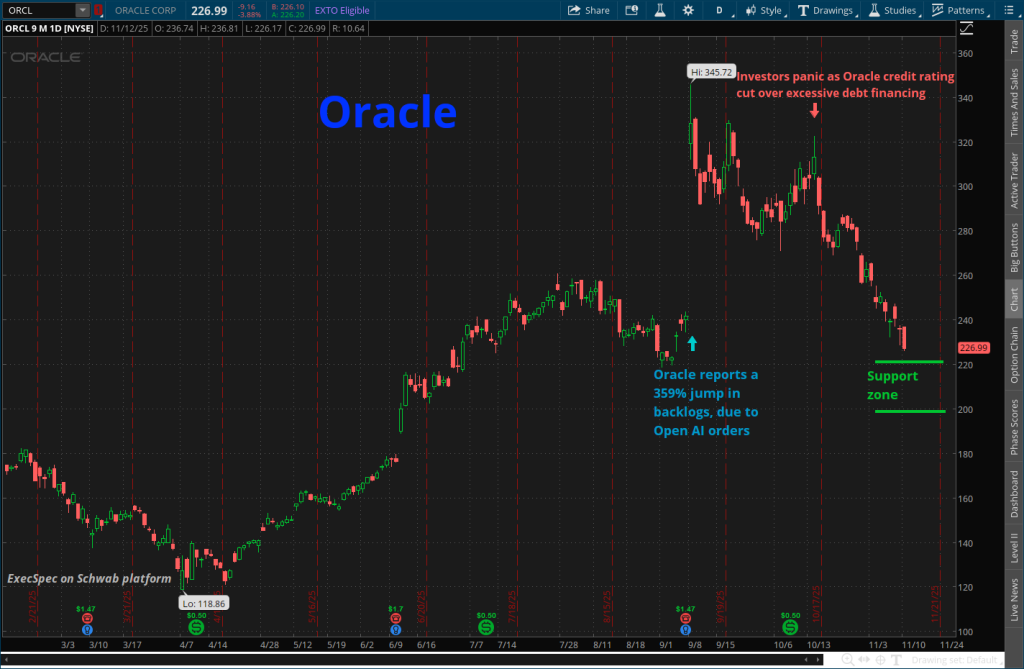
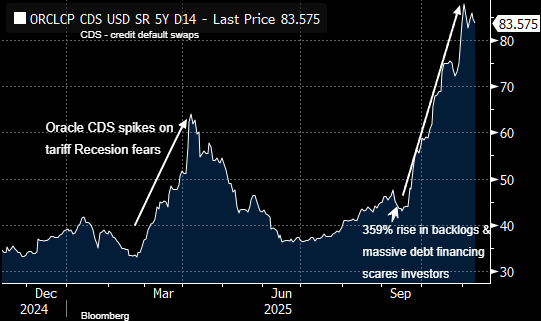
Oracle epitomizes this unease. On September 9, 2025, it disclosed a 359% increase in backlogs to a – gulp – $455 billion. However, scrutiny reveals a heavy reliance on OpenAI contracts, financed via $75 billion in fresh debt, potentially ballooning total obligations from $100 billion to over $290 billion by 2028 amid rapid data-center ramps to deliver on their backlog. The stock has since relinquished that 44% one day gain and more since they announced the new order surge. Rating agencies have notched downgrades, citing doubts over earnings velocity versus debt service; credit default swaps, a barometer of peril, have spiked above 90 basis points. While this may verge on undue pessimism—inviting buys near $200—we counsel prudence for a leveraged entity where backlog conversion to cash flow remains the litmus test. Short-term, upside appears capped once the dead cat bounce arrives.
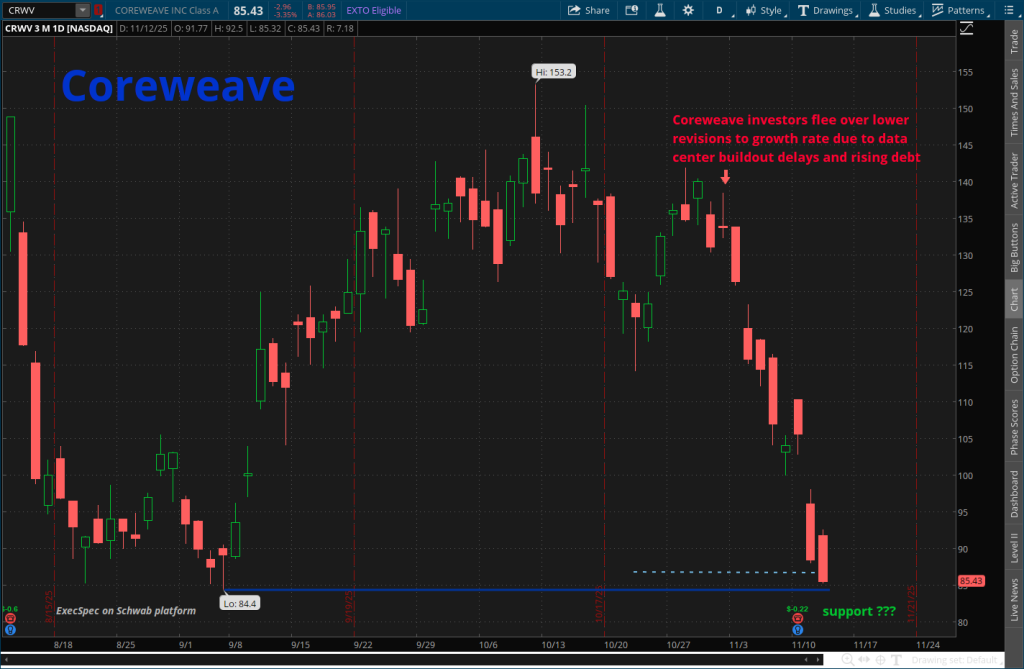
CoreWeave, the ascendant data-center darling tethered to Nvidia’s ascent and timing of data center buildout, commands software prowess unmatched in optimizing interiors. Yet, profitability eludes amid revenue leaps, with debt swelling to $55.6 billion and construction delays from partners like Core Scientific prompting estimate trims. These exemplars underscore a systemic hazard for the premium-priced tech vanguard driving U.S. growth: should chip supplies, power grids, or data-center rollouts falter below projections, revenues and earnings will follow, inviting downgrades and steeper borrowing costs. Such dynamics likely constitute the paramount threat to the economy and AI sector through 2027.
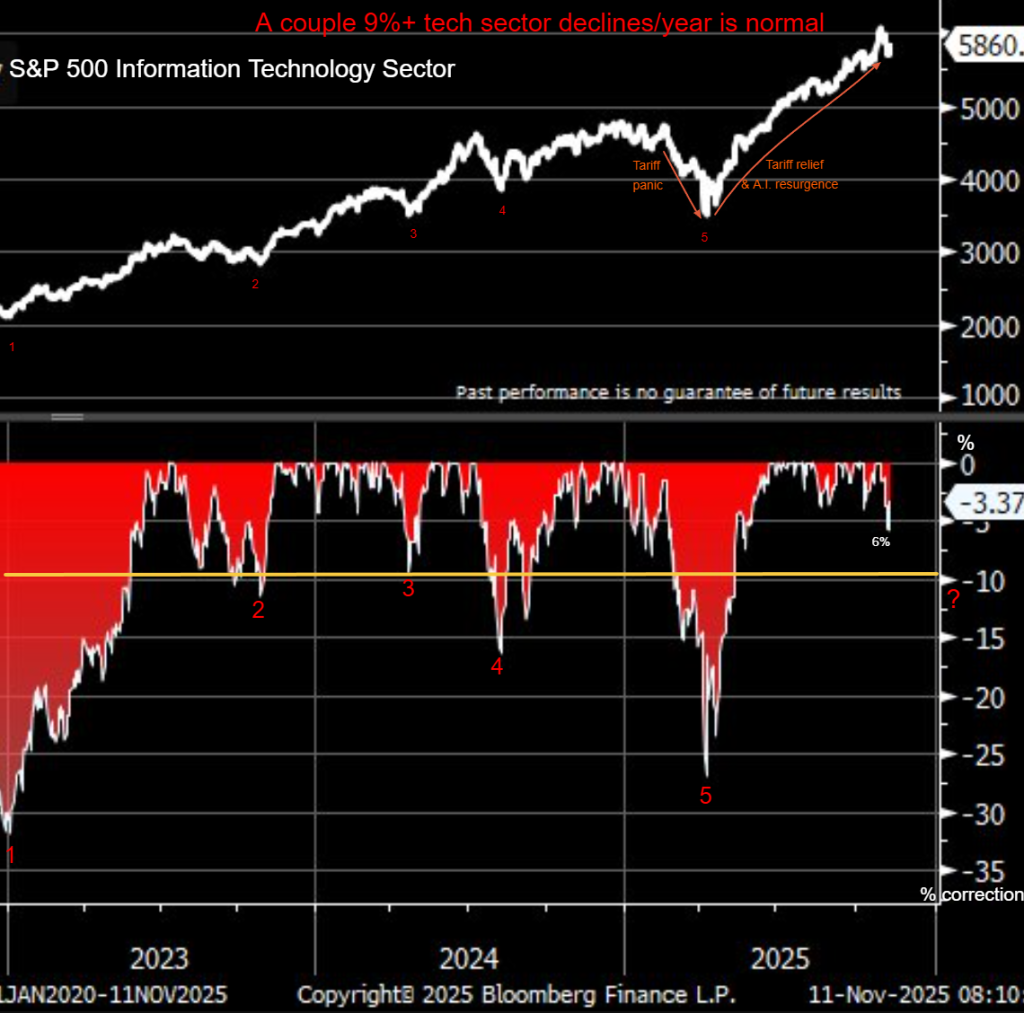
History instructs that such ascents invite “corrections”. Whether one materializes in this seasonally buoyant year-end period, spurred by Court rulings or recalibrated AI timelines, or proves averted, our outlook tilts optimistic for the sector, anticipating broader momentum as infrastructure investments mature in 2026. Bull markets routinely absorb 5 percent setbacks biannually or deeper 10-20 percent retreats annually; tech’s volatility amplifies this. Embrace the advance, but brace for turbulence—favoring earnings-funded stalwarts over debt-burdened aspirants, whose credibility with raters and investors hangs in the balance. The current weakness in some top performing AI stocks this year and others that are being punished despite earnings beats is another indication that our bias toward weakness in November could lead to an 8% or greater correction this month.
As we turn now to the technological vanguard of Artificial Intelligence stocks, the rhetoric of this era echoes that of the late 1990s: a belief that a new technology has rendered the laws of economics moot. Yet, a closer inspection reveals a crucial, sobering distinction. The current AI buildout is not a flimsy edifice built on speculative IPOs and vendor financing. It is primarily an infrastructure investment funded by the vast free cash flow and pristine balance sheets of the hyperscale tech titans—Microsoft, Google, and Amazon. They are not chasing “eyeballs” over profit; they are profitable entities reinvesting in tangible compute capacity to meet exponential, real-world demand. Oracle and Coreweave are cautionary tales that hopefully remain ring-fenced until they grow into their debt burdens.
The danger is not a sudden broad collapse born of universal insolvency, but a risk of mis-timing and mis-valuation. The current market premium is predicated on near-perfect execution and a sustained, unquenchable thirst for compute power. Should power constraints emerge, or should new, more efficient algorithms decrease the demand for current hardware – as China endeavous to manage with their 90% lower capital allocation to AI hardware – then the giants of the GPU market will suffer an inevitable correction. In essence, the bubble this time is less one of fraudulent accounting and more one of hyper-concentration and a collective belief in a perfect, uninterrupted future. Such bubble talk could be years down the road and limited by the secular race to become the global technology standard bearer. The core buildout and adoption will take another 5 to 10 years before this growth cycle enters the maturity phase. Corrections and mini-panics will occur – as with any growth cycle – which requires a focus on strong cash flows and a panic dip buyer mentality. This nexus of growth prospects concentrated in interlinked firms, dependent on a geopolitically exposed supply chain, amid regulatory flux and labyrinthine deadlines, evokes a risk calculus that might have daunted the more circumspect investors of yore. Were logistics seamless and outcomes assured, no premium for uncertainty would apply. At this juncture, investors should permit proven performers to compound while paring speculative holdings and amassing liquidity from underachievers. Investors are $8 trillion wealthier during the 2025 stock market boom, yet there is much more household asset appreciation ahead that will continue to exceed the growth of liabilities this decade. Despite the risk of an 8 percent or greater correction over the next couple of months, our outlook remains optimisitc, but the sensible investor must navigate a world where legal challenges threaten the stability of our trade agreements and where the new titans of technology command valuations that leave precious little room for the inevitable disappointments of reality.