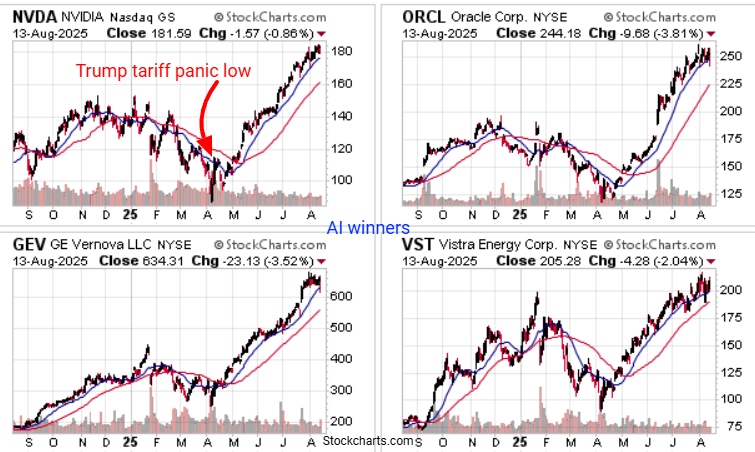
In the ceaseless churn of economic data, few documents elicit such anticipation as the monthly Consumer Price Index (CPI) release.. The July figures, unveiled in mid-August, have not disappointed in their capacity to stir the markets—though, with inflation below the feared levels of yesteryear’s inflationary spikes, investors applauded. Core inflation, that less volatile measure excluding food and energy, ticked upward year-over-year to 3.1 percent. A modest ascent, yet one that might have provoked indigestion among investors a few months ago when unwarranted tariff fear pervaded the stock exchange. Instead, it has been greeted with a collective sigh of relief, like a batter dodging a wayward pitch. The specter of recession, so keenly feared last spring, has receded, replaced by a burgeoning faith in America’s economic resilience – thank you Nvidia! Recently, investment banks and economists perceive the Federal Reserve’s anticipated rate cuts in September and beyond as all but assured, even though their predictive track records are atrocious.
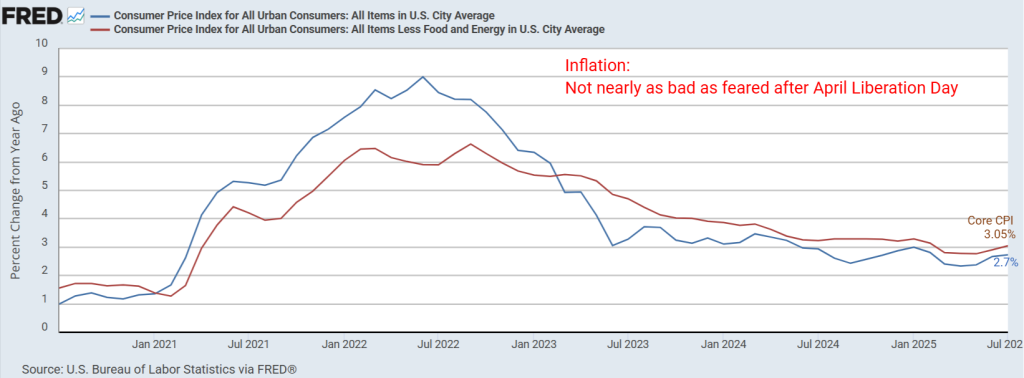
The bulk of July’s expected inflationary nudge in CPI surprisingly emanates not from the chatter of tariff-laden imports or manufacturing woes, but from the domain of services. Owners’ equivalent rent, that lagging proxy for housing costs which so often skews the index, contributed significantly to the rise, reflecting persistent pressures in shelter amid a housing market still recovering from pandemic-era distortions. Airfare, too, has ascended, propelled by resurgent travel demand. These non-tariff-related elements, lack the geopolitical sting of imported goods affected by Trump’s trade threats, allowing observers to parse the data with a measure of equanimity. Investors, attuned to these nuances, have pivoted from April trepidation to anticipation of persistent stock market records, pricing in tame inflation and monetary easing with a fervor that belies the modesty of the CPI’s advance.
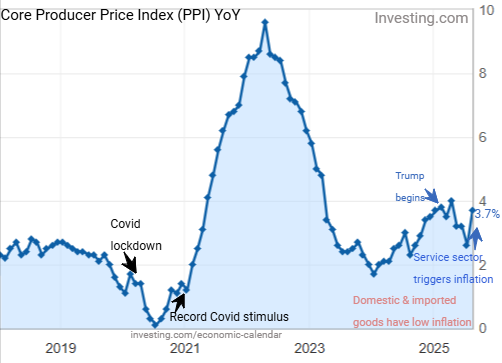
On the PPI front, the latest report on producer prices arrived today with a shock, registering the highest monthly advance in three years and an annualized rise of 3.7%. At first blush this is alarming and should dash the ardent hope that the Fed would finally start cutting rates at the September FOMC convocation. Yet the Fed’s lingering vigilance has been less about present inflation than about the phantom menace of tariff-driven price surges. Four months into the new tariff regime, that specter is proving more chimerical than reality: goods inflation is conspicuously absent from the data. Mirroring this weeks CPI report, the culprits in this upward price pressure reside chiefly in the service sector. Artificial intelligence has kept electricity prices and demand brisk. Money management fees have vaulted 5.4%—a statistic that will elicit few complaints from investors reveling in their swollen portfolios. The inflation in travel, leisure, and trucking industries hum along, testament to a consumer who remains both solvent and willing to pay for more vacations. None of this inflationary vigor stems from the much-heralded “tariff terror” that so many economists confidently, and now embarrassingly, predicted. Deep rate cuts would, at present, be premature. But with trade agreements reaching their conclusion in coming months, the Fed enjoys the latitude for a symbolic trim next month to satisfy market expectations. Neglect to do so, and the investor reception will be frosty. All of course still unflods in the shadow of a legal battle to reverse Trump tariffs that may surface in coming weeks.
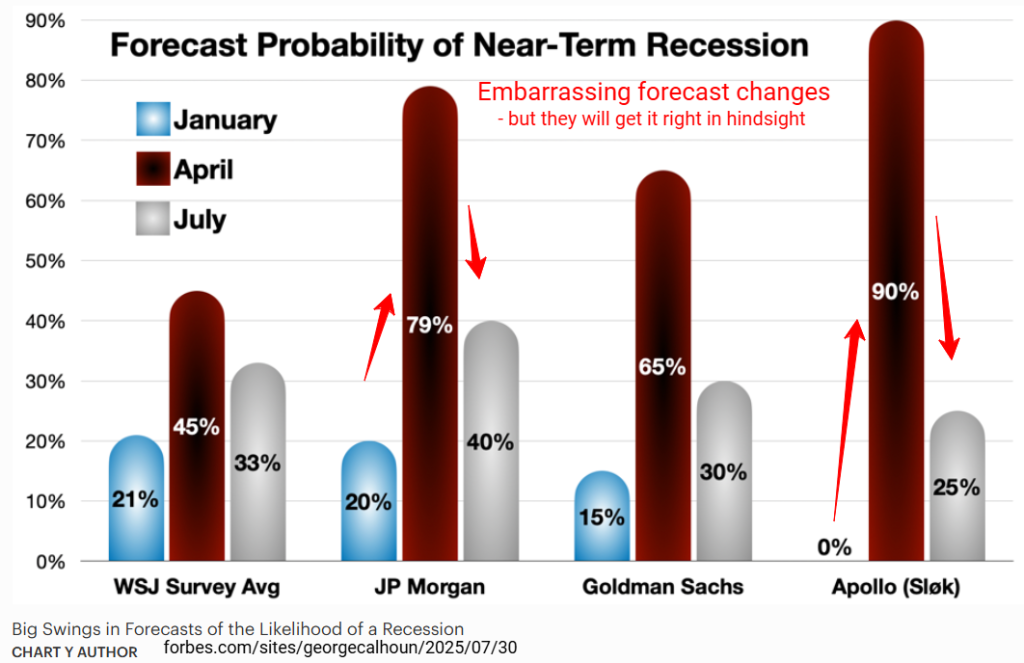
Yet, we must pause to consider the fallibility of those who purport to divine the economic future. Macroeconomic forecasting models, those workhorses of professional economics, are often heralded by the media as oracles of truth. Unfortunately, as a recent Forbes analysis trenchantly observed, “the forecasts they generate are extremely noisy, shockingly inaccurate, and seem to function less as predictions of the future than as belated confirmations of what we already know.” This indictment underscores a humbling reality: the economists’ crystal ball is often clouded, its predictions trailing events rather than presaging them. Last spring’s dour consensus of an impending recession, now largely abandoned, serves as a case in point—a reminder that markets, like history, reward those who question the prevailing wisdom that leaps to extreme assumptions before there is evidence. Bluntly, it was naive and unprofessional for esteemed institutions like JPMorgan, Apollo and Goldman Sachs and most public – private forecasters to eggregiously factor in Trump’s April Liberation Day tariff threat levels, and assume our trading partners would fail to cut a trade deal. The outlook at ExecSpec has consistently remained recession free throughout this years uncertainty index volatility.
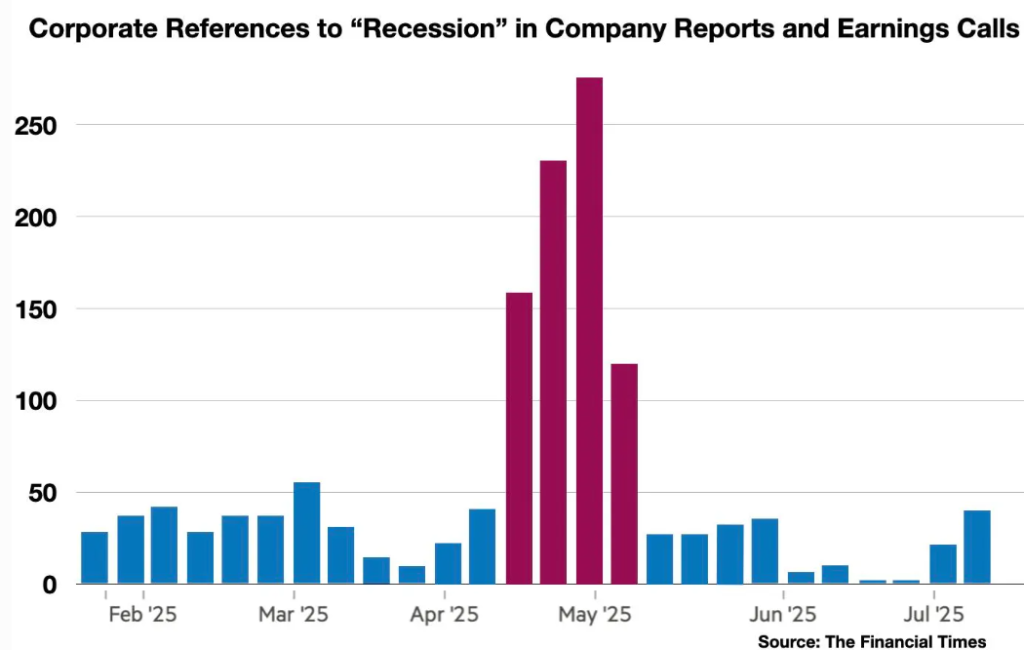
Investors, those perennial barometers of economic sentiment, have responded with exuberant buying as tariff and related inflation fears have calmed. Expectations of Federal Reserve rate cuts in September—and indeed, through the balance of the year—have solidified, with futures markets now pricing in a near-certainty of monetary easing. This shift marks a dramatic about-face from the springtime gloom, when whispers of recession echoed through every boardroom. Back then, the consensus leaned toward contraction. No longer. The July CPI, by confining its inflationary impulses to domesticated services, has allayed fears of a broader resurgence, fostering confidence that the Fed can navigate the soft landing.
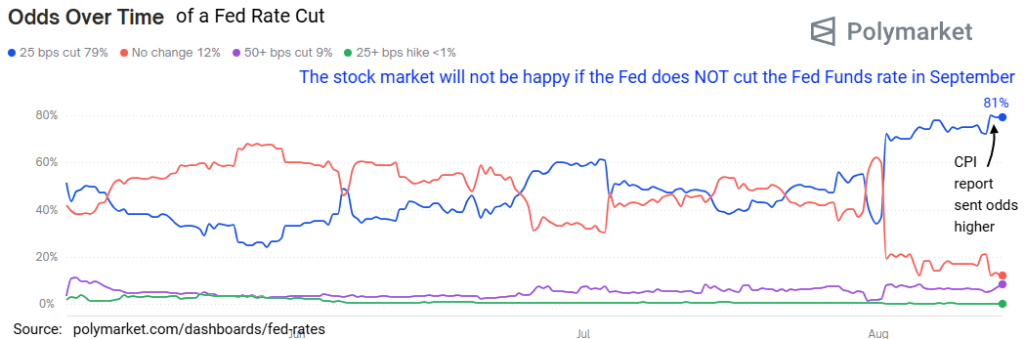
Yet, let us not succumb to unbridled optimism without acknowledging the possibility of a late summer downpour. Further tariff-related price hikes loom on the horizon, as the administration’s protectionist inclinations gain traction. Major trade deals with China, India, Canada and Mexico remain unresolved, their outcomes to be determined in the waning months of this year. The most alarming, although still a temporary storm, would be a Federal Court ruling aginst Trump’s tariff authority that is not factored into equity valuations. Recent communications between the courts and the Government hint that a decalartion could be days or weeks away, not months. Trump has other pathways to legally sustain tariffs against the world, to be resolved next year, such uncertainties could yet inject volatility into markets, testing the resilience of this nascent calm and growing optimism.
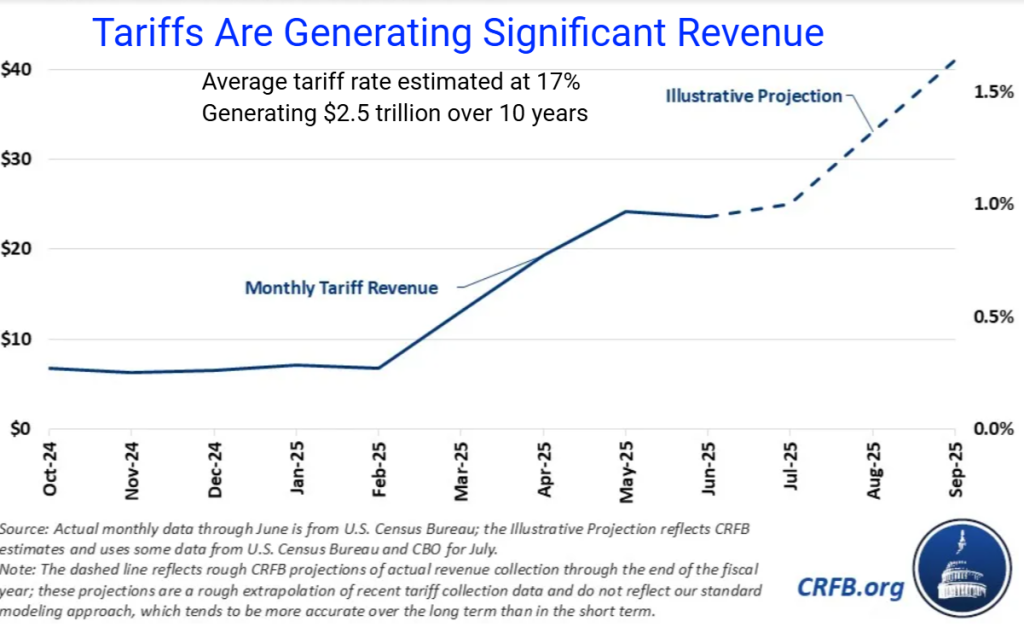
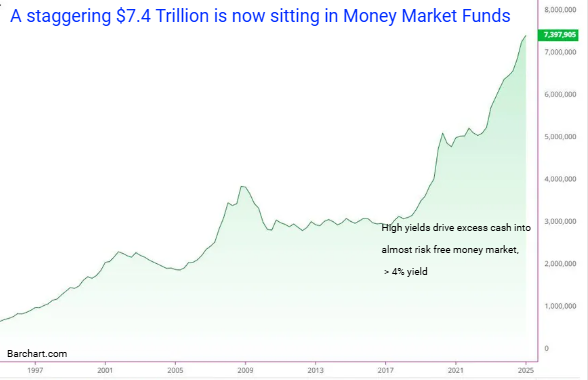
Looking forward, the economic horizon gleams with promise, undimmed by the tariff-related price hikes that may yet materialize as trade negotiations unfold later this year. Monetary stimulus, already in motion, will soon be complemented by recently enacted fiscal measures, channeling public funds into infrastructure and innovation. Over the next year, these efforts will converge with trillions in private and sovereign capital investments, fueling U.S. production and bolstering orders for American goods and reshoring. An excessive $7.5 trillion in risk free high yielding money market funds also awaits as an investment tailwind, as long as interest rates fall due to slowing inflation and not a slowing economy. Recent signs of a slowdown—waning consumer spending and tempered job growth—are but temporary waves in a broader current of expansion. The post-trade battle landscape, should diplomacy prevail, promises robust growth.
While we expect a brief but potentially sharp detour when Federal Courts shoot down Trump’s tariff authority in coming months, we remain resolutely bullish on the longer-term trajectory. Any market correction of 5 to 15 percent should be regarded not as a calamity, but as a “gift,” if you will, for the discerning investor to accumulate positions at favorable valuations. Our focus remains on large-cap stalwarts in AI-related technology, where capital spend and innovation continue to outpace even the most sanguine forecasts. Cyber-security, despite its recent pullback warrants attention, as does the end to end domestic supply chain of rare earth elements essential to high-tech endeavors. Nuclear energy, data centers, and cryptocurrency ecosystems round out this portfolio of promise, with AI’s broadening applications poised to catalyze further growth in the smaller cap and healthcare sectors come 2026 and beyond.
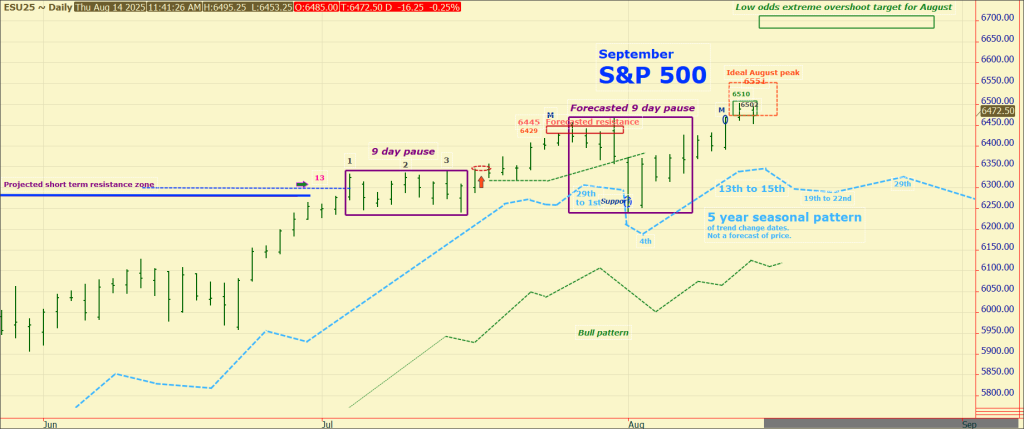
Stocks seasonally peak in July/August with more turbulence in September/October. Failure of the Fed to cut rates in mid September would depress stocks. More importantly, we worry that the high odds of a Federal Appeals court ruling negating Trump’s tariffs will add uncertainty and volatility to stocks, when that decison arrives. For this week, however, the July CPI and PPI reports remind us that vigilance is requisite, but so too is optimism. The markets, like the nation they reflect, thrive not on fear, but on the reasoned pursuit of opportunity.