Consumption, that unflappable force of America’s GDP, accounts for 70% of national output—a tribute to our free enterprise economic structure as well as the cravings of our republic’s world beating shoppers. In the peculiar aftermath of the Covid stimulus bonanza, our economy has raced ahead, buttressed by persistent consumer strides and an insatiable artificial intelligence investment zeal.
Yet, even sturdy pillars can crack. The titans of Main Street—Bank of America among them—report customer spending up over 5% annually as of July, a pulse that should embolden any optimist. But the consumer’s pulse, stoked for so many seasons by easy credit and government largesse, now beats with tariff hesitation.
Consider how corporate captains view the American wallet: PepsiCo confides that demand is muted, particularly in North America, with the consumer profligacy giving way to cautious frugality. Align Technology (Invisalign) notes a 3.3% decline in demand for the elective enhancement of our nation’s smiles. Kering, Louis Vuitton, Gucci, Dior – purveyors of luxury – report a steep revenue slide, signaling that status may now be subject to inflation. Whirlpool and its household appliances sense waning confidence. Across autos and home improvement, purchases falter under the weight of high borrowing costs, captive to a central bank reluctant to loosen its hold on the interest rate reins.
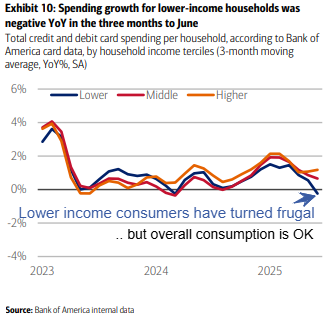
This, then, is the paradox: the economy crawls along at a sluggish 1% pace (once one subtracts the ephemeral sugar rush of tariff inventories). Yet the stock market, drunk on the promise of artificial intelligence and the looming prospect of fiscal and private investment stimulus, dances to record highs. While awaiting smaller companies and basic industries to join the large cap technology surge, investors have developed the conviction to bet big and early on tomorrow’s technologies and tomorrow’s government.
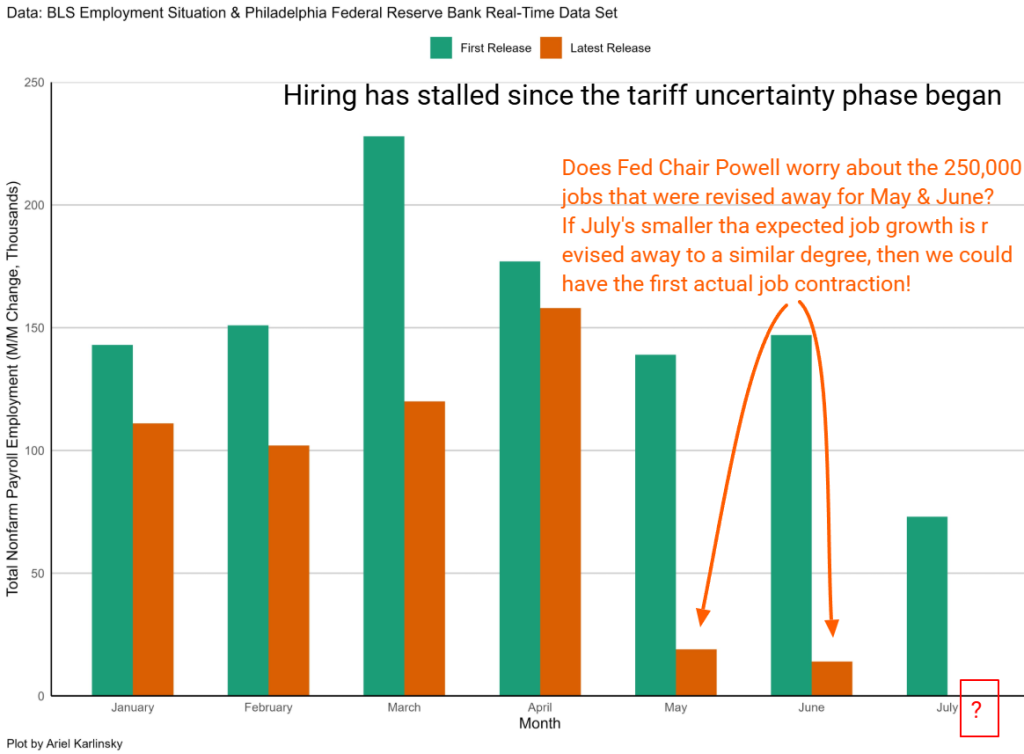
Into this scene strides the jobs report: what was thought to be robust has been revised, downward by 250,000, an error that fuels hope for a September rate cut. The Bureau of Labor Statistics deserves some blame in failing to adapt or fix the historic declines in business survey participation. Even so, businesses lament not the absence of jobs but the dearth of capable workers—a nearly upside-down version of the malaise of past cycles. Public companies certainly retain confident about the future having bought back $166 billion worth of their own stock – a record for the month of July – that they deemed undervalued. The trend indicates that total share buybacks for 2025 will reach a new record, above $1 trillion, which is supportive to underlying prices.
Meanwhile, the nation’s leading firms float above the fray with escalating detachment. Nvidia’s CEO Jensen Huang recently hailed President Trump as “America’s unique edge”—not for his caustic market moving posts, but for his robust embrace of energy policy, a cornerstone Huang deems essential to AI-driven economic renewal. Manufacturing, reshoring, the entire venture of innovation—they demand not just data bytes and ideas, but the watts and BTUs often ignored by political idealists. Until now, energy production was demonized. This year it has become an urgent requirement for our technological future.
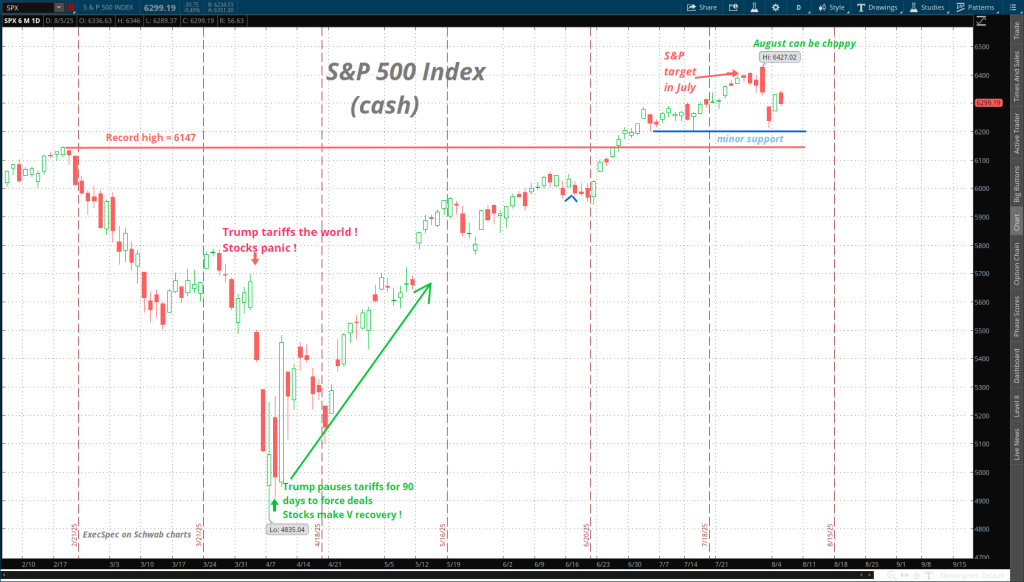
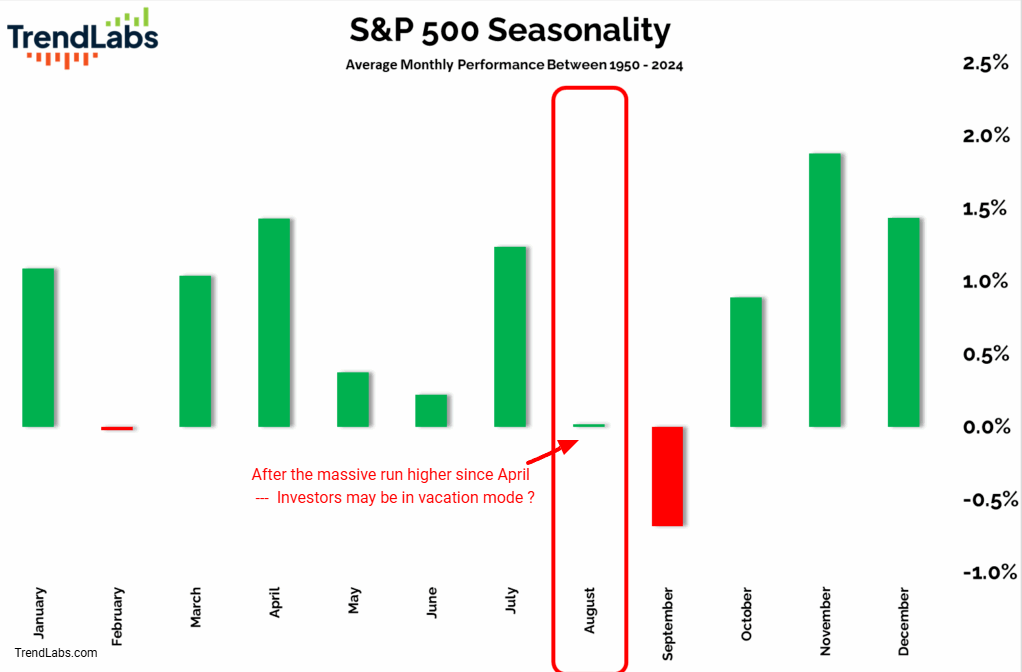
The S&P 500, for its part, staged a remarkable rebound from its April 8 correction low, scaling unprecedented peaks above all forecasts. Yet, the recent sell-off late last week from record highs on “good” news carries the scent of profit-taking—perhaps a prudent pause before the seasonal shadows of August and September. The market’s historic monthly seasonality, illustrated below, underscores this rhythm: April through July’s robust gains, long foretold by the market’s summer pattern, have delivered profitably. Yet, caution is warranted. August frequently ushers in a subtle softening of momentum, a prelude to the deeper declines that often descend by late September and early October. The correction may be just a modest 4 to 5% if a lack of rate cuts is the primary driver, but the unspoken arrival over the next few months of a Federal Appeals court decision to over-rule Trump’s emergency tariff usurpation could lead to an autumnal chill slicing as much as 10% from portfolios.
At this juncture, investors face a market at lofty heights and a promising future, but laced with tariff related ambiguity near term. The economy is sluggish for low income workers, yet, the resolute spending in the mid to upper income brackets indicates that recession worries remain muted. Resilient growth endures—in cyber, nuclear, data centers, semiconductors, artificial intelligence, even aerospace. The second quarter saw Boeing’s commercial airplane unit boost sales by 81% over the prior year, halving its negative margin that once yawned wider.
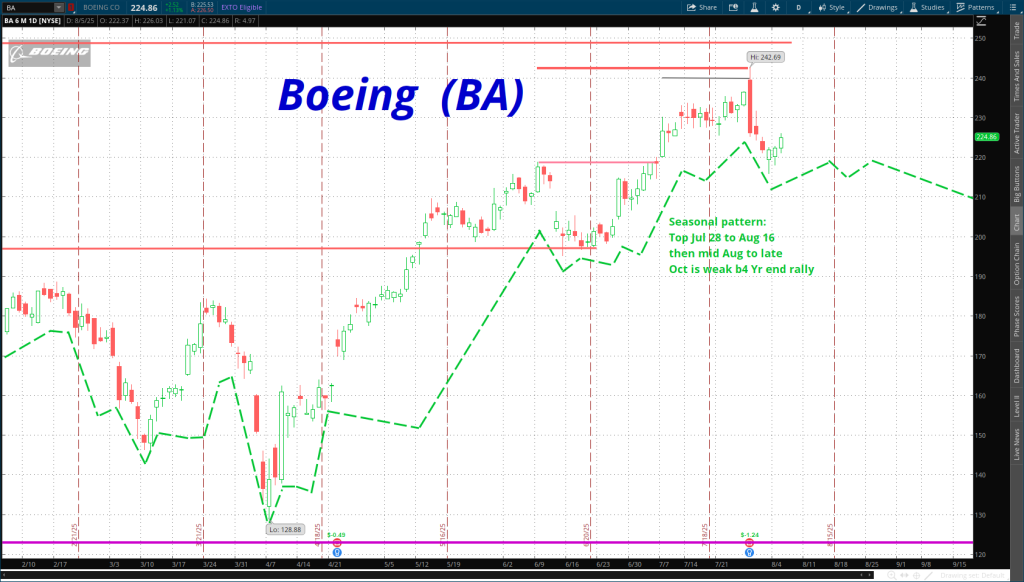
Looming over all is the unresolved matter of tariffs: President Trump seems poised to brandish them as both fiscal bludgeon and foreign policy tool, yet the courts may soon rule such powers beyond his legal grasp. The market, attuned to seasonal currents, braces for volatile swings in August and the risk of a sharper correction into early autumn. Should the judiciary curb Trump’s tariff authority, uncertainty could spike to a market volatility crescendo.
Yet the American investor is nothing if not resilient. Balance sheets remain sturdy, though businesses are weary of the endless waiting game. Once tariff frameworks solidify and ground rules clarify, expect the economic engines to roar—propelled not only by the mighty few (Big Tech), but by a broader resurgence, quickened by fiscal, monetary, and private capital alike. For now, the brakes are tapped, market momentum teeters at its zenith, and the nation awaits its next bold step.