The US stock market, despite its fickle sentiment, continues to serve as a forward-looking oracle, parsing the nation’s collective future through its proverbial ticker tape. Despite presidential curveballs aimed at resetting global trade in favor of the US, bewildered investors ultimately found footing, inflation expectations cooled, and corporate earning forecasts regained their upward march. The surging capital flows and record foreign stock buying here and abroad contain discernible clues about the broad contours of our clearing economic horizon.
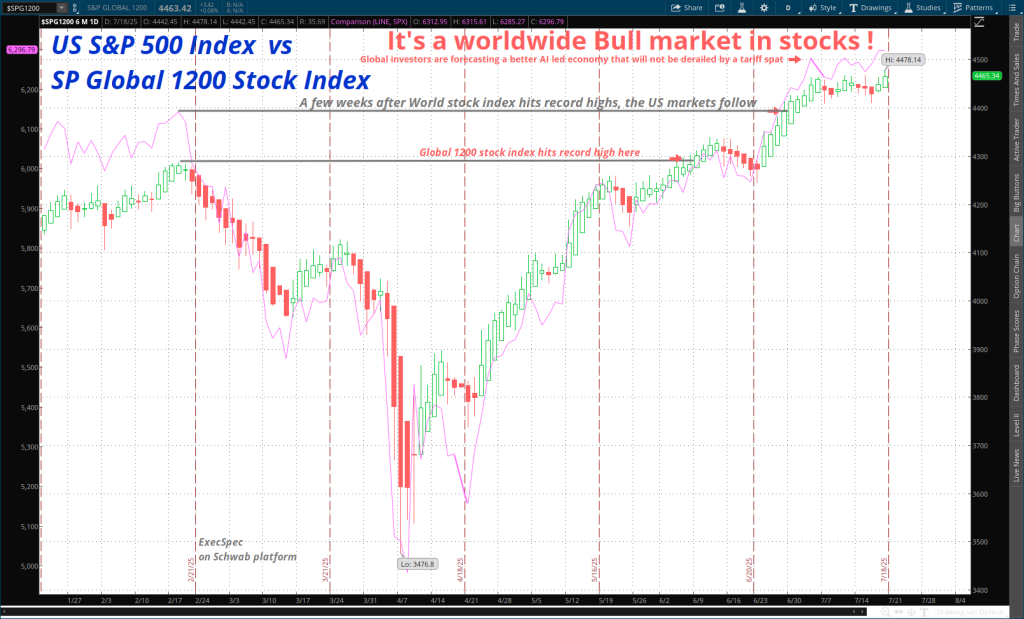
After the tempestuous April trade showers, as the fog of headline anxiety dissipated, two telling phenomena asserted themselves in the market’s narrative: inflation expectations declined and the pace of forward earnings growth improved. Notably, foreign indices pivoted upwards at a greater velocity—a transnational vote of confidence in resilience rather than an arbitrary act on Wall Street or a Trump tweet. Until the summer surge in June and July, global markets outran even the tech-heavy titans of the U.S. large-cap indices. This is not the caprice of speculators but a broader conviction that tariff tumult is, for now, more noise than nemesis. Investors, both in the U.S. and among our trading partners, are peering past the storm storm forecast to calmer seas.
Inflation, consumer health, and the interplay of fiscal and monetary levers remain the market’s lodestars. Inflation, that perennial Achilles’ heel of American expansions, has yet to draw blood. Take automobiles, the supposed canary in the tariff coal mine: new car prices have remained docile, a far cry from the vertiginous spikes of 2021–2023. Dire prophecies of tariff-driven price surges at checkout counters have, thus far, failed to materialize, undermining the case for keeping the Fed Funds rate so loftily above underlying inflation compared to other central banks. This elevated rate environment, though, has birthed an unexpected bounty: over $7 trillion now idles in money market funds, a war chest for future spending. Meanwhile, despite the U.S. piling on almost $2 trillion in federal debt from Q1 2024 to Q1 2025, households have swelled their net worth by an even mightier $7 trillion. Tariffs may nudge prices upward in the near term, but consumers, flush with capital and facing only moderate inflation, seem more than equipped to absorb the blow.

A civilization’s vigor is best measured by its commerce. Leisure and travel are enjoying a renaissance; cruise lines were drowning during Covid and now chart a golden age with record bookings cresting into the next presidential term. American Express reports a robust 7% rise in spending; Bank of America’s seventy million account holders are growing discretionary spending at a 4% rate year over year. Default rates and unemployment—those twin specters beloved by recession prognosticators—remain reassuringly subdued.
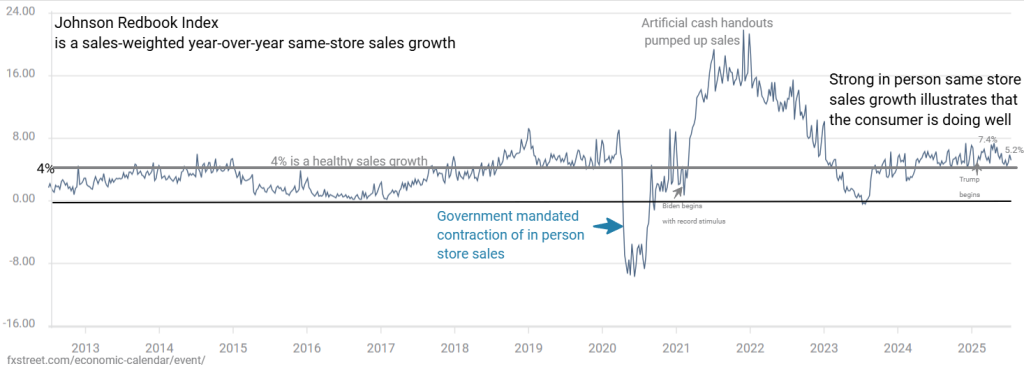
Small business, a shrinking part of an expanding economic pie, endures its Sisyphean struggles duirng this narrowly led Bull market; but before one renders a dire verdict, consider the coming cascade of Trillions in fiscal stimulus, deregulation and the delayed payoffs of tariff settlement. Retail sales, buttressed by more than 5% same-store nominal growth, continue to defy the doomsayers who persist, as they always do, in forecasting the exhaustion of the American consumer. Well-capitalized banks, untroubled by default risks, echo this resilience.
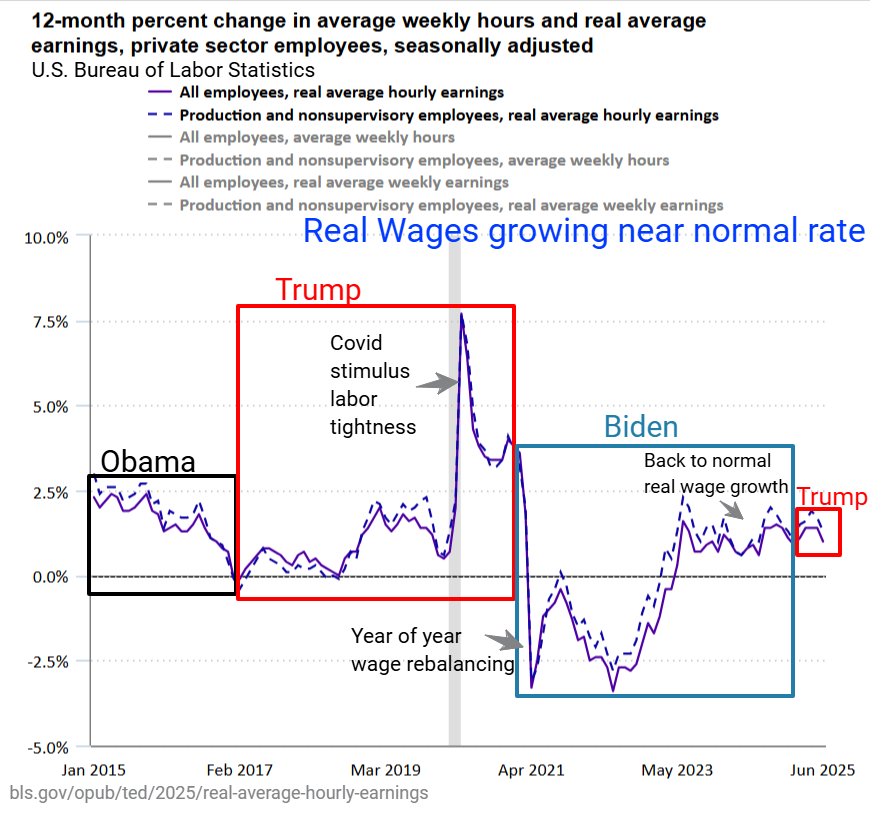
Inflation indices, though stubbornly above the Federal Reserve’s target, have not smothered real wage growth, which remains positive. With 7.8 million job openings and near-full employment, the net gain in wages will keep adding fuel to the fire where businesses and households overall have excess capital to burn.
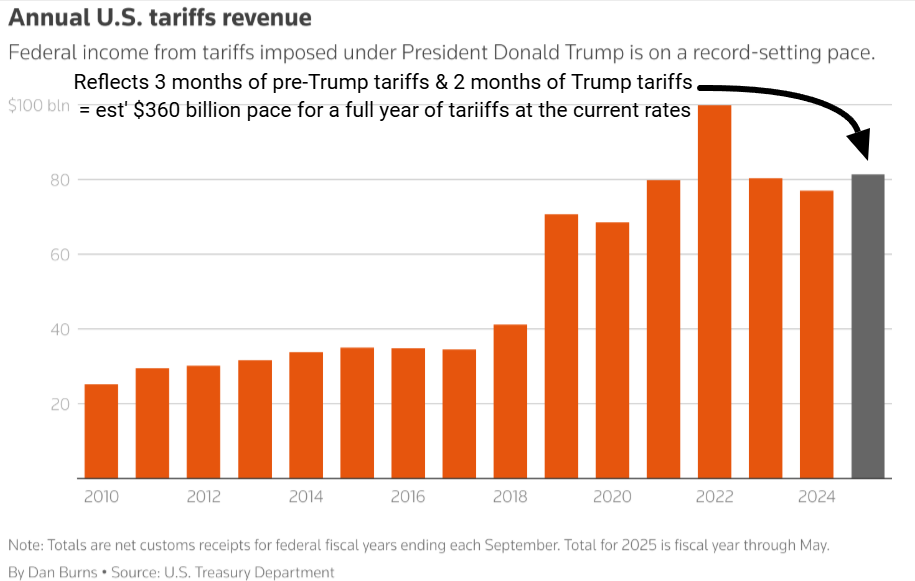
It’s premature to expect the parabolic ascent of equities to catalyze a universal economic boom, but the prerequisites for a broader boom are in place—insatiable demand for AI-driven innovation, abundant liquidity, fortified banks, and robust private equity and venture capital reserves. When one tallies the forthcoming tidal wave—some $300 billion in annual tariff receipts, trillions of dollars in onshoring investment, a quarterly $100+ billion in fiscal invigorants, and at last a potential softening of interest rates—the possibility emerges that our prosperity’s only true check may be the capacity of our labor force to automate, to educate, and to adapt when the tariff tempest subsides.
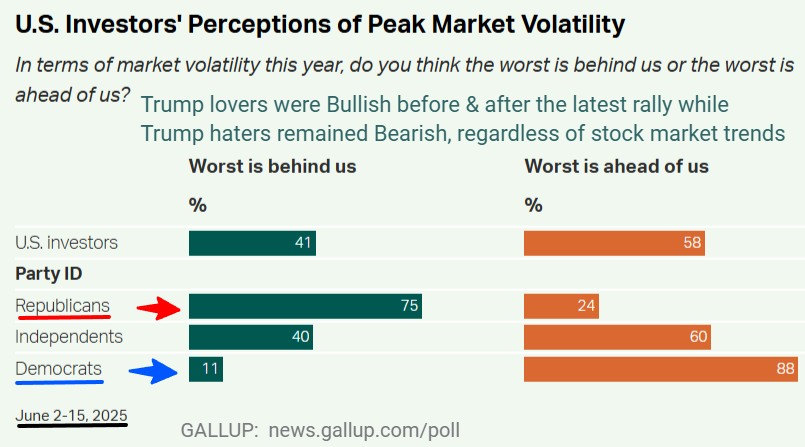
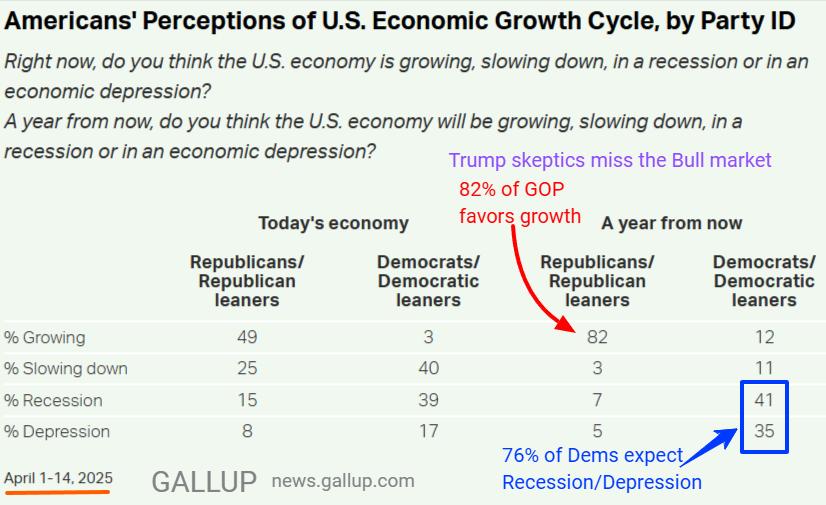
The stock market, as the adage goes, thrives on climbing a wall of worry. Today, that wall is built of partisan bricks. At the market’s April 2025 nadir, Gallup found 82% of Republicans anticipating economic growth, while a mere 12% of Democrats foresaw brighter days under a Trump presidency. The schism persists even as markets rallied to record highs when half of Democrats in June reported being “very concerned” about a market drop, up from 17% under Biden, while only 9% of Republicans shared such fears. This is no mere statistical quirk but a defining feature of investor sentiment. Democrats, twice as likely as Republicans to fret, are more risk averse in their portfolios, tapping the brake on market exuberance. Republicans, conversely, see volatility fading, their optimism a tailwind for risk-taking.
This partisan lens—red portfolios bullish, blue portfolios wary—shapes not just sentiment but action. Economic surveys, once a barometer of shared reality, now mirror political tribes as much as financial fundamentals. Media narratives and social platforms amplify these biases, rendering investor outlook as volatile as the market itself. Should Democrats shed their skepticism and join the bullish chorus, a reservoir of pent-up demand could flood the market. Yet, when sentiment unifies across political lines, history whispers a warning: the boat may tip.
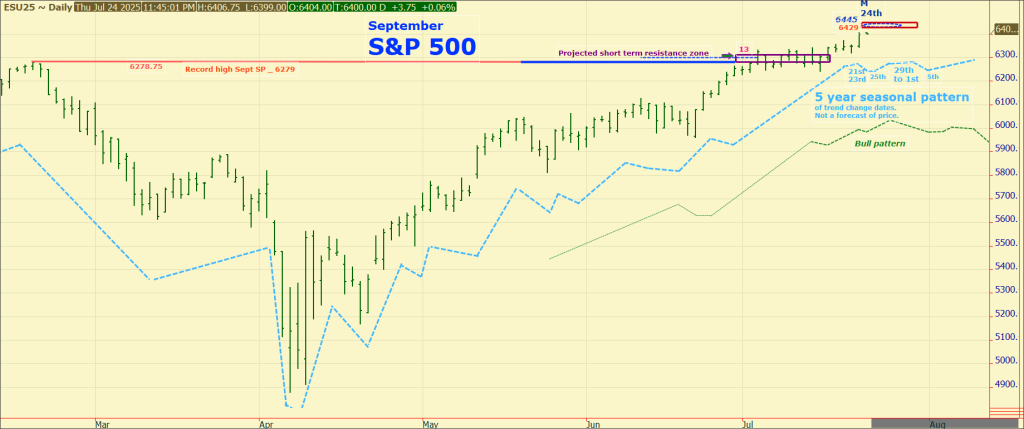
The S&P 500, riding its forecasted upwave, is poised to crest near 6400 by early August, buoyed by not only AI but a late rally in value, materials, and mid-cap stocks. Yet, a correction looms—5 to 11% by late September—likely triggered by tariff-related surprises. Two shadows darken the horizon: first, Europe, by August 1, may balk at a trade deal, countering Trump’s tariffs with their own and sparking at least a brief transatlantic trade war. Second, Federal Appeals Court decisions, expected in early August, could nullify Trump’s tariff authority, a legal thunderbolt that even the Supreme Court might struggle to overturn. Either could ignite volatility, shaking the market’s climb.
In sum, the anxieties over an exhausted consumer and a tariff-induced inflationary spiral, so vividly painted in the echo chambers of discourse, appear distinctly overwrought. The market whispers its verdict that there is no economic storm, just the faint early light of more vitality in the days ahead. Yet, optimism hangs on a knife’s edge: European defiance or legal rulings could yet unsettle the rally, driving a 5 to 11% correction by late September. Far from a calamity, this near-term downside risk presents a major buying opportunity. Our longer-term forecast envisions a robust economy, fortified by strong corporate earnings in 2026 and an S&P 500 soaring past 7000, propelled by the kindling of innovation, liquidity, and consumer vigor. For those with the patience to see beyond the tariff squall, the market’s dip will be but a prelude to a brighter ascent.