Presidents are known for political theater and the recurring theme of the rhetorical victory lap—sometimes when accompanied by breakfast. In early June, President Donald J. Trump took to the podium and proclaimed, with characteristic flair, that egg prices had “dropped 400%.” For those of us schooled in both arithmetic and understatement, this sounded less like a data point and more like a scrambled metaphor. What is the “poultry truth behind the price drop”.
What Mr. Trump no doubt intended to suggest—through his typical megaphone of hyperbole—is that egg prices, which had surged more than 400% during the acute phase of the avian flu crisis, have since returned to near-historic norms under his watch. That much, at least, is true. In February 2025, during the seasonal demand peak, eggs fetched eye-watering prices that left consumers in a state of mild revolt in search of the cause for the mother of all poultry pandemics that forced the slaughter of over 92 million chickens.
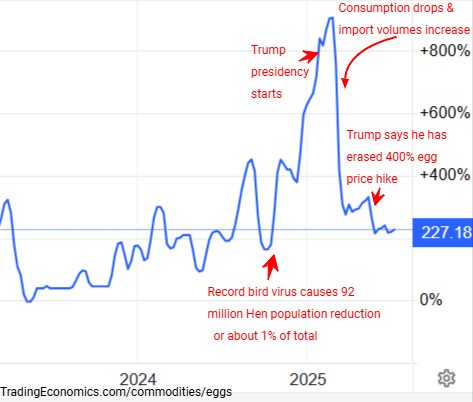
Percent change in US Egg prices
But in the months that followed, policy and poultry both adjusted. As the old adage goes, the best cure for high prices is high prices—a maxim proven once more in the humble domain of eggs. With the tail end of the avian flu pandemic finally receding, a pragmatic decision was made to allow record levels of egg imports into the U.S. market while simultaneously curbing exports. United States egg production actually fell to 8.59 billion during May 2025, down 6 percent from the previous year, but the big factor boosting overall supply—and avoiding egg on Trump’s face—was his administration’s aggressive move to boost imports and consumers finding substitutes. While domestic production declined and demand wavered, imports surged from 11.5 million to 40 million eggs—a roughly 250% increase, while also curbing exports. This double-barreled strategy—one part economic realism, one part election-year optics—helped flood domestic markets with supply. Prices, no longer propped up by scarcity, descended rapidly. From a peak that threatened to make omelets a luxury good, we are now comfortably back to levels that feel over-easy.
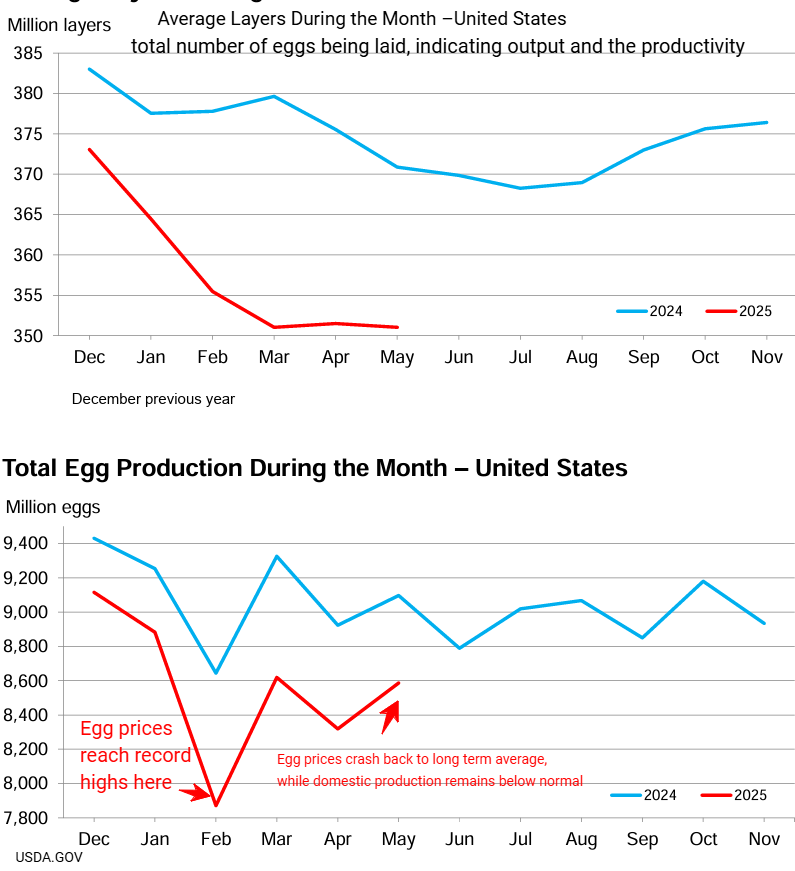
Credit, of course, is a currency hoarded more greedily than gold in election years. And Trump, ever the maestro of the inflation narrative, has seized this poultry renaissance as proof of providential inflation reduction policy. For those who prefer their facts sunny-side up, the reality is more prosaic: global supply dynamics adjusted, domestic policy opened the gate, and the crisis passed, as crises tend to do. Ever the sultan of embellishment, the exaggeration, or perhaps eggsaggeration, carries a kernel of truth.
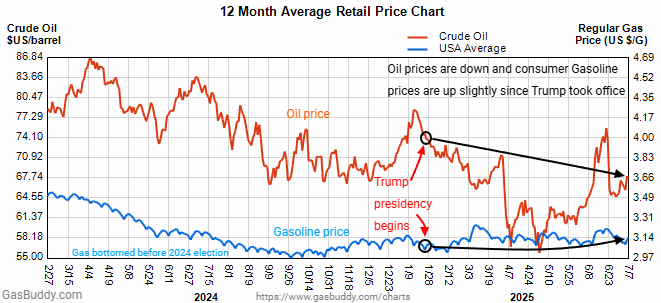
While Trump has presided over a very modest deflationary breeze in his nascent second term, his penchant for hyperbole has migrated from the henhouse to the oilfields with the same theatrical gusto. He has frequently boasted of gasoline prices dipping to $1.98 per gallon at some mythical pump, a claim as fanciful as it is unverifiable, conjuring visions of a bygone era rather than today’s reality. In truth, gasoline prices remain in a narrow range either side of $3/gallon this year and have crept slightly upward during Trump 2.0. Yet, one must acknowledge a countervailing force: oil production has edged slightly higher to record levels since Trump’s inauguration, and crude oil prices have softened, offering consumers a de facto tax cut. This decline owes less to any coherent energy policy than to the market’s fickle sentiment, whipsawed by forecasts of tariff impacts on global trade and the US economy. The administration’s exhortations to “drill, baby, drill” collide with a stubborn economic truth: without higher prices, producers lack the incentive to ramp up investment for ever higher oil and gas output. A prudent course, one might suggest, would be to replenish the Strategic Petroleum Reserve—decisively depleted under Biden’s watch—while prices linger at historic lows. Such a move seems likely soon after the tariff trade war uncertainty becomes certain and interest rates begin falling.
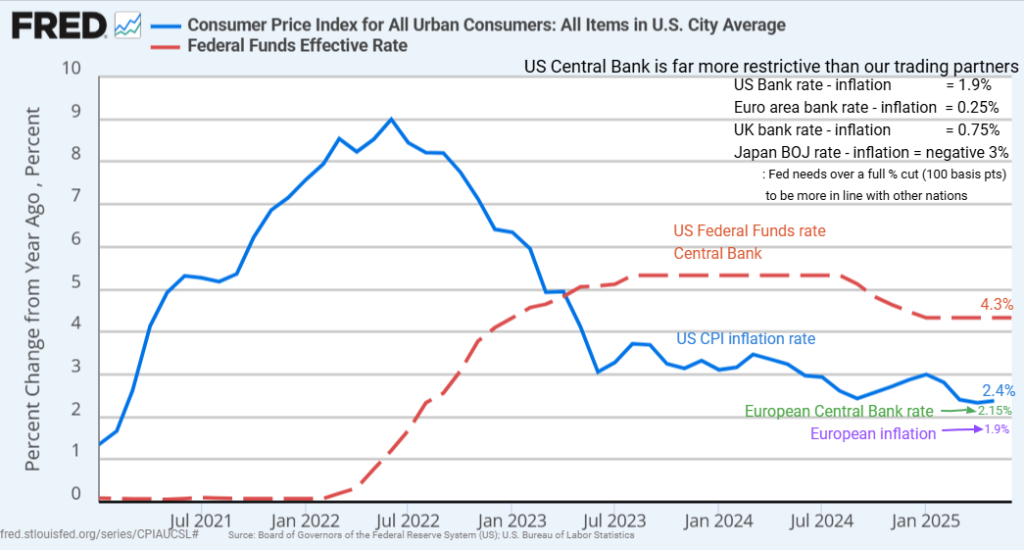
Lower egg and energy prices fulfill a sliver of Trump’s capacious promises, yet the specter of tariffs menaces like an uninvited guest at the economic party. Uncertainty over their scope and scale keeps markets and business leaders on edge, fueling both inflationary fears and political posturing. Federal Reserve Chairman Jerome Powell, ever cautious, has delayed rate cuts until the tariff fog clears—a stance that earns him the Trumpian moniker “too late Powell”. Compared to our trading partners, the Fed’s benchmark rate towers above our inflation rate, a disparity that strengthens the case for a cut of 0.5 to 1.25 percentage points. Yet, Powell’s reticence is not without logic, although possibly overreliant upon the crutch of tariff inflation uncertainty. The relatively high Fed rate above inflation and this weeks comment from Amazon, the nation’s second-largest retailer, that there are no broad price spikes despite tariff threats, suggest inflation remains tame. The Fed awaits clarity on trade deals, now slated for resolution by August, setting the stage for a potential September cut—assuming prices hold steady.
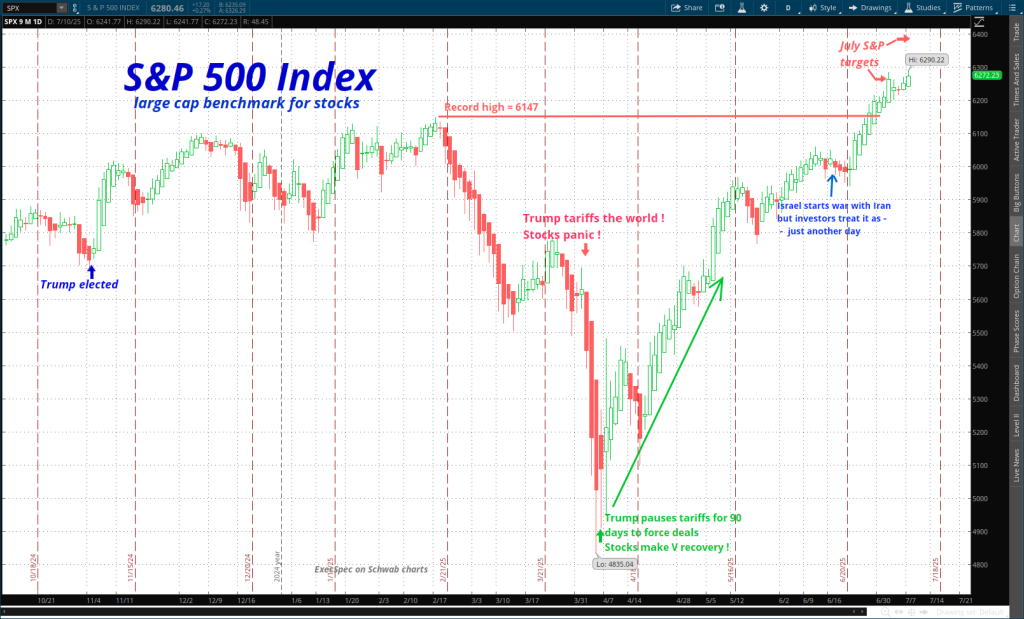
Equity markets, buoyed by an AI-fueled renaissance, a hefty federal spending bill, excess M&A liquidity and the promise of stimulative cuts, continue their bullish ascent. Our July target of 6250 on the S&P 500 cash index (6300 September futures) has been met, paving the way for a push toward 6370–6390 (SPX) this month before our expected corrective phase begins a trek toward a late summer low for traders. With 2026 targets north of SP 500 Index 7,000, long-term investors should stay nearly fully invested, favoring large-cap tech, industrial and financial growth, until rate cuts materialize, at which point a reassessment of diversification risk may be warranted.