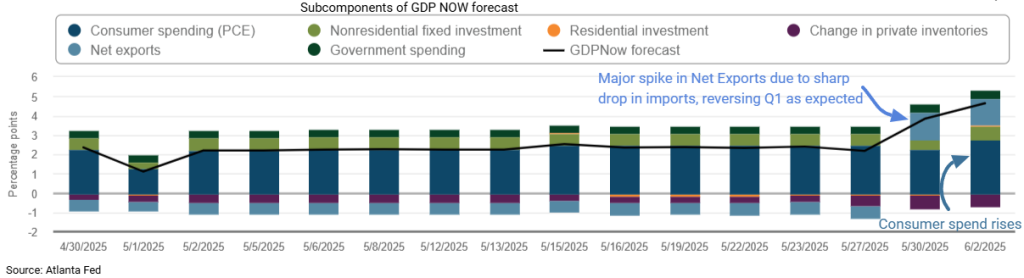
The American economy, in the telling of President Donald Trump, is a juggernaut, careening toward prosperity with the force of a campaign promise and the most beautiful word – tariffs. His rhetoric is a vivid tapestry of superlatives, woven from robust GDP projections, enviably low unemployment figures and cherry picked data. The Atlanta Federal Reserve’s automated estimate of 4.6% GDP growth for the second quarter of 2025 lends a sparkling veneer of plausibility to this narrative. Yet, beneath the sheen of such statistics, a more intricate reality emerges— the economy’s pulse is strong, yet it beats with scary palpitations in an environment of maximum ambiguity and weak guidance.
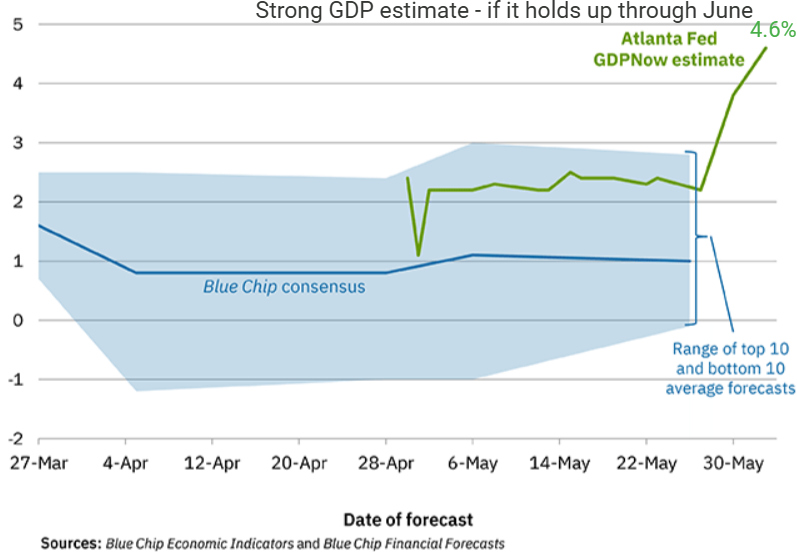
The first quarter’s GDP contraction, a statistical hiccup attributed to a surge in imports anticipating Trump’s tariff threats, has given way to an expected rebound. This reversal, however, is less a testament to enduring vitality than a mechanical correction of trade flows. Consumer income and spending, the economy’s indefatigable engine, continues to hum, bolstered by unemployment rates that remain stubbornly low and credit spreads that suggest a market more sanguine than skittish. Equity markets are forward-looking oracles, and have recently shrugged off the specter of tariffs, betting on growth fueled by tax cuts, reshoring and the secular ascent of artificial intelligence—a technological tailwind that promises to reshape the economic landscape.
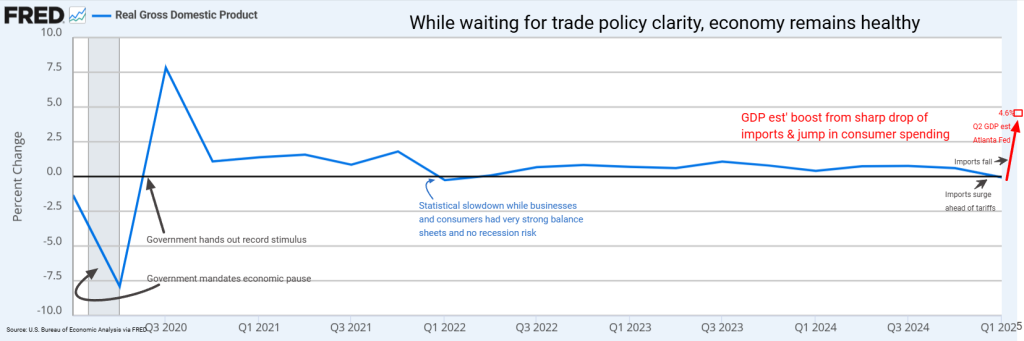
Thanks to the expected Q2 reversal of Net Exports (due to falling tariff related imports), the GDP should exhibit an impressive growth number – though artificial.
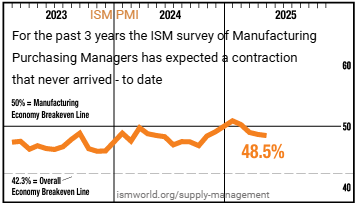
Yet, for all this vigor, discordant notes sound in the surveys that gauge the nation’s economic mood. The Purchasing Managers’ Index for manufacturing hints at deceleration, a whisper of unease about future production. Leading economic indicators, those harbingers of turning tides, flicker with pessimism, suggesting that the current boom may be skating on thinner ice than the headline numbers imply. Consumer and business confidence, too, show signs of fraying, as if the electorate and the boardroom alike sense shadows lurking beyond the horizon. These surveys are the economy’s early warning system, but have revealed to be poorly connected to the real economy since COVID.
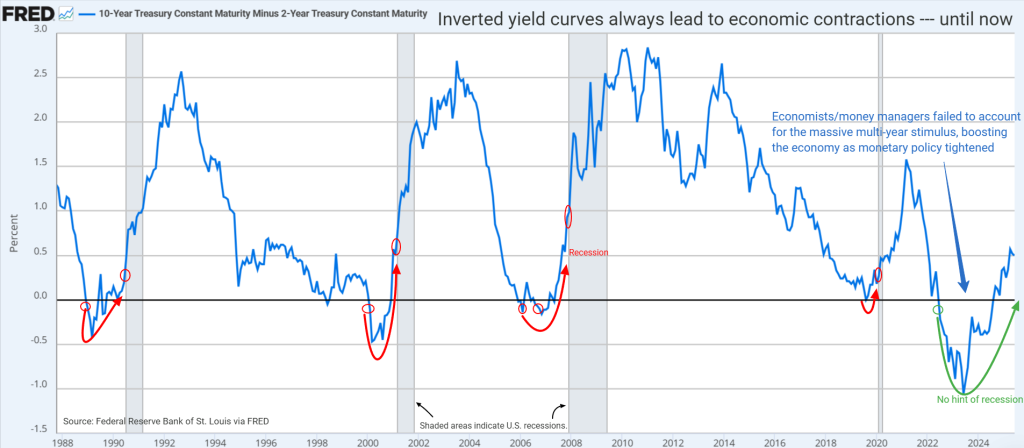
History cautions against overreading such signals. The 10-year minus 2-year Treasury yield curve inversions have an impeccable history fortelling an impending economic recession. The curve was inverted from July 2022 to August 2024, foreshadowing a Cassandra-like prophecy of recession that never materialized in the almost three years hence. The economy, defying the yield curve’s grim outlook, grew apace, and unemployment held steady. This resilience underscores a truth often obscured by the bluster of punditry: traditional indicators can falter in an era where new forces—like Quantitative Easing and AI’s transformative potential—rewrite the rules.
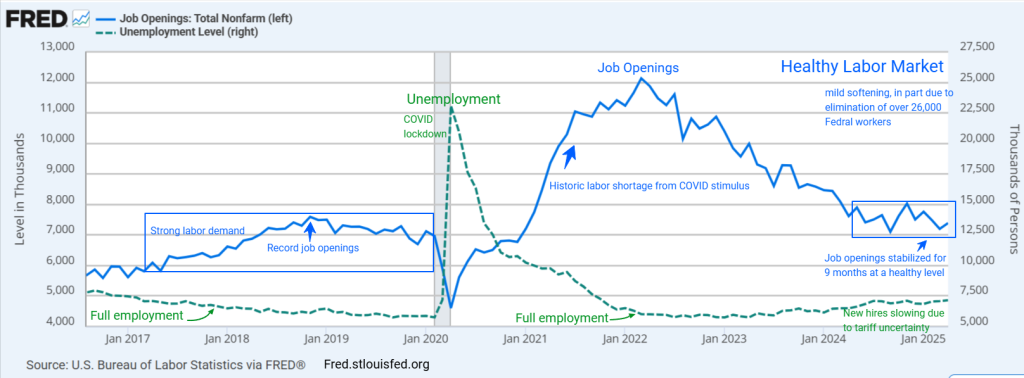
For nine months now, the number of job openings has remained stubbornly high, a sign historically associated with a healthy labor market—not a boom, but a significant threshold. Industrial production, despite the President’s onshoring ambitions, has yet to surge visibly; yet, it did register a record high in March, with industries like automobiles, steel, semiconductors, and pharmaceuticals increasingly relocating to the United States. These are real, tangible shifts—still fragile, still subject to the shadows cast by tariffs, which loom like a policy thundercloud threatening to dampen the parade of economic growth later this year.
Trade tensions, if reignited, threaten to choke supply chains and sap the momentum that currently propels us, transforming current expansion into stagnation. For now, the economy holds its ground—labor markets are tight enough, consumer income and demand are resilient. But beneath that surface, the cracks are visible; the battlefield of future policy confrontations is already forming. A surge of investment is waiting in the wings, eager for stable, predictable supply chains to emerge from the fog of tariff uncertainty. Yet, the specter of short-term panic remains: China and the United States, engaged in a nascent technological, industrial, and military arms race, could unleash economic weapons upon each other, disrupting markets and undoing progress.
The United States boasts unrivaled chip technology, an indispensable supply of food crops, and Boeing jets—assets that are not easily replaced by Airbus. Meanwhile, China wields a stranglehold on critical resources, particularly rare earth elements—over 90% of which are processed there. These materials, essential for military applications and consumer electronics alike, are fueling a complex, strategic contest. U.S. automakers, in an ironic twist, are considering shipping parts to China for manufacturing in order to keep factories open. The race is heating up, a high-stakes industrial, technological, and arms contest simmering beneath the surface. But, at least for the moment, the two largest economies find themselves intertwined—dependent—and we expect that reason will still prevail, leading to a trade agreement in the coming months.
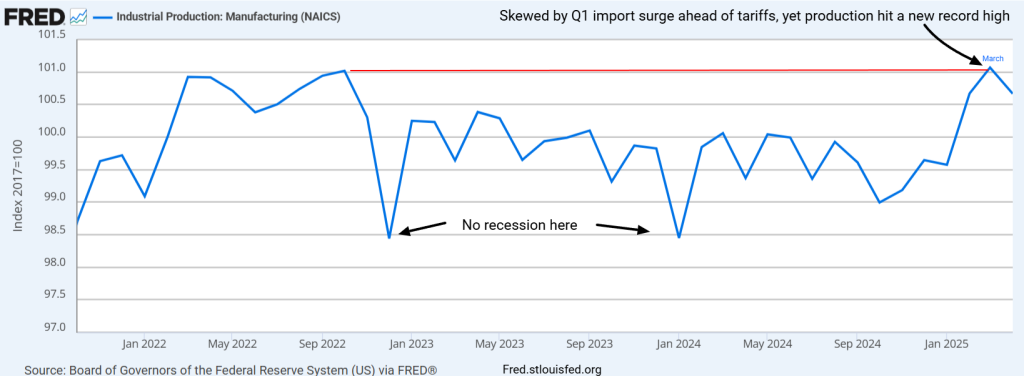
Trump’s portrayal of a booming economy is not without foundation; the data—GDP projections, unemployment, consumer spending—bear his imprint. Yet the surveys, with their quiet voice warnings, remind us that optimism must be tempered by scrutiny. The truth, as it so often does, resides in the tension between what is revealed and what remains hidden, between what we see and what we fail to understand.
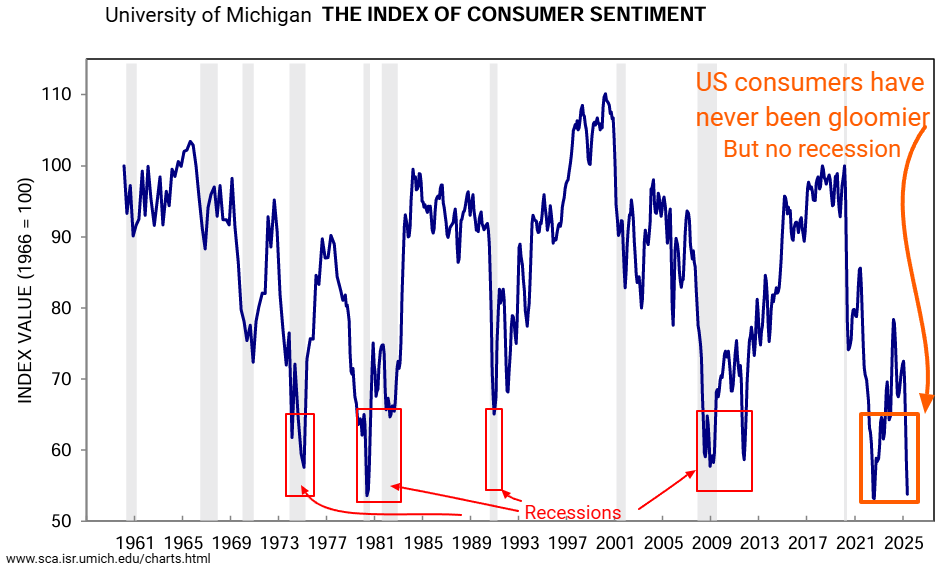
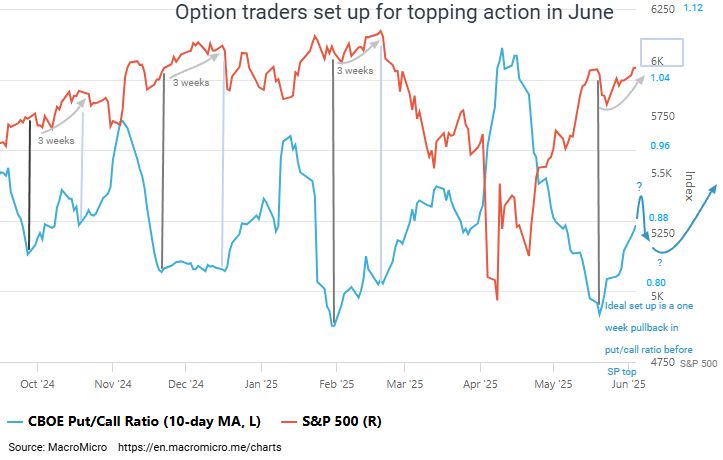
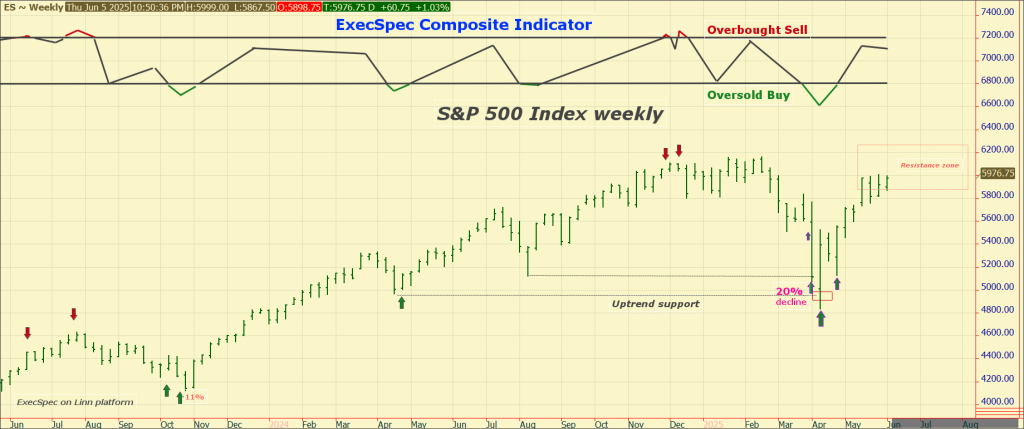
Trepid investors foolishly started referring to Trump’s tariff pause and false threats as a “TACO” trade—Trump Always Chickens Out—early in April. While catchy, this acronym grossly oversimplifies Trump’s caustic carrot and stick deal-making approach to bargaining over trade concessions. Overall, we remain optimistic about the economy and the stock market, especially once we sail past what might be a third-quarter storm. For the past two months, we’ve discussed how the market would likely rise, and recent options trader sentiment suggests momentum will slow in June, leading to a potential peak followed by a pullback—possibly a 4% to 6% correction or more—that would alleviate current short-term overbought conditions and create a buying opportunity in the third quarter.
Seasonally, stocks are poised for a short-term peak over the next few days, with a minor pullback expected between June 11th and 23rd. Historically, the pattern points to strength extending into July, but with the 90-day tariff pause ending in early July, there is a real risk of renewed trade fears unless significant trade agreements—similar in scale to those with Japan or South Korea—are announced this month. Since the S&P 500 is just a few percentage points below record highs, positive trade developments could push markets to new highs over 6147.
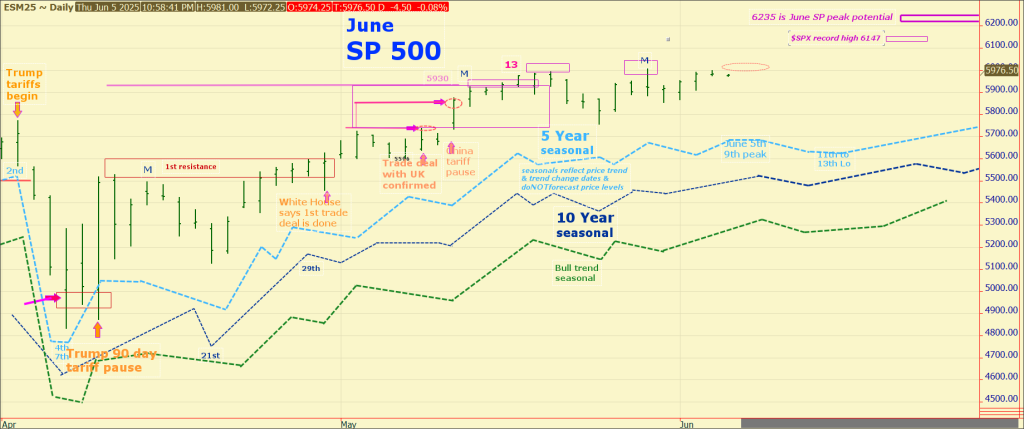
Our composite indicators were nearing overbought levels, but key measures such as Smart Money, AAII investor sentiment, and money manager leverage have not yet reached levels that typically signal a correction. Until the technical data hits normal overbought levels, the S&P has potential for the 6150 – 6250 zone in this June-July timeframe. It’s encouraging for bulls that small investor sentiment is evenly split between bulls and bears despite the market rally exceeding 20% in less than two months. Few investors feel better about the economy than they did at the start of the year, which is a healthy pre-condition for stock market support. We continue to see this as a bull market since the Q3 2022 bottom, disrupted only briefly by an eight-week 20% tariff panic into early April. While ongoing conflicts with the EU and China could temporarily impact the U.S. and global economies, we believe a resolution will eventually be reached, sparking an accelerated industrial and technological race. The soft data, such as sentiment, is extremely negative, but the more critical hard data, such as business earnings, are good.
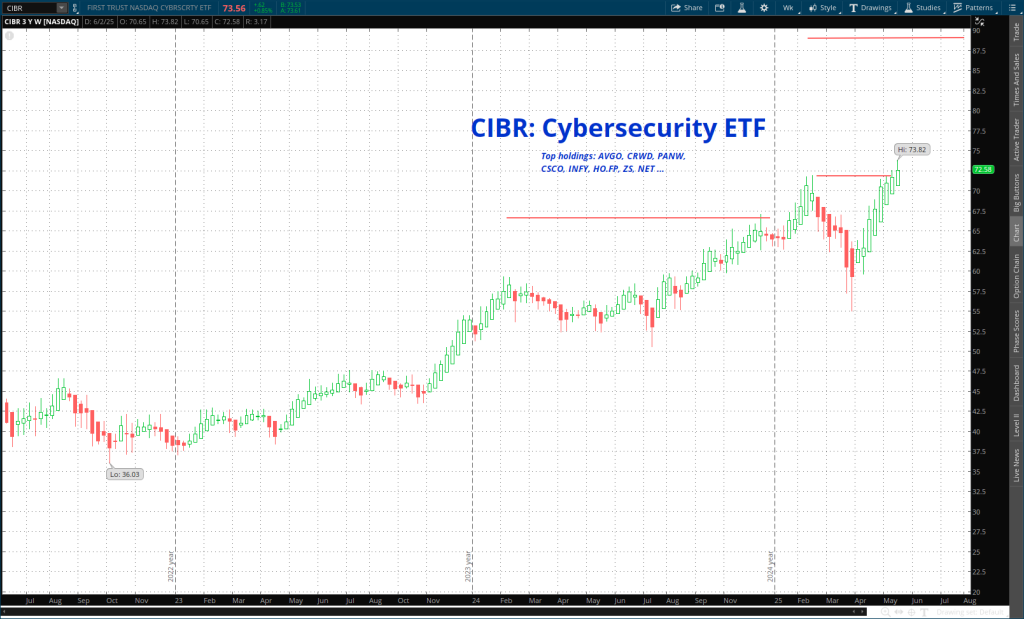
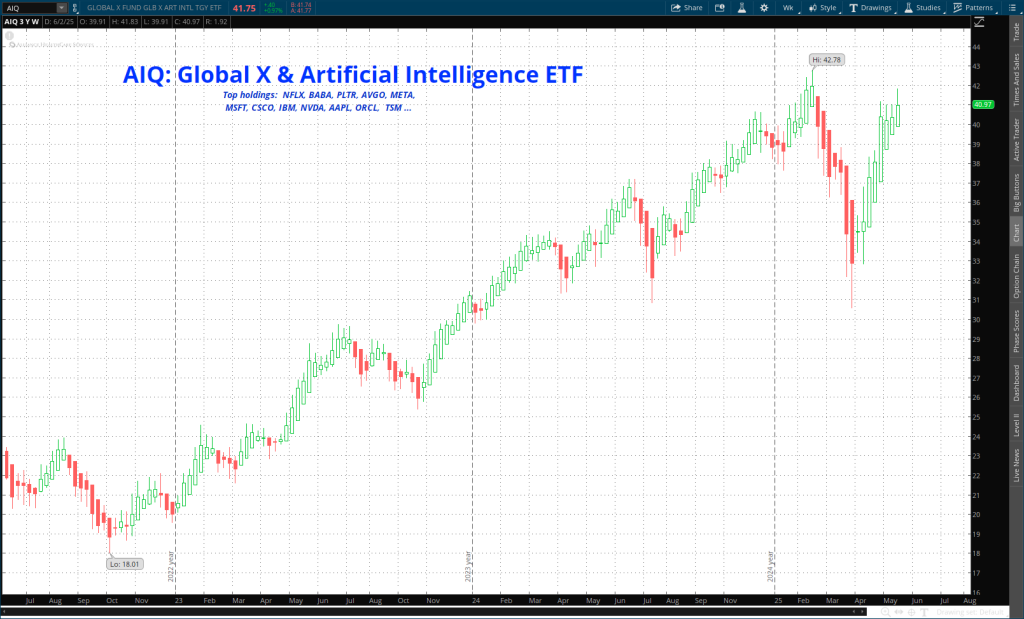
Our model portfolio has favored overweight positions in cybersecurity and AI-related companies over the past couple of years. While not cheap, these sectors are driven by secular trends, and their importance has become increasingly recognized by corporate boards and Governments worldwide as “must have” capital expenditures. Any 5 to 10% corrections in the S&P into a Q3 nadir should be used to add to these rapidly growing sectors.