In the endless drama of markets, perception takes the starring role, while reality resides in the shadows. Mercurial investors care less for the truth than for the consensus that shapes their bets. In recent months, the specter of President Trump’s tariff policies has been the script guiding this drama, with markets rising and falling on the whims of expectation rather than the substance of fact.
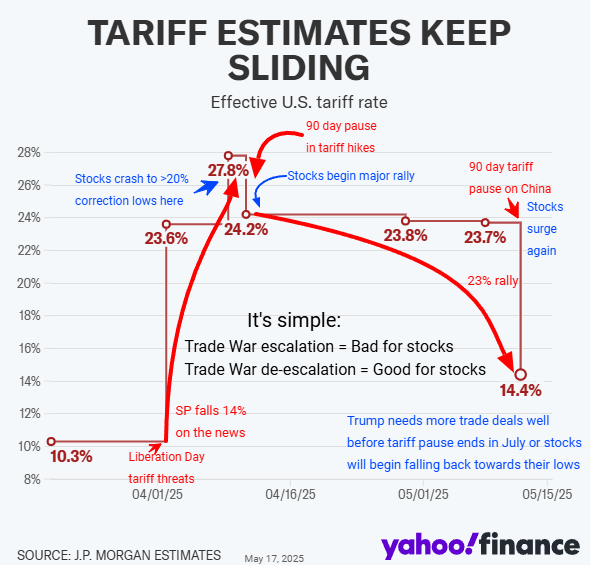
When, in the autumn of 2024, the electorate tilted toward Trump’s return, stocks soared, propelled by the belief that his administration would unfurl the most robustly pro-growth policies since Reagan. Investors envisioned a second Trump term as a reprise of his first—a deregulatory bonanza, a tax-cut encore. Yet, upon taking the oath in late January, the president threw a major league curveball. His initial musings on tariff hikes in February erased the pre-election “Trump premium” faster than a New York minute. By early April, on “Liberation Day,” Trump’s proposal of draconian tariffs on every nation, from Canada to the penguin colonies of Antarctica, sent markets into a tailspin. Stock indices plummeted, shedding over 20% as investor estimates of tariff burdens soared.
Yet, as swiftly as the market plunged, it rebounded. A tariff pause, announced with Trumpian flourish, saw investor fears recede and stocks vault upward, completing a V-shaped recovery a month later. The catalyst? Not economic fundamentals, but a shift in perception, as investors slashed their tariff expectations, particularly after the suspension of China tariffs. This oscillation underscores a truth as old as markets themselves: sentiment, not substance, drives the ticker tape.
Consider the reality, which has been curiously sidelined. First-quarter earnings, reported recently, revealed a robust economy: 77% of companies surpassed analyst expectations, the strongest showing since Q2 2024. Earnings growth, projected at a modest 6.6%, clocked in at a vigorous 13%. Consumer spending remains buoyant, and employment is near full capacity. These fundamentals suggest an economy that could slow, but in reality is still humming along. Yet markets careened into bear territory in early April, only to vault back to bullish heights by month’s end—all on the whims of tariff speculation.
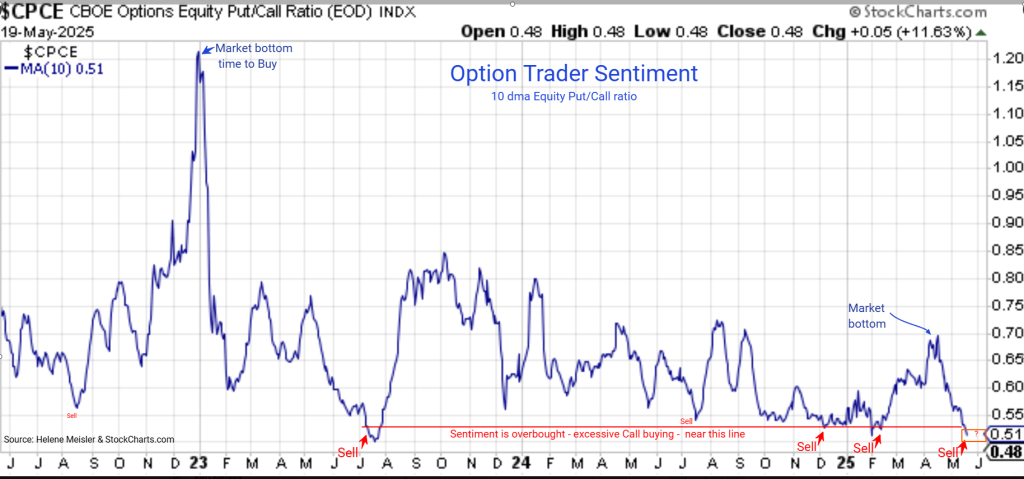
Another gauge of this perceptual caprice is the options market, where the put-to-call ratio serves as a barometer of investor mood. A low ratio, reflecting a surfeit of optimistic call purchases over defensive puts, signals complacency—an overbought market ripe for correction. The last time such option optimism was present, occurred at records highs in February. Through much of April, adding stocks to portfolios was a prudent move, as valuations reflected genuine opportunity. Now, however, the pendulum has swung too far. The current bullish exuberance, evidenced by an anemic put-to-call ratio, suggests investors are treading on thin ice. Stocks, hovering in the upper 5,000s to 6,000 range, may linger there for weeks, but we suspect a descent looms in the third quarter, as the 90-day tariff pause nears its July expiration without significant trade agreements.
This is not to say the market’s fate is sealed. Trump, a maestro of the unexpected, may yet orchestrate a series of trade deals, sending indices to modest new highs. Such is the paradox of perception: it can elevate markets on hope alone or dash them on the rocks of doubt. As John Maynard Keynes noted, markets can remain irrational longer than one can remain solvent. For now, prudence dictates holding modest cash reserves, poised for a correction that will offer a chance to add stocks at more attractive valuations. In this age of tariff brinkmanship, perception is not merely reality—it is the only reality that matters.