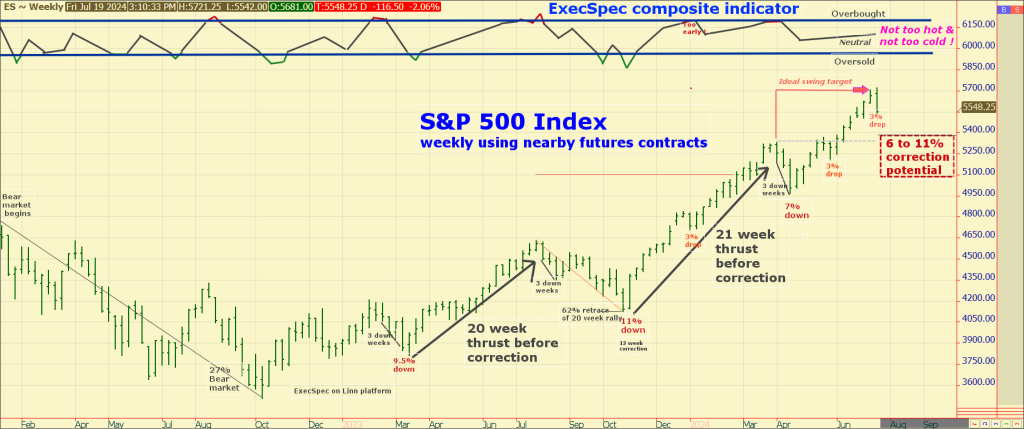
In the aftermath of the post-COVID bear market’s nadir in October 2022, American equity indices staged a remarkable resurgence, achieving record highs by early 2024—a gain exceeding 60%. The first half of 2024 experienced the most robust performance of any election year since the 1970s. Throughout this low volatiltiy ascent, small-cap stocks languished within striking distance of multi-year lows, only recently discovering their wings. Following Federal Reserve Chairman Jerome Powell’s testimony last week, investor confidence in imminent rate cuts surged to a resounding 100%, propelling small-cap equities to 30-month highs, like a phoenix from the ashes.
Today’s bull market, while prominently showcasing trillion-dollar AI enterprises, has left many smaller stocks wallowing in their metaphorical foxholes. Yet, with the prospect of lower interest rates, better earnings and the historical tendency for higher valuation multiples seeping into economic forecasts, there is reason for optimism. Historically, small-cap firms flourish in the early stages of economic recovery, particularly in conjunction with declining interest rates. The stock market functions as an anticipatory mechanism, and much of the past 23-month bull market has been predicated on the twin pillars of artificial intelligence and receding inflation rates—trends that could herald a cycle of interest rate reductions. Until actual cuts materialize, stocks will remain tethered to the whims of inflation-related news.
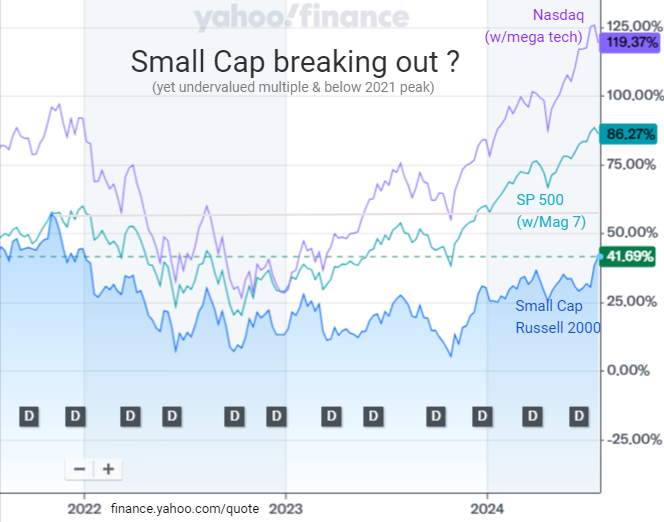
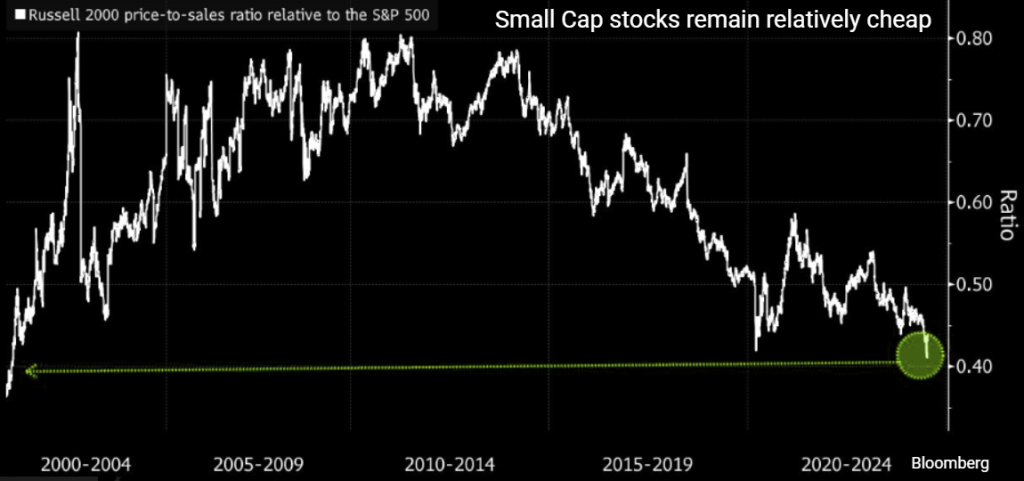
Recently, encouraging signs of a broadening Bull emerged, notably exemplified by the Russell 2000’s unprecedented five-day outperformance against the S&P 500. Our previous commentary 2 weeks ago highlighted the record disparities wherein the S&P 500 outpaced small-cap Russell 2000 stocks and the historical pattern suggesting that market victors often embark on “catch-down” trajectories to realign values with their small cap children. In this context, however, it appears small-cap stocks initiated a “catch-up” rally even as large-cap equities receded, serving to bring a semblance of alignment and rationality to market valuations.
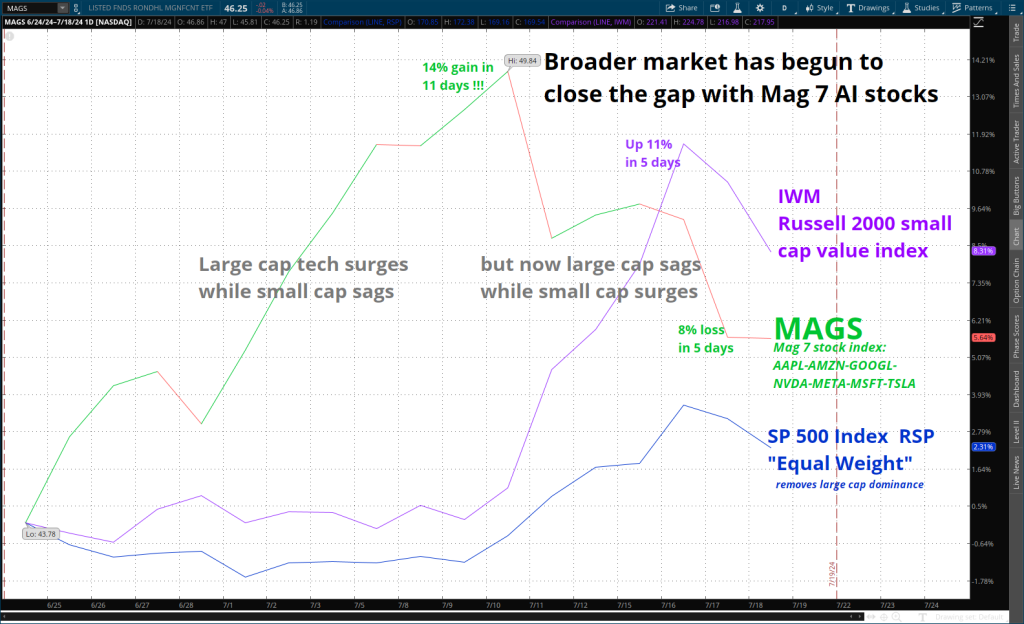
Over the long haul, the “Magnificent Seven”—the titans of large-cap technology—continue to outshine the vast legion of stocks populating the market spectrum. If the Federal Reserve can orchestrate the unprecedented normalization of inflation without precipitating economic turmoil, interest rates could decrease, triggering a broad-based market rally. Presently, it seems that AI-driven big tech is enduring its annual correction from overbought conditions, while the overall market is rebounding from a perceived undervaluation.
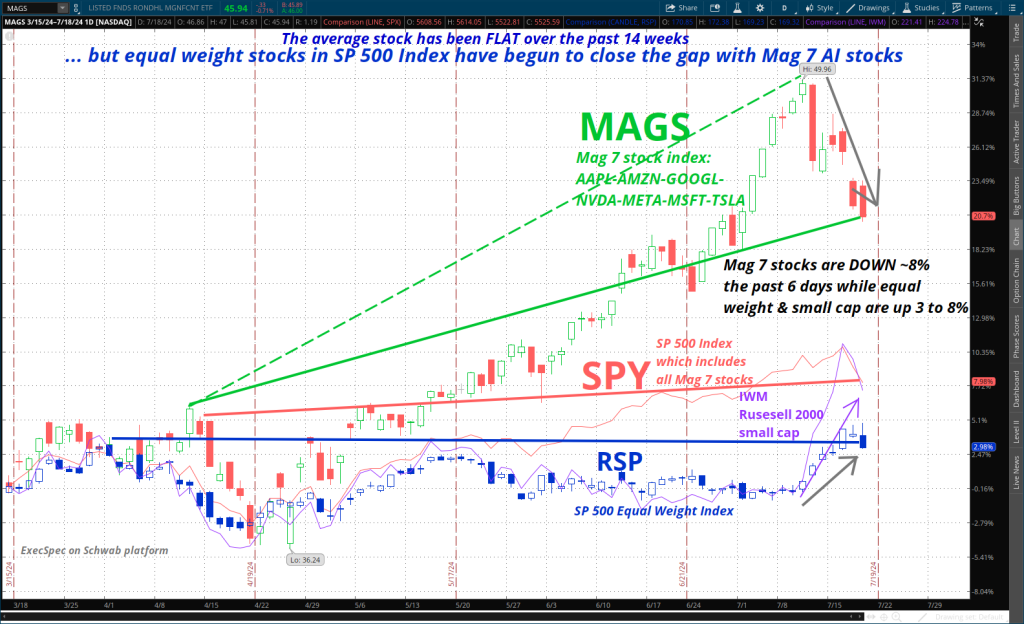
Despite a notable move nearly four standard deviations from its average over a five-day span, small-cap valuations are at their most attractive on a Price-to-Sales basis in more than two decades. A correction in the S&P 500, which we anticipated during the third quarter—projected at between 5% and 11%—may indeed cast a shadow over the typically under-owned small-cap and banking stocks, yet confidence surrounding greater allocation to small-caps during pullbacks has notably improved.
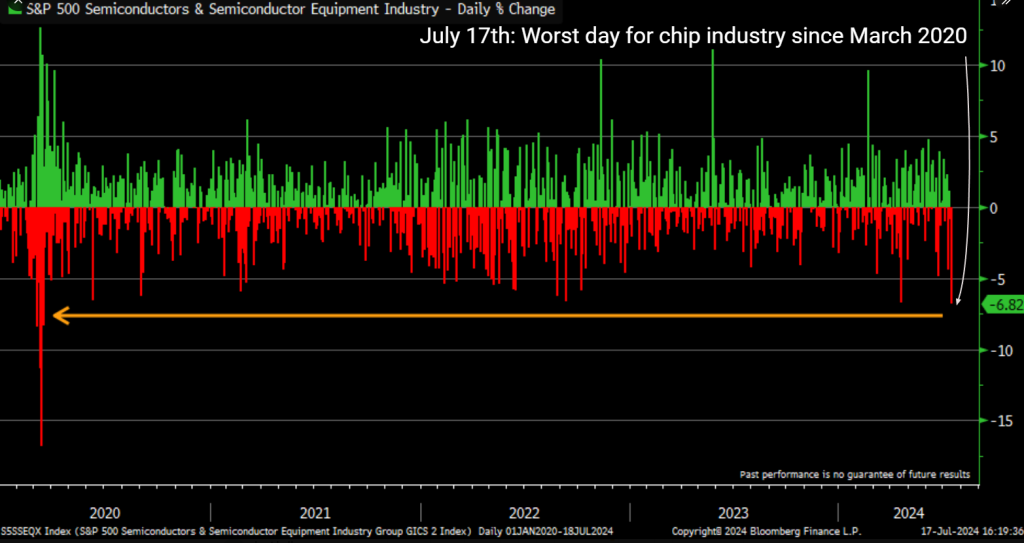
Speculation abounds regarding the catalysts for the recent – overdue – resurgence of small caps over their larger counterparts. Favorable inflation data undoubtedly reignited investor interest in smaller equities, yet political developments may have imposed constraints upon the growth prospects of big tech. The Republican nominee recently suggested to Bloomberg that Taiwan should compensate the U.S. for its defense, a move framed by the assertion that Taiwan has supplanted American chip production. Such rhetoric raised alarms amongst investors, insinuating that long-standing strategic ambiguity policy surrounding a potential conflict with China over Taiwan is, at best, conditional. Today’s global economy hinges on access to Taiwan’s resources, essential for fueling the lofty ambitions of the AI sector.
Furthermore, the tech sell-off appears partly motivated by the Biden administration’s forewarning that the U.S. might restrict semiconductor exports to China— a gambit with the potential to ignite a trade war or provoke conflicts regarding Taiwan’s sovereignty. These geopolitical risks, while substantial, remain notoriously difficult to predict.
Despite these uncertainties, the underlying economic fundamentals remain firmly bullish. Inflation, once daunting, is on a predictable path toward normalization without the specter of recession looming. Consumer debt burdens and default rates are at historically low levels; unemployment remains low, echoing the abundance of job openings and wage growth. Financial institutions find themselves well-capitalized, equipped to weather potential downturns. The economic landscape meticulously cultivated by the Fed is positioned favorably for interest rate cuts, aligning with what could be a steady GDP expansion— a scenario that Powell himself would have only dreamed of.
However, a rapid decline in borrowing costs would signal troubling economic tides, perhaps hinting at impending troubles in growth or employment. Just prior to the July 4th holiday, we warned that the strong seasonal investor dynamics typically associated with July, widely discussed among investors, risked being fully priced into market valuations. As it stands, the S&P has dipped a mere 3%, while the tech-heavy Nasdaq faces a 6% decline this week, suggesting we may have entered a consolidation phase that could extend into September. The lack of overbought sentiment readings suggest any correction now would not derail the bull market train.
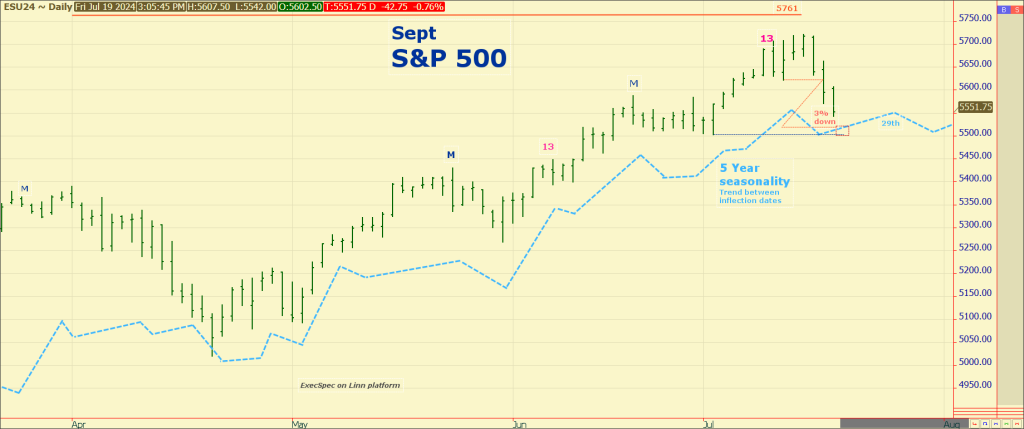
While a market correction could engulf all equities, interest-sensitive small-cap financials and industrials are positioned to emerge as leaders during a rate cut adjustment cycle. Our key technical indicators have been mired in neutral territory for several months; an oversold condition would ideally present an opportunity for more aggressive investment. This stagnation is indicative of a bifurcated market dynamic, wherein small caps remain long-term oversold while large caps appear overextended. Given the robust fundamental backdrop we have previously outlined, coupled with the current neutral technical landscape, the long-term outlook remains optimistic, although short- to medium-term risks loom before the approaching elections.